


David Ogilvy (1911–1999) was a British-born advertising executive who arrived in New York in 1948 with $6,000, no clients, and no experience writing copy, and founded the agency that became Ogilvy & Mather. His campaigns for Hathaway shirts, Schweppes, Rolls-Royce, and Dove made him the most famous copywriter of his era, and his 1963 book Confessions of an Advertising Man sold more than a million copies. He took the agency public in 1966 and was named non-executive chairman of WPP after its 1989 hostile takeover; he died at the Château de Touffou in France on July 21, 1999, at eighty-eight.
Part IThe Story
The Eye Patch
On his way to a photo shoot for a small shirtmaker from Maine in 1951, David Ogilvy stopped at a drugstore and bought an eye patch for $1.50. He had no particular theory about it. The model, a genuine Russian aristocrat named Baron George Wrangell, looked distinguished enough without the prop — tall, silver-haired, the kind of man who appeared to have won wars and lost fortunes. But Ogilvy had been reading the research, as he always had, and one finding nagged at him: photographs with an element of "story appeal" performed far above average in attracting attention. The eye patch was story appeal reduced to its barest, most irrational element. Who was this man? What had happened to him? Why was he conducting an orchestra, or fencing, or having his measurements taken for a bespoke suit, all while wearing the mark of some unspoken wound?
Soon after the advertisement ran in The New Yorker, by Ogilvy's account, Hathaway shirts were selling out.
The C. F. Hathaway Company had been manufacturing shirts since the 1830s, and was little known outside New England. Its advertising budget was tiny. Yet within eighteen months, the Man in the Hathaway Shirt was a pop-culture phenomenon, parodied in magazines, imitated by competitors, studied in business schools. Hathaway ran the campaign for roughly two decades. The eye patch never came off.
The eye patch should not have worked. It violated every established convention of men's shirt advertising — show the shirt, describe the fabric, name the price. What Ogilvy understood, and what the eye patch proves in miniature, is the foundational paradox of his entire career: the most effective salesman on Madison Avenue was the one who refused to treat advertising as salesmanship. He treated it as storytelling, and then insisted — with the zeal of a convert and the rigor of a Gallup pollster — that the stories be grounded in facts, tested against data, and measured by the cash register. The eye patch was a flourish. But the headline underneath it, the body copy that followed, the positioning of Hathaway as a brand with an aristocratic backstory — that was architecture. Ogilvy built cathedrals and topped them with gargoyles, and people remember the gargoyles.
By the Numbers
The Ogilvy Empire
$6,000Cash on hand when he founded his agency in 1948
0Advertisements written before starting his agency
38His age when he started his agency, by his own telling
1,000,000+Copies sold of Confessions of an Advertising Man
75+Years the agency has operated continuously
Blood, Brains, and Beer
David Mackenzie Ogilvy arrived on June 23, 1911, in West Horsley, Surrey, the son of a classics scholar and stockbroker who had played rugby for Cambridge and who, when David was six, required the boy to drink a tumbler of raw blood every day to make him strong. When that produced no discernible result, his father switched to beer. To sharpen the boy's mental faculties, he ordered calves' brains three times a week. "Blood, brains, and beer," Ogilvy later wrote, with the dry relish of a man who understood his own origin myth. "A noble experiment."
The experiment was interrupted by economic catastrophe. The senior Ogilvy's brokerage failed during the post-war downturn of the 1920s, and the family — once comfortably upper-middle-class — was forced to move in with relatives in London. David's mother, a beautiful and eccentric Irishwoman who had trained as a medical student before marrying, would later disinherit her son on the grounds that he was "likely to acquire more money than was good for me without any help from her." He could not disagree.
Scholarships rescued him. First to Fettes College in Edinburgh, a school of Spartan disciplines, then to Christ Church, Oxford, to read history. The headmaster at his preparatory school had written of him: "He has a distinctly original mind, inclined to argue with his teachers and to try and convince them that he is right and the books are wrong; but this, perhaps, is further proof of his originality." At Oxford, this originality proved fatal. He was too preoccupied to do any work and was "duly expelled" — his phrase, and a well-rehearsed one. He called it "the real failure of my life," a formulation so practiced it raises the question of whether he believed it at all, or whether the expulsion was the first stroke of accidental genius: the thing that forced him out into the world where his actual education would begin.
For the next seventeen years, while his friends established themselves as doctors, lawyers, civil servants, and politicians, David Ogilvy adventured about the world, uncertain of purpose.
The Kitchen and the Stove
Paris first. In 1931, at the bottom of the Depression, the expelled Oxford student found work as an apprentice chef in the kitchen of the Hôtel Majestic. His first assignment was preparing meals for customers' dogs. He graduated, eventually, to the human menu, working under a head chef named Monsieur Pitard, whom Ogilvy would invoke for the rest of his life as the archetype of leadership.
Pitard was terrifying. He praised very seldom, but when he did, his cooks were "exalted to the skies." He did not tolerate incompetence — he understood that it was demoralizing for professionals to work alongside incompetent amateurs. Ogilvy did not stay. "If I stayed at the Majestic," Ogilvy later wrote, "I would have faced years of slave wages, fiendish pressure, and perpetual exhaustion." But the lesson lodged: that a great organization is run like a great kitchen, with exorbitant standards, ruthless editing of mediocrity, and praise so rare it becomes currency.
He returned to England and became a door-to-door salesman for Aga Cookers, selling cast-iron stoves across Scotland. He sold to nuns. He sold to drunkards. He sold to everyone in between. He was, by all accounts, astonishing at it — not because of any natural charm, but because he treated each sale as a problem to be analyzed, each prospect as a human being whose needs could be understood if you listened carefully enough. In 1935, at twenty-four, his employer asked him to write a guide for other Aga salesmen. The result — The Theory and Practice of Selling the Aga Cooker — was so tightly argued, so shrewdly observed, that Fortune magazine would later call it "probably the best sales manual ever written." Among its suggestions: "The more prospects you talk to, the more sales you expose yourself to, the more orders you will get. But never mistake quantity of calls for quality of salesmanship."
His older brother Francis, working at the London advertising agency Mather & Crowther, showed the manual to his superiors. They offered David a job on the spot.
This is worth pausing on. The Aga manual was an instruction manual for salesmen rather than advertising copy — practical, empirical, devoid of cleverness. Yet the senior partners at a London advertising agency read it and saw in its author someone who understood the machinery of persuasion at a level their copywriters did not. What they recognized, though they could not have named it, was the quality that would define Ogilvy's career: the ability to think about selling not as performance but as communication, not as art but as engineering, and to do so in prose so clean and direct it read like neither.
The Pollster and the Spy
In 1938, Ogilvy persuaded Mather & Crowther to send him to the United States to study American advertising techniques. He arrived in New York, quickly accumulated a circle of improbable friends — Harpo Marx, Ethel Barrymore — and decided to stay. He moved to Princeton, New Jersey, to work as associate director of George Gallup's Audience Research Institute.
George Gallup — the Iowa-born statistician who had founded the American Institute of Public Opinion in 1935 and correctly predicted Roosevelt's 1936 landslide when the Literary Digest got it catastrophically wrong — was running a pioneering research operation for the motion picture industry, testing audience reactions to predict which films would succeed. Ogilvy spent three years absorbing Gallup's methods: the meticulous sampling, the adherence to empirical data over intuition, the belief that you could understand what people wanted if you asked them the right questions in the right way.
He would later credit Gallup as the single most important influence on his career. Not because Gallup taught him about advertising — Gallup had no particular interest in advertising — but because Gallup taught him about reality. "Advertising people who ignore research," Ogilvy would write, "are as dangerous as generals who ignore decodes of enemy signals."
The metaphor was not casual. When World War II broke out, Ogilvy's research skills and his British passport delivered him into intelligence work. He served with British Security Coordination in Washington, D.C., eventually becoming second secretary at the British Embassy. His work was classified — the details are still largely opaque — but what is known is that he was trained at Camp X, the secret British paramilitary installation in Canada, in sabotage, close combat, propaganda, and psychological operations. His assignments reportedly ran less to physical sabotage than to something more suited to his gifts: gathering intelligence on businessmen who were supplying the Nazis with industrial materials. He wrote a report recommending "applying the Gallup technique to fields of secret intelligence" — using polling methods to understand and manipulate public opinion in occupied countries. Eisenhower's Psychological Warfare Board picked up the report and successfully deployed Ogilvy's suggestions in Europe during the final year of the war.
A chef, a salesman, a pollster, a spy. Each job taught him the same thing from a different angle: that human beings are knowable, that their behavior follows patterns, and that if you study those patterns with sufficient care, you can move them.
The Amish Interlude
After the war, Ogilvy did the most unexpected thing in a life already marked by serial improbability. He bought a farm in Lancaster County, Pennsylvania, and went to live among the Amish.
The atmosphere of "serenity, abundance, and contentment" held him for several years. He grew tobacco. He tended the land. He absorbed the rhythms of a community that had opted out of modernity — no electricity, no advertising, no persuasion industry of any kind. It is tempting to read the Amish years as a pastoral retreat, a man of the world seeking simplicity. But Ogilvy was always more complicated than his anecdotes suggested. He was also broke, uncertain, approaching forty with no career, no credentials, and a dawning realization that farming was not his calling.
"I remembered how my grandfather had failed as a farmer and become a successful businessman," he later wrote. "Why not follow in his footsteps? Why not start an advertising agency?" He was thirty-eight years old.
Six Thousand Dollars and a Secret Weapon
In 1948, David Ogilvy arrived in New York City with $6,000 in the bank, no clients, no credentials, and no experience writing advertisements. He had not penned a single line of copy in his life. He enlisted his brother Francis, now running Mather & Crowther, to provide financial backing; S. H. Benson Ltd., another London agency, joined in the backing but insisted that Ogilvy hire someone who actually knew how to run an advertising agency. He chose Anderson Hewitt, an experienced American account man. The firm opened as Hewitt, Ogilvy, Benson & Mather.
The notion of an Anglo-Scot seeking to conquer the American advertising business seemed, on its face, foolhardy. Madison Avenue in 1948 was a closed world — the great agencies had been established for decades, their client lists were entrenched, their creative departments were staffed by men who had grown up in the business. Ogilvy had grown up in kitchens and cornfields and intelligence bureaus. He later composed a mock classified ad about himself that he would circulate for years with evident delight:
"Will Any Agency Hire This Man? He is 38, and unemployed. He dropped out of college. He has been a cook, a salesman, a diplomatist and a farmer. He knows nothing about marketing and has never written any copy. He professes to be interested in advertising as a career (at the age of 38!) and is ready to go to work for $5,000 a year. I doubt if any American agency will hire him. However, a London agency did hire him. Three years later he became the most famous copywriter in the world, and in due course built the tenth biggest agency in the world. The moral: it sometimes pays an agency to be imaginative and unorthodox in hiring."
The agency was airborne within six months. How? By deploying what Ogilvy called his "secret weapon" — direct mail. Every four weeks, he sent personalized mailings to prospective clients. Not glossy brochures. Not clever pitches. Informational letters that demonstrated knowledge of the prospect's business, that offered specific insights, that treated the recipient as an intelligent person capable of recognizing quality. "I was always amazed to discover how many of our clients had been attracted to Ogilvy & Mather by those mailings," he said. "That was how we grew."
The first clients were British — Wedgwood china, Guinness — brought over through the London connections. But Ogilvy's ambition went beyond servicing the old country: he meant to conquer American advertising from the inside, and to demonstrate that the outsider understood the American consumer better than the insiders did.
The Discipline of Knowledge
The early campaigns arrived like detonations. The Guinness Guide to Oysters — one of Ogilvy's earliest advertisements, and in effect an early specimen of what would later be called content marketing — was a lush, informational piece that educated the reader on varieties of oysters while gently suggesting that Guinness was the appropriate accompaniment. It delivered value. It did not shout. It assumed the reader was sophisticated enough to appreciate being taught something.
Then Schweppes. Ogilvy enlisted Commander Edward Whitehead, the actual president of Schweppes in the United States, to serve as the face of the campaign — an eccentrically bearded Brit who embodied the brand's personality so completely that the line between advertisement and editorial dissolved. The campaign introduced the word "Schweppervescence" into the American vocabulary and ran for eighteen years.
Then Hathaway, with the eye patch.
Then Rolls-Royce, with the headline that may be the most famous in advertising history: "At 60 miles an hour the loudest noise in this new Rolls-Royce comes from the electric clock." Ogilvy had found the line in a road test by the technical editor of the British magazine The Motor, after spending three weeks reading everything he could find about the car before writing a word of copy. The headline was not invented; it was excavated. The body copy that followed listed thirteen specific, concrete facts about the car's construction. No superlatives. No adjectives unmoored from evidence. Just facts, presented with the confidence that facts, properly arranged, are the most persuasive thing in the world.
— David OgilvyThe consumer is not a moron. She is your wife. Don't insult her intelligence. You wouldn't lie to your wife. Don't lie to mine.
Then Puerto Rico. The island's government hired Ogilvy to attract industry and tourism. His campaign — "Pablo Casals is coming home — to Puerto Rico" — reframed the island's image from impoverished territory to cultural destination. Ogilvy later said it was his proudest achievement: advertising that changed not just buying habits but the perception of an entire country.
Then Dove. This was his greatest commercial success, if the least glamorous. Ogilvy positioned Dove not as soap but as a beauty bar — "one-quarter moisturizing cream" — aimed at women with dry skin. The positioning was so precise, so firmly established, that Dove used it without alteration for more than thirty years. Dove has since grown into one of the largest personal-care brands in the world, and the agency's long partnership with it, including the "Real Beauty" campaign launched in 2004, has continued to win top creative awards more than a quarter century after its founder's death.
What connected these campaigns — oysters and Rolls-Royces, eye patches and moisturizing cream — was a philosophy so simple it was almost invisible: advertising exists to sell, and the best way to sell is to give the consumer information. Not entertainment. Not cleverness. Not art. Information.
"I do not regard advertising as entertainment or an art form," Ogilvy declared, "but as a medium of information."
The Teaching Hospital
As the campaigns accumulated and the clients followed — General Foods, American Express, Shell (which gave him their entire North American account), Sears (which hired him for their first national advertising campaign), Lever Brothers — Ogilvy faced the problem that confronts every founder who succeeds beyond expectation: how to replicate himself.
His solution was culture. Not culture in the vague, modern corporate sense — ping-pong tables and mission statements — but culture as indoctrination, culture as liturgy. He codified his beliefs into what he called "Magic Lanterns," slide and film presentations that were shown to every new employee. He wrote memos — torrents of memos, composed with the care of a novelist — that laid out principles on everything from how to write a headline to how to hire talent. He developed training programs modeled not on business schools but on medical education.
"Great hospitals do two things," he said. "They look after patients, and they teach young doctors. Ogilvy & Mather does two things: We look after clients, and we teach young advertising people. Ogilvy & Mather is the teaching hospital of the advertising world."
The metaphor was deliberate. Ogilvy always chose metaphors that elevated — not because he was pretentious, but because he believed that language shapes behavior, that calling your company a teaching hospital instead of an ad shop changes how people inside it think about their work. He called regional directors "barons." Group creative directors were "syndicate heads." Promising young executives were "crown princes." Deadwood employees were "barnacles." The vocabulary was eccentric, even theatrical, but it served a function: it made the culture legible, memorable, transmissible.
At one board meeting, every director found a set of Russian matryoshka dolls at their seat. Opening the nesting dolls, each smaller than the one before, they found a slip of paper in the smallest: "If you hire people who are smaller than you are, we shall become a company of dwarfs. If you hire people who are bigger than you are, we shall become a company of giants."
Russian dolls became part of the permanent culture. So did the principle they contained. "Hire big people," Ogilvy demanded. "People who are better than you. Pay them more than yourself if necessary." It was not a bromide; it was an operational directive, enforced through hiring committees and talent reviews and the sheer gravitational force of Ogilvy's attention.
— David OgilvySearch all the parks in all your cities. You'll find no statues of committees.
The Public Offering and the French Château
In 1966, Ogilvy & Mather became one of the first advertising agencies in history to go public. The move was deliberate — Ogilvy had written Confessions of an Advertising Man in 1963 partly, as he cheerfully admitted, "to condition the market for a public offering of our shares." The book was expected to sell a few thousand copies. It became a runaway bestseller, eventually moving more than a million copies in fourteen languages.
The company expanded relentlessly through the 1970s and 1980s, opening offices around the world. By the late 1980s, Ogilvy & Mather was among the largest advertising networks on earth. But in 1989, the firm was acquired — swallowed, really — by WPP Group PLC in a hostile takeover that Ogilvy initially resisted with fury. He was named non-executive chairman of WPP, a concession to his stature, and held the title for a few years.
By then he had long since stepped back from day-to-day leadership. In 1973 he had retired as chairman of Ogilvy & Mather and moved to the Château de Touffou, a medieval castle near Bonnes in western France. Retirement suited his persona — the Anglo-Scot aristocrat in his French castle — but it did not suit his temperament. He continued writing. He published Ogilvy on Advertising in 1983, a magisterial and opinionated guide that functioned less as a textbook than as a compendium of his accumulated wisdom, organized with the clarity of a man who had spent forty years thinking about how to communicate effectively. He came out of retirement briefly to oversee Ogilvy's new office in India. He revised his autobiography, originally published as Blood, Brains & Beer in 1978, into An Autobiography in 1997.
And he kept sending memos. In 1982, he sent an internal communication to every employee of Ogilvy & Mather, titled "How to Write":
"The better you write, the higher you go in Ogilvy & Mather. People who think well, write well. Woolly-minded people write woolly memos, woolly letters and woolly speeches. Good writing is not a natural gift. You have to learn to write well."
The ten rules that followed were vintage Ogilvy — short, imperative, devoid of jargon, each one a small grenade lobbed at the pretensions of corporate communication. Rule four: "Never use jargon words like reconceptualize, demassification, attitudinally, judgmentally. They are hallmarks of a pretentious ass."
He died on July 21, 1999, at Touffou, after a long illness. He was eighty-eight. Advertising Age named him among its Top 100 Advertising People of the Century. In early 2004, when Adweek asked people in the industry which individuals, alive or dead, had made them consider pursuing a career in advertising, David Ogilvy topped the list. The same result came when students were surveyed.
The Paradox of the Empirical Showman
The standard account of David Ogilvy resolves into a tidy narrative: eccentric outsider disrupts established industry through force of talent and personality. But the real story is more interesting, because it doesn't resolve at all.
Ogilvy was an empiricist who deployed theatrics. A research zealot who bought an eye patch on impulse. A man who insisted that creativity was "the most dangerous word in the lexicon of advertising" but whose own campaigns were, by any reasonable standard, among the most creative of the twentieth century. He preferred the word "remarkable" to "creative" — a distinction that reveals everything about his mind. Creative implied originality for its own sake, art detached from purpose. Remarkable implied that the work was so effective, so precisely calibrated to its audience, that people could not stop talking about it.
He was, in the same breath, a man who wrote a famous house advertisement laying out thirty-eight specific, numbered rules for creating advertising that sells — and a man who wore a cape, lived in a château, and cultivated a persona so flamboyant it bordered on parody. He was the living embodiment of his own philosophy: the brand image he built for himself was as carefully constructed and as precisely positioned as anything he ever did for Hathaway or Schweppes.
"If you detect a slight stench of conceit in this book," he wrote, "I would have you know that my conceit is selective. I am a miserable duffer in everything except advertising. I cannot read a balance sheet, work a computer, ski, sail, play golf, or paint. But when it comes to advertising, Advertising Age magazine says that I am the creative king of advertising."
He liked to add a coda:
"When Fortune magazine published an article about me entitled 'Is David Ogilvy a Genius?' I asked my lawyer to sue the editor for the question mark."
The Two Worlds
Late in his career, Ogilvy gave a speech — recorded on video and later circulated as "We Sell or Else" — in which he described advertising as two worlds on a collision course. On one side were the "generalists," the glamour boys and girls of Madison Avenue, who regarded advertising as an art form, who worshipped at the altar of creativity, and who had never had to live with the discipline of knowing, to the dollar, whether their work actually sold anything. On the other side were the practitioners of direct-response advertising, who knew exactly what worked and what didn't, because every advertisement they produced was measured by the cash register.
"Your favorite music is the applause of your fellow art directors and copywriters," Ogilvy told the generalists. "Our favorite music is the ring of the cash register."
He was in his seventies when he gave this speech, and the conviction was unchanged from the day he'd opened his agency. The function of advertising is to sell. Not to entertain. Not to win awards at Cannes. Not to express the creative vision of the agency. To sell. Everything else — the eye patches, the bearded commanders, the Rolls-Royce headlines — was in service of that single objective. The difference was that Ogilvy understood, in a way that many of his imitators did not, that selling and boring the customer are not the same thing. You could sell with elegance. You could sell with information so interesting that the reader wanted to keep reading. You could sell by treating the consumer as an intelligent adult rather than a moron.
"You cannot bore people into buying your product," he wrote. "You can only interest them in buying it."
— David OgilvyIt is useless to be a creative, original thinker unless you can also sell what you create.
The Longest Shadow
David Ogilvy's two greatest dreams never came true. He wanted a large family; he had one son, named David. He wanted a knighthood; he received a CBE — Commander of the Order of the British Empire — in 1967. Close enough, perhaps, but not the thing itself.
What he did achieve was something rarer and more durable than either. He built an institution that outlived him. The agency he founded with $6,000 in 1948 now operates in over ninety countries. The principles he articulated — research before creativity, facts before adjectives, the consumer is not a moron — are so deeply embedded in the practice of modern advertising that they have become invisible, the water in which the industry swims. The brand he built for himself — the eccentric Scotsman, the aristocratic outsider, the empirical showman — was so vivid, so precisely constructed, that it still functions, decades after his death, as the template against which all advertising figures are measured.
When a young relative wrote asking whether he should go to university or get a job, Ogilvy reportedly replied with a letter so neatly structured that it circulated for years among his colleagues. He gave three different answers — one for the ambitious, one for the restless, one for the uncertain — and told the boy to take his pick. The letter was simultaneously advice, performance, and advertisement for the idea of David Ogilvy as a man worth listening to.
His papers reside at the Library of Congress. The Duke University archives hold boxes of correspondence, memos, and the research files of Kenneth Roman, a former chairman of the agency, who used them to write The King of Madison Avenue, the first biography. Almost everyone who worked at the agency kept a "David file" — a personal collection of his memos, letters, and pronouncements, accumulated over decades, the way monks once copied manuscripts.
At the Château de Touffou, the autumn was always too wet, too cold, too lonely after the summer visitors left. Ogilvy hated waiting for food in restaurants; it put him in a foul mood. He could not type, which was inconvenient. When stuck on a piece of copy, he would drink half a bottle of rum and play a Handel oratorio on the gramophone, which generally produced "an uncontrollable gush of copy." The next morning he would get up early and edit the gush. He was, by his own admission, a lousy copywriter but a good editor.
The distinction mattered to him. The gush was instinct. The editing was craft. The advertising was what happened when the two met — when the unconscious eruption was disciplined by knowledge, shaped by research, measured by results, and presented to the world with the confidence of a man who had sold stoves to nuns and sold nations to tourists and sold the idea that selling itself could be an honorable profession, if you did it with enough respect for the person on the other end.
The agency still carries his name. The Dove positioning he conceived still anchors the brand, refined and extended by people who never met him. Somewhere, in an office in New York or London or Mumbai, a young copywriter is reading a memo he wrote in 1982, learning that good writing is not a natural gift, that people who think well write well, and that jargon words are the hallmarks of a pretentious ass. On the desk beside the memo, there is probably a Russian matryoshka doll.
Part IIThe Playbook
David Ogilvy left behind not merely a body of advertising work but a coherent system for building an organization, creating persuasive communication, and navigating a career — much of it codified in his own writing with a clarity that makes distillation feel almost redundant. What follows are the operating principles that emerge from his life, his campaigns, and his relentless stream of memos, letters, and books. They apply far beyond advertising.
The principles
- 1.Do not begin until you have done the homework.
- 2.Promise the consumer a benefit — and make it specific.
- 3.Respect the audience's intelligence.
- 4.Build brand image through consistency, not campaigns.
- 5.Use the outsider's advantage as a permanent asset.
- 6.Codify your culture until it self-replicates.
- 7.Hire people bigger than yourself.
- 8.Write to think, and think to lead.
- 9.Measure everything — then trust the measurement.
- 10.Sell or else.
- 11.Make the ordinary remarkable through story appeal.
- 12.Use your product as your autobiography.
Principle 1
Do not begin until you have done the homework
Before writing the Rolls-Royce advertisement, Ogilvy spent three weeks reading everything he could find about the car. The famous headline — "At 60 miles an hour the loudest noise in this new Rolls-Royce comes from the electric clock" — was not created; it was found, in a road test most copywriters would never have read. Before writing for any product, he studied twenty years of competing advertisements. Before defining a campaign strategy, he wrote out a formal statement of the problem and the purpose he wished the campaign to achieve, and refused to proceed until the client had accepted it.
This went beyond due diligence into something like theology. Ogilvy's years with George Gallup had given him an almost religious conviction that reality is knowable — that if you do enough research, the right answer will reveal itself. As he put it: "We prefer the discipline of knowledge to the anarchy of ignorance. We pursue knowledge the way a pig pursues truffles: a blind pig can sometimes find truffles, but it helps to know that they grow in oak forests."
The implication is radical. Most creative professionals begin with an idea and look for evidence to support it. Ogilvy began with evidence and waited for the idea to emerge from it. The distinction is everything.
Tactic: Before writing a word of copy, a line of strategy, or a slide of a pitch, exhaust the available research on the product, the competitor, and the consumer — then write a formal problem statement and get alignment before proceeding.
Principle 2
Promise the consumer a benefit — and make it specific
"The key to success," Ogilvy wrote, "is to promise the consumer a benefit — like better flavor, whiter wash, more miles per gallon, a better complexion." He was relentless on this point. Not a claim. Not a theme. Not a slogan. A benefit — something the consumer would actually receive in exchange for their money.
The Rolls-Royce ad promised quiet. The Dove ad promised soft skin. The Puerto Rico campaign promised tax exemption for new industry. Even the Hathaway campaign, seemingly about mystique, actually promised social elevation — the implicit message that wearing this shirt would make you the kind of man who conducts orchestras and fences.
The specificity matters as much as the promise itself. "Now Puerto Rico Offers 100 Percent Tax Exemption to New Industry" is not vague. "At 60 miles an hour the loudest noise comes from the electric clock" is not vague. "One-quarter moisturizing cream" is not vague. Every great Ogilvy headline contains a concrete, verifiable claim. He knew that vagueness signals either ignorance or dishonesty, and that consumers can tell the difference.
Tactic: In any communication — advertisement, landing page, pitch deck, sales email — lead with a single, specific benefit that the audience cares about, stated in terms they would use themselves.
Principle 3
Respect the audience's intelligence
"The consumer is not a moron. She is your wife." This is Ogilvy's most quoted line, and it contains his most important insight. The advertising industry of the 1950s and 1960s was dominated by a paternalistic assumption that consumers needed to be entertained, tricked, or emotionally manipulated into buying. Ogilvy rejected this entirely. His advertisements were dense with information — the Rolls-Royce ad contained thirteen specific factual claims in the body copy — because he believed that intelligent consumers respond to information, not to cleverness.
The position came from empiricism rather than idealism. His direct-response training had taught him that long copy outsells short copy, that factual claims outsell atmospheric claims, and that headlines promising a benefit outsell clever wordplay. The data was unambiguous. The industry ignored it because the data contradicted the self-image of creative people who wanted to be artists.
"The trouble with most advertising," Ogilvy once said, "is it tries too damned hard to be entertaining. You'd run like hell if a salesman came to your door and began singing at you; why do it in advertising?"
Tactic: When creating any piece of persuasive communication, ask: would you say this to an intelligent adult sitting across the table from you? If not, rewrite it.
Principle 4
Build brand image through consistency, not campaigns
Ogilvy's concept of "brand image" — now so ubiquitous it seems self-evident — was in the 1950s genuinely revolutionary. He insisted that every advertisement should contribute to "the complex symbol which is the brand image," and that 95 percent of advertising was created ad hoc, with no consistent image from one year to the next.
The Hathaway campaign ran for roughly two decades. The Dove positioning lasted more than thirty. The Schweppes campaign with Commander Whitehead ran for eighteen. These were not campaigns in the modern sense — a burst of activity followed by a new direction. They were identities, maintained with monastic consistency, refined but never abandoned.
"Unless your campaign is built on a big idea, it will pass like a ship in the night," Ogilvy wrote. But the corollary is equally important: once you have the big idea, do not discard it for novelty's sake. The compounding effect of consistent brand messaging over decades is one of the most powerful forces in business, and one of the most underused, because it requires the rare combination of initial brilliance and subsequent patience.
Tactic: Define your brand's positioning in a single sentence, then test every piece of communication against it. If it doesn't reinforce the positioning, kill it — no matter how creative it is.
Principle 5
Use the outsider's advantage as a permanent asset
Ogilvy was a Scotsman in New York, a dropout among graduates, a former chef and farmer among career advertising men. He should have failed. Instead, his outsider status became his defining competitive advantage — not because the industry admired mavericks (it didn't), but because being an outsider forced him to approach advertising from first principles rather than inherited conventions.
He had no mentor in the business. He had no established methodology. What he had was Gallup's research training, the Aga manual's understanding of direct selling, Pitard's standards of kitchen management, and the spy's instinct for understanding human motivation. These were not advertising skills. They were meta-skills — transferable frameworks that gave him a perspective his competitors, who had spent their careers inside agencies, simply could not access.
The mock classified ad he circulated — "Will Any Agency Hire This Man?" — was not self-deprecation. It was positioning. Every time Ogilvy told the story of his improbable background, he was reinforcing the implicit argument: that the person who comes to your problem from outside your industry may see things you cannot.
Tactic: Never apologize for an unconventional background. Instead, explicitly articulate the unique perspective it gives you, and frame it as the reason you see what others miss.
Principle 6
Codify your culture until it self-replicates
Ogilvy understood that a founder's values decay with distance — that the further an organization grows from its origin, the more diluted its original culture becomes. His solution was obsessive codification. He wrote the principles down. He put them in slide presentations. He sent memos. He created training programs. He repeated himself until repetition became ritual and ritual became culture.
"Through maddening repetition," he acknowledged, "some of my maxims have been woven into our culture."
The key word is "maddening." Ogilvy did not assume that saying something once was enough. He said it in speeches, in memos, in books, in house advertisements, in matryoshka dolls left at board meetings. The head of a competing agency once told him that Ogilvy & Mather was "the only agency in the world with a real corporate culture." Ogilvy took this as the highest compliment he had ever received — higher than any Cannes Lion, higher than any billing record.
🏥
The Teaching Hospital Model
Ogilvy's framework for scaling culture through education.
| Element | Ogilvy's implementation |
|---|---|
| Onboarding | "Magic Lantern" presentations codifying beliefs |
| Standards | Written principles for every function, from copy to hiring |
| Vocabulary | Proprietary terminology — "barons," "crown princes," "barnacles" |
| Repetition | Maxims woven into memos, speeches, house ads, and physical objects |
| Measurement | Every campaign tested; every principle grounded in evidence |
Tactic: Write your core principles down, give them memorable language, and repeat them in every medium available until people groan — then keep going, because the groaning is the sound of culture taking root.
Principle 7
Hire people bigger than yourself
The Russian doll principle did structural work. Ogilvy believed that the single greatest risk to any growing organization was the tendency of insecure managers to hire people less talented than themselves — a cascading failure that produces, within a few generations, a company of mediocrities.
"If each of us hires people who are smaller than we are, we shall become a company of dwarfs. But if each of us hires people who are bigger than we are, we shall become a company of giants."
He coupled this with a related principle: ruthlessness about removing underperformers. Drawing on Gladstone's dictum that "the first essential to be a good Prime Minister is to be a good butcher," Ogilvy did not hesitate to scrape barnacles. He recognized that high performers become demoralized when forced to work alongside incompetent colleagues — the lesson from Pitard's kitchen, learned in Paris at twenty and applied in New York at fifty.
The tension between generosity in hiring and ruthlessness in firing is uncomfortable. Ogilvy did not resolve it; he embraced it. The same man who demanded that you pay people more than yourself if necessary also demanded that you fire them without sentiment if they failed to perform. The discomfort is the point. An organization that is generous but not ruthless becomes bloated. One that is ruthless but not generous becomes toxic. You need both.
Tactic: In every hire, ask: is this person better than me at the thing I'm hiring them to do? If not, keep looking. And audit your team annually for barnacles.
Principle 8
Write to think, and think to lead
Ogilvy's 1982 memo on writing was about organizational intelligence more than prose style. "People who think well, write well. Woolly-minded people write woolly memos, woolly letters and woolly speeches."
He used writing as a diagnostic tool. If someone could not explain their strategy clearly in two pages, the strategy was not clear. If someone resorted to jargon — "reconceptualize," "demassification" — they were hiding the absence of thought behind the presence of syllables. Writing was not a support function; it was the primary medium through which the organization thought.
This explains why Ogilvy composed his memos with the care of a novelist, why he wrote twenty alternative headlines for every advertisement, why he circulated letters and speeches that were themselves pieces of persuasion as finely crafted as anything he produced for clients. The internal memo and the external advertisement were, for Ogilvy, the same act: an attempt to move people through the clear, disciplined arrangement of language.
Tactic: Before any major decision, force yourself (and your team) to write the argument in plain prose, no longer than two pages. If the writing is unclear, the thinking is unclear — go back and think again.
Principle 9
Measure everything — then trust the measurement
Ogilvy's split-run tests, his obsession with direct-response data, his insistence that every headline be tested against alternatives before publication — all of this was, in the 1950s, radical. Most agencies relied on instinct, taste, and the approval of their peers. Ogilvy relied on the cash register.
The direct-response discipline taught him that the difference between one advertisement and another, measured in terms of sales, "can be as much as nineteen to one." Nineteen to one. The same product, the same medium, the same audience — but a headline change, a layout change, a positioning change could produce a nineteen-fold difference in results. This is not a marginal effect. It is the difference between success and failure, and most agencies never measured it.
"I predict that the practitioners of general advertising are going to start learning from your experience," he told direct-response advertisers in his "We Sell or Else" speech. "You have more to teach them than they have to teach you. You have it in your power to rescue the advertising business from its manifold lunacies."
Tactic: For every major creative or strategic decision, establish a measurable outcome in advance, test at least two variants, and let the data — not the committee, not the creative director, not the CEO — choose the winner.
Principle 10
Sell or else
Of all the maxims woven into the culture through maddening repetition, the shortest was the most important: "We sell, or else."
Not "we create." Not "we communicate." Not "we build brand awareness." We sell. The function of advertising is to move product. Every other consideration — aesthetics, awards, cleverness, entertainment — is subordinate to this single objective. An advertisement that is beautiful but does not sell is a failure. An advertisement that is ugly but sells is a success. Ogilvy preferred, of course, to do both — to sell through beauty, to move product through intelligence — but when forced to choose, the choice was clear.
This principle sounds obvious. It is not. The history of advertising — and of marketing more broadly, and of content creation, and of branding — is littered with organizations that forgot it, that fell in love with their own creativity, that measured success by peer approval rather than commercial results. Ogilvy's insistence on this point was a form of integrity rather than philistinism: the client is paying you to sell their product. If you cannot do that, nothing else matters.
Tactic: Before launching any campaign, content initiative, or marketing effort, define "sell" in concrete terms — revenue, leads, conversions, units moved — and make that number the only standard of success.
Principle 11
Make the ordinary remarkable through story appeal
The eye patch cost $1.50 and made an obscure shirtmaker famous. Commander Whitehead was a real person doing a real job, but by placing him in the advertisement, Ogilvy transformed a tonic water brand into a narrative about British sophistication arriving in America. Eleanor Roosevelt — persuaded to endorse Good Luck margarine — lent not just her fame but her story to a commodity product.
Ogilvy called this "story appeal," and his research showed that advertisements with story appeal performed far above average. The principle is not about deception: the story elements served true claims about real products. The eye patch was a story element. Commander Whitehead was a character. The Rolls-Royce headline was a narrative detail extracted from a road test.
The insight is that human beings are narrative creatures. We do not process information; we process stories. A fact embedded in a story is remembered. A fact presented in isolation is forgotten. The genius of Ogilvy's approach was to never sacrifice factual accuracy for narrative power — he achieved both simultaneously, by finding the story that was already latent in the product and making it visible.
Tactic: For any product, service, or idea you need to communicate, find the single most surprising true detail — the equivalent of the eye patch or the electric clock — and build the story around it.
Principle 12
Use your product as your autobiography
Ogilvy's three books were not acts of vanity. They were advertisements. He admitted this openly: Confessions of an Advertising Man was written "to attract new clients to my advertising agency," "to condition the market for a public offering of our shares," and "to make myself better known in the business world. It achieved all three of these purposes."
The house advertisements he wrote for his own agency — "How to Create Advertising That Sells," "How to Run an Advertising Agency" — were masterpieces of the form. People requested reprints ten years after they ran. They demonstrated, in their very execution, the principles they described: long copy that was irresistibly readable, factual claims grounded in evidence, a benefit promised in the headline and delivered in the body.
This is the deepest level of Ogilvy's genius. He did not separate the message from the medium, the seller from the product. The way he wrote was itself evidence of his ability. The way he ran his agency was itself an advertisement for his approach. The way he lived his life — the château, the cape, the eccentric vocabulary — was itself a brand campaign, conducted with the same rigor and consistency he demanded from every client engagement.
He became the product. The product sold itself.
Tactic: The most powerful marketing you can do is to make your work so good that it becomes its own advertisement. Show, don't tell — and when you tell, make the telling itself an example of the quality you claim.
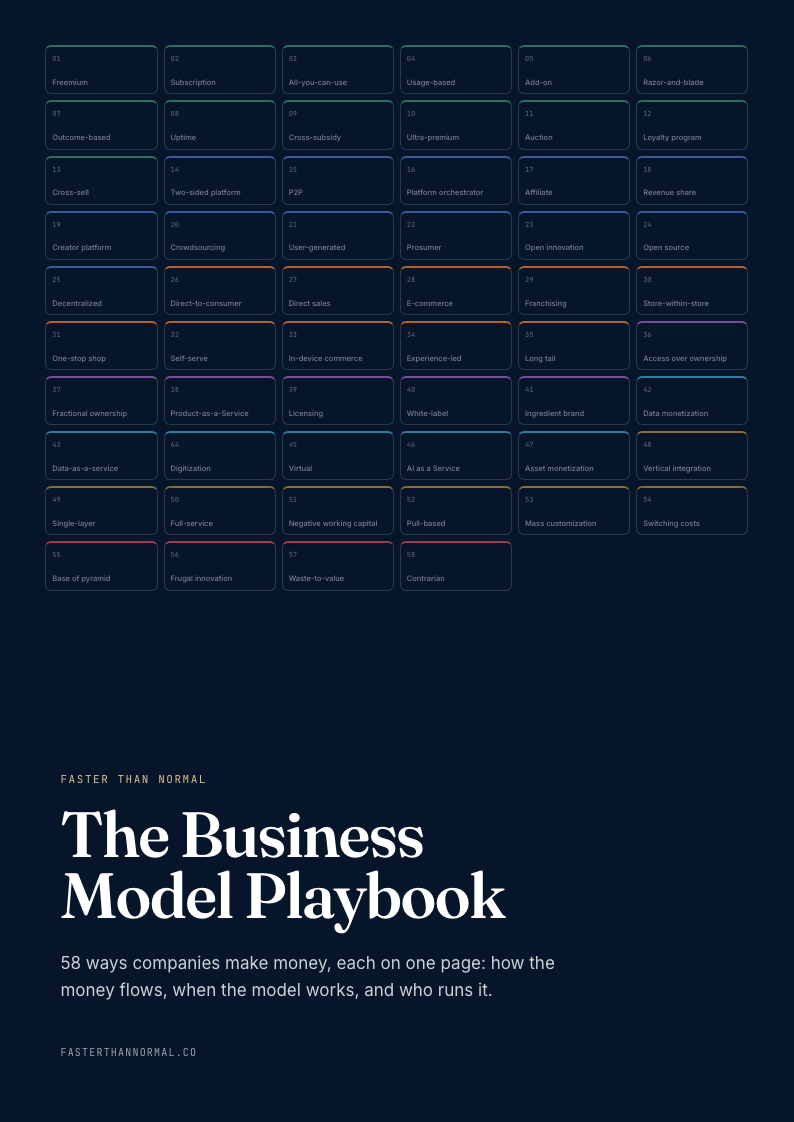
Free playbook
Get The Business Model Playbook
58 business models, one visual page each: how the money flows, the metrics that matter, and who runs it. Free when you join the Faster Than Normal email.
Free. No spam. Unsubscribe anytime.
Part IIIMaxims
-
Gush first, edit the next morning. When stuck, Ogilvy drank half a bottle of rum, played Handel, and let the copy pour out, then got up early to cut it. He called himself a lousy copywriter but a good editor. Separate the drafting from the judging.
-
Never bore. You cannot bore people into buying your product; you can only interest them in buying it. Information, properly presented, is never boring.
-
The best line may already exist. Ogilvy's Rolls-Royce headline about the electric clock came from a road test in The Motor, found after three weeks of reading. Look for your headline in the source material before you try to write one.
-
Write down how you do your job. The sales manual Ogilvy wrote for Aga salesmen at twenty-four got him his first advertising job when his brother showed it to the partners at Mather & Crowther.
-
Prospect like a publisher. Ogilvy's new agency grew on informational letters mailed to prospects every four weeks. "That was how we grew," he said. Showing a prospect you understand their business beats telling them you are good.
-
Going public puts the company up for sale. Ogilvy took his agency public in 1966; in 1989 WPP bought it in a hostile takeover he fought with fury. Once the shares trade, control is no longer entirely yours to keep.
-
A book can have a business purpose. Ogilvy admitted he wrote Confessions of an Advertising Man partly to condition the market for the agency's share offering. It sold more than a million copies and made him famous far beyond Madison Avenue.
-
Know exactly where you are a duffer. "I am a miserable duffer in everything except advertising," Ogilvy wrote, listing balance sheets, computers, and golf among his failings. Narrow, declared competence is more credible than general brilliance.
-
Make the truth fascinating. Tell the truth, but make the truth fascinating. The best headlines are facts so surprising they read like fiction.
In Their Own Words
We sell – or else.
We have a divine discontent with our performance. It is an antidote to smugness.
If each of us hires people who are bigger than we are, we shall become a company of giants.
The consumer isn't a moron. She is your wife.— Confessions of an Advertising Man
I don't know the rules of grammar. If you're trying to persuade people to do something, or buy something, it seems to me you should use their language.
The more informative your advertising, the more persuasive it will be.
A good advertisement is one which sells the product without drawing attention to itself.
I always tell prospective clients about the chinks in the armour. I have noticed that when an antique dealer draws my attention to flaws in a piece of furniture, he wins my confidence.
The best ideas come as jokes. Make your thinking as funny as possible.
Hard work never killed a man. Men die of boredom, psychological conflict, and disease. They do not die of hard work.
Whenever you can, make the product itself the hero of your advertising. If you think the product too dull, I have news for you: there are no dull products, only dull writers.
I have come to the conclusion that the top man has one principal responsibility: to provide an atmosphere in which creative mavericks can do useful work.— David Ogilvy, Confessions of an Advertising Man
The better you write, the higher you go in Ogilvy & Mather. People who think well, write well. Woolly-minded people write woolly memos, woolly letters and woolly speeches.— David Ogilvy, internal memo, 1982
You direct response people know what kind of advertising works and what doesn't work, you know to a dollar. The general advertising people don't know.— David Ogilvy, 'We Sell or Else' speech
I admire people who work with gusto. If you don't enjoy what you are doing, I beg you to find another job. Remember the Scottish proverb: Be happy while you are living because you are a long time dead.— David Ogilvy, Confessions of an Advertising Man
When Fortune published an article about me and titled it 'Is David Ogilvy a Genius?' I asked my lawyer to sue the editor for the question mark.— David Ogilvy, on the Fortune profile
Further reading
- Eternal Pursuit of Unhappiness by Ogilvy & Mather


