

Part IThe Story
The Scissors and the Myth
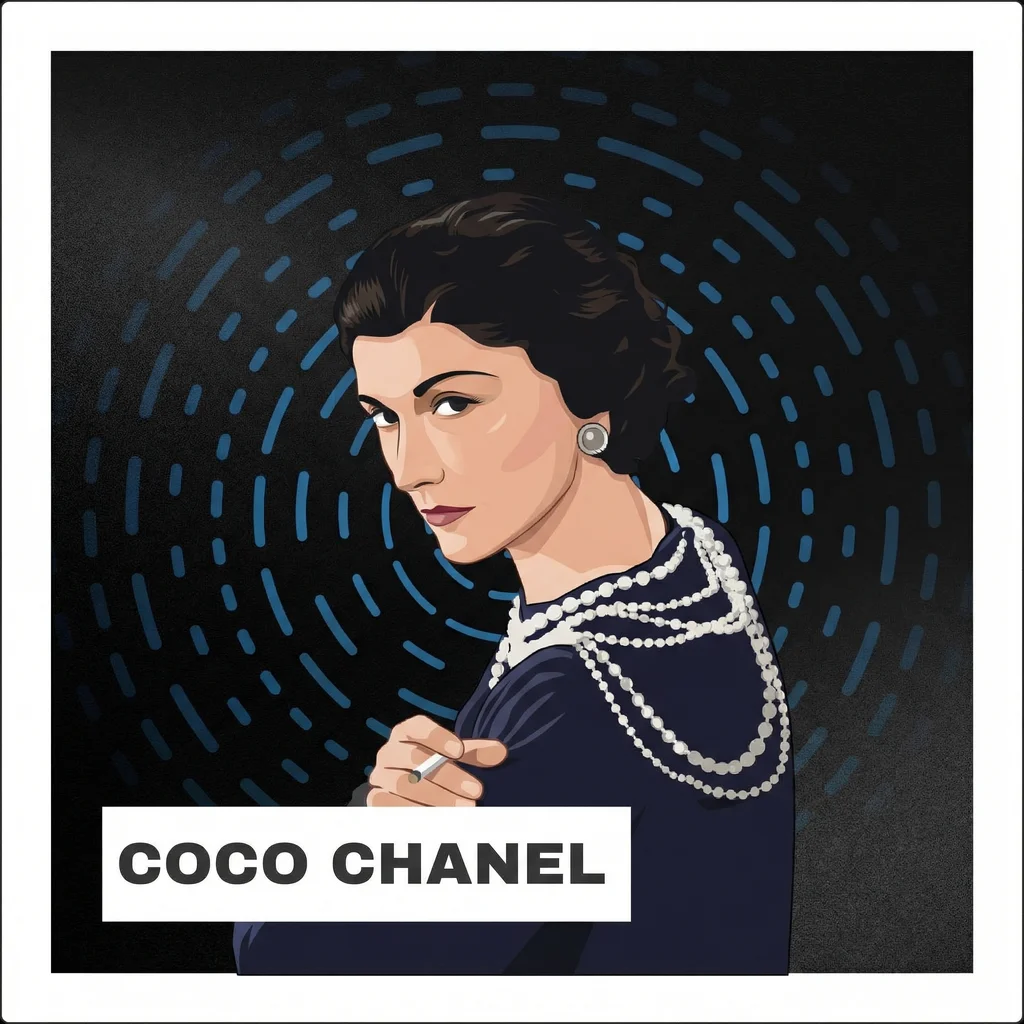
On a winter evening in 1954, in the mirrored staircase of 31 rue Cambon — that narrow, glass-and-gilt rabbit warren she had occupied for more than four decades — a seventy-one-year-old woman stood behind a curtain and watched the audience file in for her first fashion show in fifteen years. The French press had come to bury her. They had good reason: she had closed her couture house in 1939, consorted with a German diplomat during the Occupation, fled to Switzerland under a cloud of collaboration charges that never quite became a trial, and spent the better part of a decade in a kind of gilded exile while Christian Dior — plump, gentle, everything she was not — remade Parisian fashion in his own image. The New Look, they called it: cinched waists, full skirts, the whole corseted architecture of femininity she had spent her career demolishing, rebuilt overnight. "Dior doesn't dress women," she said. "He upholsters them." She came back out of rage, not nostalgia.
The collection that evening was, by the accounts of the French critics who reviewed it, a disaster — old-fashioned, out of touch, the work of a woman who had overstayed her relevance by a generation. But the Americans, who had always understood her better than the French, saw something else: a woman who, at an age when most designers had long since stopped working, was picking up her scissors and cutting again. Within two years, the Chanel suit — collarless, braid-trimmed, weighted with gold chain at the hem so it would hang just so — had recaptured the imagination of women from Manhattan to Milan. It would become the single most copied women's fashion design in history. She had, as she always did, outlasted everything.
This is not a story about fashion. Or rather, it is a story about fashion only in the way that the Book of Genesis is a story about gardening. Gabrielle Chanel — illegitimate, orphaned, poor, self-invented, self-mythologized, and possessed of a talent for destruction and creation in approximately equal measure — built something that would outlast the century, and she did it by understanding a single, terrifying truth about human desire: people do not want what they have been told to want. They want what they have been told they cannot have.
By the Numbers
The House That Coco Built
1883–1971Lifespan: from a poorhouse in Saumur to the Ritz in Paris
120M francsAnnual revenue by 1931 (~$4.5M), highest of any Parisian couturier
2,400+Employees in 26 sewing ateliers alone at the peak of the 1930s
$17.2BChanel brand revenue in 2022, more than a century after founding
1 every 30 secFrequency at which a bottle of Chanel No. 5 is sold worldwide
87Age at which Chanel was still working daily, scissors in hand, the week she died
The Auvergne Arithmetic
The facts of her origin are few, contested, and deliberately obscured — by Chanel herself most of all. She was born Gabrielle Bonheur Chanel on August 19, 1883, in Saumur, France, though her surname was misspelled as "Chasnel" on the birth certificate, a clerical error that seems almost metaphorically appropriate for a woman who would spend her entire life revising the document of herself. Her mother, Eugénie Jeanne Devolle, was a laundrywoman. Her father, Albert Chanel, was an itinerant peddler — a man who sold ribbons and lace from a cart and who, in the way of certain charming, useless men throughout history, could not be relied upon to remain present in any fixed location.
There were eventually six children. The family was destitute, moving perpetually through the French countryside, chasing whatever small commerce Albert could scratch from market towns. Eugénie died in 1895, of tuberculosis, exhausted at thirty-three by thirteen years of poverty and six pregnancies. Gabrielle was eleven.
What happened next is the hinge upon which everything turns. Albert Chanel — the charming, absent father who had already demonstrated a comprehensive inability to support his living children — drove his three daughters to the Aubazine Abbey in Corrèze, the largest girls' orphanage in the region, and disappeared. He never came back.
Chanel would spend the rest of her life rewriting this chapter. To the diplomat and writer Paul Morand, she said her mother had died when she was six and that she had been sent to live with two aunts. To the psychoanalyst Claude Delay, she offered different timelines, different relatives, different degrees of suffering. "I don't like the family," she told Delay. "You're born in it, not of it. I don't know anything more terrifying than the family." She circled around and about the narrative of her youth, as Justine Picardie observed in Coco Chanel: The Legend and the Life, "remaking history just as she remade the sleeves of a jacket, unfastening its seams and cutting its threads and then sewing it back together again."
But the nuns at Aubazine, whatever their severity — and by multiple accounts they were severe — taught her two things that would define her career. The first was to sew. The second, more subtle and more lasting, was an aesthetic: the black-and-white of habits, the austerity of stone corridors, the stripped elegance of ecclesiastical architecture. A string of pearls is a rosary, secularized. A collarless jacket is a nun's tunic, refined. The interlocking Cs of the Chanel logo have been traced by some observers to the circular stained-glass windows of the abbey itself. She hid the orphanage. She wore it every day.
Men, Money, and the Education of Coco
At eighteen, Chanel moved to Moulins, where she attended school at a convent while working as a seamstress. She was not, by any account, an intellectual — she read little, claimed to hate history ("it is so dead"), and would later say, with a pride that verged on defiance, that she had been "fortunately never educated." But she possessed what no curriculum could provide: a ferocious attentiveness to the world's surfaces, a predator's eye for the false note, and an understanding — arrived at through poverty, not theory — that elegance and simplicity were the same thing.
She also possessed extraordinary physical charisma. In Moulins, she supplemented her income as a café singer, performing at establishments that catered to military officers. Her repertoire was limited — two songs, by most accounts: "Ko Ko Ri Ko" and "Qui qu'a vu Coco?" The audiences loved her not for her voice, which was unremarkable, but for something harder to name. The nickname stuck.
Étienne Balsan found her there. Balsan was a wealthy textile heir and racehorse owner — a bachelor who lived on a vast country estate at La Croix-Saint-Ouen, near Compiègne, and who collected horses and women with approximately equal enthusiasm. In 1906 or 1907, Chanel went to live with him, entering a milieu of aristocrats, courtesans, and professional beauties whose idea of fashion involved floor-length silk, whalebone corsets, and hats the size of small furniture. Chanel wore riding clothes borrowed from Balsan's closet. She trimmed her own hats down to severe little boaters. She was, even then, editing — hacking away at what she considered excess, which was most of what she saw.
Arthur "Boy" Capel changed everything. An Englishman, polo player, and coal magnate — handsome, cultured, and possessed of the one quality that distinguished him from Balsan: he took her seriously as something other than a mistress. Capel financed her first real business ventures, lending her the money to open a tiny millinery shop at 21 rue Cambon in Paris in 1910. He believed, unlike nearly everyone else in her life to that point, that she was capable of building something.
— Coco ChanelMy life didn't please me, so I created my life.
The hat shop — Chanel Modes — was the beginning. French actresses wore her designs on stage. By 1912, her hats appeared in the press. By 1913, Capel had found her a second shop in Deauville, the resort town on the Normandy coast where fashionable Parisians summered. There, she began selling not just hats but clothing — simple jersey sweaters, sportswear, garments that were, by the standards of the era, shockingly plain. Jersey, it should be noted, was a fabric used almost exclusively for men's underwear. Chanel purchased it because she could not afford anything better. But when she put it on women — when she draped it, belted it, cut it into pullover tunics that echoed the style of sailor's sweaters — something happened that could not be undone.
"My fortune is built on that old jersey that I'd put on because it was cold in Deauville," she once told Morand. The origin myth of a billion-dollar empire: a woman was cold.
Boy Capel died in a car accident on December 22, 1919. He had married someone else by then — an aristocratic match, the kind expected of men of his class — but the affair with Chanel had continued. She buried her grief in work. It was a pattern she would repeat for the rest of her life, love and loss transmuted into fabric and form, the cutting table as confessional.
The Genre Pauvre
To understand what Chanel did, you have to understand what she was destroying. The 1931 New Yorker profile by Janet Flanner — the finest single piece of writing about Chanel produced in her lifetime — described the world she entered with surgical precision: "Women were full of gussets, garters, corsets, whalebones, plackets, false hair, and brassières. In short, as the men passionately muttered, women were full of mystery."
The Gould girls were brushing the grass at Longchamp with their trailing silk flounces. The Duchesse d'Albe swept the opera steps with her tiered train. The petticoats of the courtesan Liane de Pougy were stiff with blue satin and complicated beyond engineering. Fashion, in the first decade of the twentieth century, was a system of containment — physical, social, psychological. The corset was not merely a garment; it was a metaphor, a cage of whalebone that enforced a certain shape and, by extension, a certain role. To dress as a woman of fashion was to submit to an architecture of constraint.
Chanel's first iconoclastic move, per Flanner, was "a cobalt tricot sailor frock that might have been worn, at least in masquerade, by the French navy." From there, the catalog of subversions accumulated: "She has put the apache's sweater into the Ritz, utilized the ditch-digger's scarf, made chic the white collars and cuffs of the waitress, and put queens into mechanics' tunics." She kept hemlines short — "as pleasantly short as those of peasant girls about to go gleaning in the fields" — for more than a decade, in defiance of everyone except, apparently, the women who bought the clothes.
The trick she turned was one that even Marie Antoinette, playing dairymaid at the Petit Trianon, had not managed: she made poverty chic without making it ridiculous. The genre pauvre — the poor look — was her invention, and its genius lay in a paradox that was also a business insight: the simpler the garment, the more exquisite the execution had to be, and the more it had to cost. Unornamented, workmanlike, and expensive — those three adjectives, held in tension, were the Chanel formula. A waitress's cuffs, rendered in silk. A mechanic's tunic, cut from the finest wool.
The timing was impeccable. The post-war social instinct, Flanner wrote, "was ripe not only for peace but also for simplification." Chanel did not merely sense the Zeitgeist; she metabolized it, converting a continent's exhaustion into an aesthetic. The women who bought her clothes could breathe. They could move. They could, for the first time in French fashion history, be at ease.
By the late 1920s, the Chanel industries employed more than 2,000 people — not only in the couture house at 31 rue Cambon, which by then occupied nearly an entire block, but also in a perfume laboratory, a textile mill, and a jewelry workshop. Semiannually, she designed approximately 400 garments for each of her major February and August collections. Her annual chiffre d'affaires was publicly quoted at 120 million francs — close to $4.5 million, the highest of any couturier in Paris by far.
Bottle Number Five
The clothes made her famous. The perfume made her rich.
In 1921, Chanel collaborated with Ernest Beaux, a French-Russian chemist who was one of the most talented perfume creators in France, to produce something unprecedented. The dominant fragrance philosophy of the era held that perfumes should smell like a single flower — rose, jasmine, violet — identifiable, legible, uncomplicated. Chanel wanted the opposite: a scent that smelled like a scent, abstract and unplaceable, the olfactory equivalent of her design philosophy.
Beaux created a series of samples. Chanel chose the fifth. Whether the name derived from this simple fact of sequence, or from her superstitious attachment to the number five, or from some combination of both, is one of those biographical details that resists resolution. What is certain is that Chanel No. 5 — a combination of jasmine and more than eighty other compounds, layered into a complexity that no single sniff could decode — was unlike anything on the market.
The bottle was as revolutionary as its contents. Where the industry standard ran to ornate glass and decorative excess, Chanel chose a beveled rectangle — clean, transparent, almost pharmaceutical in its simplicity. The stopper was square. The label was minimal. The interlocking Cs on the box would become the most recognized insignia in luxury commerce. The bottle was reportedly inspired by Boy Capel's whiskey decanter, though this may be another thread in the tapestry of myth. The dead lover, transformed into glass.
The business arrangement behind No. 5 would haunt Chanel for decades. She partnered with Théophile Bader of the Galeries Lafayette department store and the brothers Pierre and Paul Wertheimer of the Bourjois cosmetics company to produce and distribute the fragrance at scale. The resulting contract gave Chanel 10 percent of the royalties. The Wertheimers received 70 percent. Bader received 20 percent.
It was, by any reckoning, an unfavorable deal, and Chanel knew it almost immediately. She filed lawsuit after lawsuit over the ensuing decades, deploying every legal and extralegal stratagem available — including, during the Occupation, the repellent argument that the Wertheimers, being Jewish, should be dispossessed under Vichy's Aryanization laws. The Wertheimers, however, had anticipated this and transferred their shares to a non-Jewish businessman before fleeing to the United States. Chanel's effort failed.
The eventual resolution, reached in the late 1940s after years of acrimony, was a deal that made her unassailably wealthy: 2 percent of gross royalties on worldwide perfume sales — a figure that translated to approximately $25 million per year in 1940s currency, or roughly $300 million in today's dollars. Chanel also insisted that the company pay all of her living expenses, in perpetuity. By 1954, the Wertheimers had acquired the couture house itself for an undisclosed sum. The family remains the sole owners of Chanel to this day. Every thirty seconds, somewhere in the world, a bottle of Chanel No. 5 is sold.
The Little Black Arithmetic
In 1926, American Vogue published a sketch of a simple black dress — long-sleeved, belted at a low waist, utterly unadorned — and proclaimed it "The Ford of Fashion," alluding to Henry Ford's Model T: mass-producible, universally appealing, democratic.
Black, in French fashion, had been reserved for mourning or servants. Chanel steered into the association rather than away from it, producing what she called the "little black dress" — a garment whose "somewhat severe and simple lines," as the Australian Broadcasting Corporation later noted, "were offset by her signature accessories: a rope of large fake pearls, a fabric camellia or a plain cloche hat." The LBD was, in its way, the most complete expression of the Chanel paradox: it democratized fashion while remaining exclusive; it was available to any woman in any color, so long as it was black.
The move fit her pattern. Where other designers retreated from the grief and austerity of the post-war years into color and ornamentation, Chanel absorbed the darkness and sold it back as elegance. She understood, as perhaps only someone raised in monastic austerity could, that severity had its own glamour — and that glamour, stripped of excess, became something harder and more durable: style.
"Fashion changes, but style endures," she said. It was one of dozens of pronouncements she issued over the decades — aphoristic, ruthless, occasionally contradictory — that would be quoted so often they ceased to seem like the insights of a particular mind and became instead the ambient wisdom of the culture. She had a genius for the line that sounds inevitable after the fact but that no one had thought to say before.
— Coco ChanelSome people think luxury is the contrary of being poor. No, it is the contrary of vulgarity.
The Court of Coco
The roster of her intimates reads like a catalog of early twentieth-century creative genius, each name freighted with its own mythology. Pablo Picasso — the Andalusian who shattered pictorial space, who painted her portrait and then either forgot to give it to her or she forgot to collect it, and in any case no one seems to know where it ended up. Igor Stravinsky, who lived in her house after fleeing Russia. Jean Cocteau, for whose production of Antigone she designed the costumes. Sergei Diaghilev, whose Ballets Russes she and the Princesse de Polignac bankrolled year after year, pouring money into a company that hemorrhaged it. When Diaghilev died penniless in Venice in 1929, it was Chanel who paid for his burial.
She designed costumes for Cocteau's modernist Antigone, for the Marie Laurencin–decorated ballets, and for the controversially sparse choreography of Darius Milhaud's Le Train Bleu. She supervised the coloring of Nijinska and Stravinsky's Les Noces, the last and greatest of the Ballet's Parisian performances. The relationship between Chanel and the avant-garde was symbiotic and peculiar: she was not an artist in any conventional sense — she could not sketch, did not particularly like to sew, and was indifferent to theory — but she moved among artists with the ease of a co-conspirator, absorbing their innovations into her own idiom.
Picasso said she had more sense than any woman in Europe and was "almost the only one he can talk to with comfort." The qualifier is pure Picasso — he could not quite bring himself to concede full intellectual equality to anyone — but the fact that he said it at all suggests the force of her intelligence, which operated not through education but through a kind of ruthless perceptual clarity. She understood what she knew, not what she learned. She operated exclusively by instinct. And since she had been, as she said, fortunately never educated, her native sagacity matured uncluttered.
Hugh Grosvenor, the 2nd Duke of Westminster — one of the wealthiest men in England, who courted her through the late 1920s — proposed marriage. Her refusal produced the single most quoted sentence of her life: "There have been several Duchesses of Westminster. There is only one Chanel."
The Darkness at Noon
No honest account of Chanel can omit the war, though the temptation to minimize or aestheticize it is strong. She closed her couture house in 1939, when war broke out, retaining only the boutique at 31 rue Cambon, which continued to sell perfume and accessories. She was living at the Hôtel Ritz — her residence since the early 1930s — and when France fell to Germany in 1940 and the hotel became Nazi headquarters, she remained.
There she began a relationship with Baron Hans Günther von Dincklage, a German diplomat whom researchers have identified as a Gestapo agent. The extent of Chanel's collaboration remains genuinely disputed. Some biographers argue that she merely socialized with Germans, a not-uncommon survival strategy in occupied Paris. Others — notably Hal Vaughan in Sleeping with the Enemy — assert that she was a registered Nazi agent, assigned the codename "Westminster," a reference to her earlier affair with the Duke. In 1941, she traveled to Madrid with a German intelligence officer on a mission whose precise nature remains unclear; what is known is that her nephew, André Palasse, a prisoner of war in a German detention camp, was released shortly after.
What is beyond dispute is her antisemitism. She petitioned Nazi officials for sole control of Chanel No. 5, arguing that the Wertheimers' Jewish identity should preclude them from owning property. This was not a passive accommodation of circumstance; it was an active attempt to exploit a genocide for commercial advantage.
After the liberation in 1944, she was arrested by French authorities. No charges were brought. She later claimed that Winston Churchill — a longtime friend — had intervened on her behalf. She left France for Switzerland, where she lived for nearly a decade, wealthy, comfortable, and tainted.
The cultural historian Valerie Steele, director of the Museum at the Fashion Institute of Technology, has framed the moral question bluntly: "Like Picasso or Wagner, she was really really brilliant and just an absolutely despicable human being." The comparison is apt. The genius and the ugliness were not separate compartments; they coexisted in the same woman, fed by the same ferocious will, the same refusal to be constrained by anyone's rules — moral or sartorial.
The Comeback as Revenge
She returned to fashion in 1954 at seventy-one not because she had been forgiven — she hadn't, not entirely — but because she could not bear what Dior had done to women. The New Look, with its padded hips and nipped waists and vast consuming yardage, represented everything she had fought against for four decades. It was a regression, a return to the corset by other means, and she found it physically repulsive.
Her comeback collection was financed by the Wertheimers — the very partners she had tried to dispossess during the war. The deal gave them ownership of the couture house; in return, they paid all her expenses and funded her re-entry into fashion. It was a transaction that captures something essential about both parties: the Wertheimers understood that Chanel's name was worth more than any personal grievance, and Chanel understood that revenge is best served on a mannequin.
The French press savaged the first collection. "A melancholy retrospective," one critic wrote. But the American buyers — always more pragmatic, always less interested in the mythology of Paris than in what actually looked good on a body — recognized immediately what Chanel was offering: an alternative to the exaggerated femininity of the New Look, a return to simplicity, comfort, and the radical proposition that women's clothes should be designed for women who actually moved through the world.
Within two years, the Chanel suit — the collarless cardigan jacket in braid-trimmed tweed, worn over a slim skirt that fell just below the knee — had become the most influential garment in fashion. She added two-toned shoes that visually shortened the foot. She introduced the quilted leather purse with a gold chain strap, designed so that a woman's hands would be free. She was, at seventy-three, still innovating — not through radical reinvention but through relentless refinement, the daily wielding of scissors, the taking apart of a suit dozens of times until it was perfect.
"What you have to do is cut," she said. "One cannot be forever innovating. I want to create classics."
The Scissors Never Stop
She worked until the day she died. This is not a figure of speech. On January 10, 1971, a Sunday, she was in her room at the Ritz — the hotel that had been her home for decades, the place where she had slept through the Occupation and the Liberation and the long twilight of her comeback. She was eighty-seven years old. She had been at work in her atelier the day before, fitting garments, adjusting collars, wielding scissors with hands that were still sure.
Her method had not changed in sixty years. She could not sketch and did not like to sew. She described what she wanted to a première, who produced a rough form, which Chanel invariably found all wrong. The garment was put on a mannequin, and model and mannequin would go through as many as thirty fittings — which might last only half the night, or the better part of a week, and which might consume an entire bolt of expensive fabric. She destroyed in order to create. She subtracted in order to arrive.
"I take away, I take away, I take away everything I created, and then I find useless," she told an interviewer in 1959. The sentence is almost comically ungrammatical and almost perfectly expressive: the rhythm of her working life, the ceaseless winnowing, the pursuit of what remains after everything unnecessary has been removed.
— Coco Chanel, in a 1959 interviewI don't even know whether I've been happy.
She had no children. She never married. She left no heir in the biological sense. But the house she built — the intertwined Cs, the tweed, the quilted leather, the No. 5, the camellias, the pearls, the LBD — survived her. Karl Lagerfeld, a German-born designer with an ego as vast as his talent, took creative control in 1983 and held it for thirty-six years, until his death in 2019. Under his direction, and under the continued ownership of the Wertheimer family, Chanel grew into a $17.2 billion enterprise — the second-largest moneymaker in luxury after Louis Vuitton.
A Room at the Ritz
The evening before she died, Chanel returned from a drive through Paris — she had insisted on getting out, despite not feeling well — and retired to her room at the Ritz. She told her maid that she felt unwell. The details are sparse: there was no dramatic final scene, no deathbed pronouncement to rival the Westminster quip or the line about luxury and vulgarity. She died in her sleep. The scissors, for once, were still.
In her suite, among the Coromandel screens and the mirrored panels and the crystal lustre in pink and black and white, there was — as there had always been — no evidence of the orphanage. No photograph of Aubazine. No trace of the Auvergne. She had spent a lifetime excising her origins from the visible record, and in this, at least, she had succeeded. What remained was the myth: the woman who emerged fully formed, like Athena from the forehead of Zeus, dressed in jersey and pearls and carrying scissors.
But the myth, like all her best designs, was a simplification. Behind it lay the motherless child in the stone corridor, learning to sew. The café singer with two songs. The woman who cut a jersey because she was cold and built an empire from the gesture. The woman who told Claude Delay, very near the end: "Childhood — you speak of it when you're very tired, because it's a time when you had hopes, expectations. I remember my childhood by heart."
The orphanage walls at Aubazine are still standing, out in the empty diagonal of central France, far from the tourist track. The circular stained-glass windows still filter the light.
Part IIThe Playbook
Gabrielle Chanel's career spanned six decades, two world wars, multiple comebacks, and one of the most durable brand-building exercises in commercial history. What follows are the principles that governed her approach — not as moral exemplars (she was, in several crucial respects, morally indefensible) but as strategic insights, many of them applicable to any domain where taste, conviction, and market intuition must coexist.
The principles
- 1.Subtract until only the essential remains.
- 2.Turn your constraints into your aesthetic.
- 3.Be the first customer.
- 4.Sense the Zeitgeist before it has a name.
- 5.Weaponize copying.
- 6.Build a platform, not just a product.
- 7.Never explain, never defend.
- 8.Use social capital as startup capital.
- 9.Comeback is a strategy, not a narrative.
- 10.Work is the only reliable anesthetic.
- 11.Create classics, not novelties.
- 12.Your origin story is your design language — whether you acknowledge it or not.
Principle 1
Subtract until only the essential remains
Chanel's creative method was subtractive, not additive. She did not build garments up from sketches and embellishments; she began with a rough form and then destroyed it — thirty fittings, sometimes more, each one an act of removal. "What you have to do is cut," she said. Her scissors were not a tool of creation but of excavation: she was uncovering the garment that existed inside the excess.
This instinct extended beyond the atelier. Her hats eliminated the elaborate feathered constructions of the Belle Époque. Her dresses eliminated the corset. Her jewelry eliminated the distinction between real and fake. In every category she entered, the first move was the same: identify what was unnecessary and remove it. The result was not minimalism in the contemporary sense — her interiors were lavish, her pearls were "a sumptuous armada" — but a kind of ruthless essentialism. Nothing remained that did not earn its place.
The business insight is this: complexity is easy, simplicity is expensive, and the market will always pay more for the latter because it signals confidence. A cluttered product says its maker didn't know what to leave out.
Tactic: Before adding any feature, component, or embellishment to a product, ask what would happen if you removed it — and only add what the customer would genuinely miss.
Principle 2
Turn your constraints into your aesthetic
Chanel used jersey because she couldn't afford silk. She made hats simple because she didn't know how to make them complex. She dressed women like workers because she had been one. Every limitation of her background — economic, educational, social — was converted into a design principle that read, to the wealthy women who bought her clothes, as radical chic.
Chanel went beyond making do: she systematically reframed disadvantage as authority. The fact that she genuinely did not know what other designers knew meant that she approached the problem of dressing women from first principles rather than received tradition. Her ignorance of couture convention — she could not sketch, did not emerge from any art or trade school — was precisely what allowed her to see what the trained eye could not: that the entire enterprise was built on an architecture of discomfort that had nothing to do with beauty.
♦
Constraint → Innovation
How Chanel converted limitations into competitive advantages
| Constraint | Resulting innovation |
|---|---|
| Couldn't afford luxury fabrics | Jersey as couture material |
| No formal design training | First-principles approach to garment construction |
| Orphanage upbringing | Monochromatic, austere aesthetic |
| Male wardrobe as only reference | Menswear-inspired womenswear |
| Could not sketch designs | Iterative fitting process (30+ revisions per garment) |
Tactic: Catalog the constraints your competitors see as weaknesses in your position — limited budget, unconventional background, small team — and ask which of them, reframed, could become defining features of your product or brand.
Principle 3
Be the first customer
"I invented the sports dress for myself," Chanel said, "not because other women played sports, but because I did. I didn't go out because I needed to design dresses, I designed dresses precisely because I went out." This is not a subtle distinction. She was not conducting market research; she was solving her own problem. Every garment she created passed through the same initial filter: could she honestly wear it?
This founder-as-customer model had several advantages. It eliminated the gap between designer and user that plagued competitors who sketched elaborate confections they would never wear. It grounded design decisions in the physical reality of a body moving through the world — riding horses, walking along beaches, attending dinners. And it gave her designs an authenticity that no amount of marketing could fabricate: when wealthy women saw Chanel herself wearing jersey sweaters and cropped hair and fake pearls, they saw not a sales pitch but a lifestyle — one they wanted to inhabit.
The danger of this model, of course, is solipsism. Chanel's refusal to accept the miniskirt in the 1960s — "Dégoûtant," she said — reflected the limits of a designer who could only see fashion through her own body and sensibility. But for the first fifty years of her career, the model worked because her instincts were supernaturally aligned with the desires of the women she served.
Tactic: Build the product you need, not the product you think the market wants — but remain honest about when your own needs diverge from your customers'.
Principle 4
Sense the Zeitgeist before it has a name
The Business of Fashion called Chanel's "great strength" her "ability to read the times and the moods that changed them — and usually do so before anyone else did." She was not a predictor in any analytical sense; she kept no data, employed no trend forecasters, and disdained theory. But she had an almost somatic sensitivity to cultural shifts — the exhaustion of the post-war years, the rise of the working woman, the appetite for informality — and she could translate that sensitivity into fabric before anyone had articulated the change in words.
Her timing at Deauville in 1913–1914 was exemplary. As World War I broke out and wealthy Parisians fled to the coast, Chanel's simple jersey sportswear — practical, comfortable, suited to the stripped-down atmosphere of wartime — caught a mood that no one had yet named. The war didn't just coincidentally help her business; it validated her aesthetic. The complicated, corseted fashion of the prewar years became suddenly, visibly absurd in a world of rationing and grief. Chanel had been designing for that world before it arrived.
This capacity to anticipate cultural inflection points is difficult to systematize — it depends on a kind of empathic immersion in lived experience rather than data analysis. But it can be cultivated. Chanel cultivated it by living the life she designed for: active, independent, embedded in the social and artistic currents of her time.
Tactic: Spend less time analyzing trend reports and more time in the environments where your customers actually live — the friction points, the improvisations, the unspoken dissatisfactions are the leading indicators.
Principle 5
Weaponize copying
When Paris's major couturiers attempted to enforce the slogan "Copier, c'est voler" — "To copy is to steal" — against the wholesale theft of their designs, Chanel was the only dissenter. Copyists, she argued, "furnished excellent publicity since they popularized models among people who otherwise could never afford them and in her case, anyhow, demonstrated the vast difference between an imitation and the genuine article."
What looked like naiveté was a competitive strategy of extraordinary sophistication. By tolerating — even welcoming — copies, Chanel ensured that her aesthetic became ambient, omnipresent, the visual wallpaper of modern femininity. The copies advertised the original. And the gap between copy and original — in fabric quality, in cut, in the invisible weight of the gold chain sewn into the hem — was itself a marketing tool, driving aspirational customers upward toward the real thing.
The strategy worked because Chanel had a product whose quality advantage was perceptible but not easily replicable. If your product can be perfectly copied, this approach is suicidal. If the copy always falls slightly short — and that shortfall is noticeable — then every imitation is a billboard.
Tactic: Before fighting copies, ask whether the gap between the original and the imitation is visible to your target customer — and if so, whether the copies are expanding your addressable market rather than cannibalizing it.
Principle 6
Build a platform, not just a product
Chanel was the first major fashion designer to introduce a perfume — and in doing so, she invented the modern luxury-brand platform. The insight was structural: a couture house could dress only a few thousand women per year, but a perfume could reach millions. No. 5 was not an ancillary product; it was the economic engine that subsidized the couture and, eventually, every other extension of the brand.
From perfume, the platform expanded to costume jewelry, textiles, accessories, and — decades after her death — cosmetics, skincare, watches, and eyewear. The architecture she established — a high-prestige, low-volume couture operation supported by high-volume, high-margin products bearing the same name — became the template for every luxury conglomerate that followed.
5
The Platform Architecture
How Chanel built a self-reinforcing business ecosystem
1910
Millinery shop at 21 rue Cambon — the foundation
1913
Deauville boutique: sportswear and ready-to-wear
1915
Biarritz couture house: first haute couture collection, 300 artisans
1918
31 rue Cambon headquarters established
1921
Chanel No. 5 — the economic engine
1924
Wertheimer partnership: industrial-scale perfume production
1926
The Little Black Dress — mass-cultural icon
1932
"Bijoux de Diamants" fine jewelry collection
1954
Comeback: the Chanel suit becomes the most copied design in history
Tactic: Identify the highest-prestige, lowest-volume element of your business and use it to establish the brand authority that enables high-volume extensions at scale.
Principle 7
Never explain, never defend
"Because she sensibly never talks, gives interviews, or admits anything," Flanner wrote in 1931, "it is impossible accurately to approximate the fortune Chanel has amassed." Her silence was not modesty; it was strategy. In a world where her competitors courted press attention, discussed their inspirations, and cultivated public personas, Chanel remained "inviolably invisible." Her friends said she was shy. The shyness was, more precisely, "a mixture of diffidence, indifference, and perhaps disillusion."
The effect was to create a void that others filled with mystique. When you refuse to explain yourself, you force the world to construct its own narrative — one that is almost always more interesting than the truth. Chanel's refusal to narrate her own story (except in contradictory fragments, offered to different interlocutors at different times) meant that the Chanel myth was collectively authored, self-reinforcing, and virtually indestructible.
This principle has limits. Her silence during and after the war, for instance, allowed the ugliest episodes of her biography to fester unaddressed for decades. Strategic opacity works best when the underlying reality is at least defensible.
Tactic: Resist the impulse to explain every decision publicly; let your work speak, and let the market construct the narrative — but ensure the underlying reality can withstand scrutiny when the opacity eventually lifts.
Chanel had no money, no family connections, and no formal credentials. What she had was access — to Balsan's social circle, to Capel's financial resources, to the aristocratic and artistic networks of early twentieth-century Paris. She converted social capital into economic capital with a precision that the academic literature on entrepreneurship has only recently begun to theorize.
The mechanism was specific. By becoming the intimate of wealthy men, she gained not just financing but introductions, credibility, and what sociologists call "legitimacy borrowing" — the ability to enter a field controlled by insiders while being an outsider yourself. Her customers trusted her not because she had credentials but because the people they already trusted were her friends.
A 2023 study published in Enterprise & Society by Cattani, Colucci, and Ferriani analyzed Chanel's entrepreneurial journey and identified three factors underlying her outsider-to-insider transition: her unconventional background, which freed her from existing conventions; her network of high-society and avant-garde connections; and the exogenous disruption of World War I, which destabilized the existing order enough for a newcomer to break through.
Tactic: Map the social networks adjacent to your target market and invest disproportionately in relationships with well-connected nodes — people whose endorsement transfers credibility more efficiently than any marketing campaign.
Principle 9
Comeback is a strategy, not a narrative
Chanel's 1954 return was not a sentimental encore. It was a calculated assault on a market she believed had gone wrong, financed by partners who understood the commercial value of her name, and timed to exploit a growing dissatisfaction with the New Look's impracticality. She was seventy-one years old, tainted by collaboration allegations, and out of fashion by fifteen years. She succeeded anyway.
The lesson is not resilience in the abstract — everyone admires resilience — but the specific conditions under which a comeback works. First, the market must have a problem the returning figure is uniquely positioned to solve. (Women were tired of Dior's corseted silhouettes.) Second, the returning figure must offer something genuinely different from what's available, not merely a nostalgia act. (Chanel's suits were not retrospective; they were a proposition about the future of how women would dress.) Third, the financing must be sufficient to survive an initial period of rejection. (The Wertheimers absorbed the cost of the first failed collection.)
Tactic: If contemplating a return to a market you've exited, identify the specific problem your re-entry solves — and ensure you have enough capital to survive the critics who will dismiss you before the market proves them wrong.
Principle 10
Work is the only reliable anesthetic
After Boy Capel's death in 1919, Chanel's response was not mourning but production. After the war, after exile, after every personal loss and professional humiliation, the response was the same: return to the cutting table. She worked until the evening before she died at eighty-seven. Not out of discipline or Protestant virtue — she was neither disciplined nor Protestant — but because work was the only state in which she could be, if not happy (she was never sure about happiness), at least absorbed.
"It is immoral to play at earning one's living," she said. The statement is revealing. For Chanel, work was not a means to an end; it was an ethical stance, a form of self-respect, perhaps the only form she fully trusted. Her personal relationships were tumultuous, her wartime decisions were catastrophic, and her self-knowledge was partial at best. But the work — the daily fitting, the daily cutting, the daily pursuit of a garment that would hang exactly right — was the one domain where she could exercise total control and produce results that were unambiguously excellent.
Tactic: Build your schedule so that the work itself is the reward, not the outcome — the founder who can find absorption in the daily practice rather than the quarterly result will outlast every competitor who cannot.
Principle 11
Create classics, not novelties
"One cannot be forever innovating. I want to create classics." This from a woman who had spent three decades innovating more radically than almost anyone in her field. The shift was not a retreat from ambition but a recognition that the highest form of competitive advantage is not the new thing but the permanent thing — the product so essential, so irreducible, that it can be refined indefinitely without ever becoming obsolete.
The Chanel suit. The LBD. No. 5. The quilted bag. The two-tone shoe. Each was introduced once and then refined — obsessively, perpetually — rather than replaced. The effect was cumulative: each product reinforced the others, and together they constituted not a collection but a vocabulary, a design language so coherent that it became self-sustaining. When Lagerfeld took over in 1983, he did not discard this vocabulary; he reinterpreted it, proving that the underlying grammar was robust enough to survive translation.
Tactic: Once you've found a product-market fit that endures, resist the temptation to chase the next new thing — invest instead in refining the essential offering until it becomes the category's permanent reference point.
Principle 12
Your origin story is your design language — whether you acknowledge it or not
Chanel spent her life hiding Aubazine. She hid the orphanage, the poverty, the abandonment. She rewrote the narrative so many times that even the most careful biographers cannot fully separate the myth from the fact. And yet — here is the paradox that makes her story both tragic and exemplary — every garment she created was a coded autobiography of the childhood she disowned.
The monochrome palette: the nuns' habits. The severe lines: the stone corridors. The pearls: the rosary. The jersey: the undergarments of the poor. The austerity: the orphanage. The comfort: the absence of comfort she had known. She did not merely design from her origins; she designed in them, her entire aesthetic a sublimation of experiences she could not publicly claim.
For founders, the implication is this: your formative experiences — especially the painful ones, especially the ones you'd prefer to forget — are not obstacles to overcome on the way to building something. They are the raw material from which the something is built. The question is not whether your origin shapes your work. It always does. The question is whether you have the honesty to recognize the connection and the craft to make it legible.
Tactic: Trace the line from your earliest formative experiences to the product or company you're building — the connection may be invisible to you, but it is almost certainly visible to everyone else, and acknowledging it gives your work an authenticity that cannot be fabricated.

Free playbook
Get The Business Model Playbook
58 business models, one visual page each: how the money flows, the metrics that matter, and who runs it. Free when you join the Faster Than Normal email.
Free. No spam. Unsubscribe anytime.
Part IIIMaxims
-
Read the split before the success. Chanel took 10% of No. 5 royalties to the Wertheimers' 70% and spent decades suing to undo it. The settlement, 2% of gross plus her living expenses for life, came only after the scent had made everyone rich.
-
The ugliest tactic you try becomes part of the record. Chanel invoked Vichy's Aryanization laws to seize No. 5 from the Wertheimers. The attempt failed, and no honest account of her life can leave it out.
-
Grievance is a poor reason to refuse capital. The partners she had tried to dispossess financed her 1954 comeback. Both sides judged the name worth more than the feud.
-
When the home critics and the buyers disagree, follow the buyers. The French press called the comeback "a melancholy retrospective." American buyers bought it, and within two years the suit was the most influential garment in fashion.
-
Name your rival's flaw in one sentence. "Dior doesn't dress women. He upholsters them." A line that precise does the positioning for you.
-
Turn down the title that would absorb your name. Refusing the Duke of Westminster, she said, "There have been several Duchesses of Westminster. There is only one Chanel."
-
Patronage buys you a seat among the artists. Chanel could not sketch and cared little for theory, but she bankrolled the Ballets Russes and paid for Diaghilev's burial. Money bought her the proximity that fed her work.
-
When the category imitates nature, sell abstraction. Perfumes of the era smelled like a single flower. No. 5 combined jasmine with more than eighty other compounds so that no single sniff could name it.
-
Design for what the hands are doing. The quilted bag got a chain strap so a woman's hands would be free. A small functional choice became one of the most recognizable objects in fashion.
-
Perfection has a material cost; budget for it. A single garment might go through thirty fittings and consume an entire bolt of expensive fabric. The simplicity customers see is paid for in waste they don't.
In Their Own Words
The most courageous act is still to think for yourself. Aloud.
A girl should be two things: classy and fabulous.
It's probably not just by chance that I'm alone. It would be very hard for a man to live with me, unless he's terribly strong. And if he's stronger than I, I'm the one who can't live with him. … I'm neither smart nor stupid, but I don't think I'm a run-of-the-mill person. I've been in business without being a businesswoman, I've loved without being a woman made only for love. The two men I've loved, I think, will remember me, on earth or in heaven, because men always remember a woman who caused them concern and uneasiness. I've done my best, in regard to people and to life, without precepts, but with a taste for justice.
A woman is closest to being naked when she is well dressed.
Elegance is refusal.
In order to be irreplaceable one must always be different.
I only drink Champagne on two occasions, when I am in love and when I am not.
Fashion changes, but style endures.
Fashion has two purposes: comfort and love. Beauty comes when fashion succeeds.
Before you leave the house, look in the mirror and take at least one thing off.
A woman needs ropes and ropes of pearls.
My jewels represent an idea, first and foremost! I wanted to cover women with constellations.
There have been several Duchesses of Westminster. There is only one Chanel.— Coco Chanel, on refusing the Duke of Westminster's proposal
She smiled and kept hold of my hand. I'm very pleased as you see, there was no big audience, but the people who did come really understand work done well. No one pays me compliments anymore simply to please me. It's my work that I'm congratulated on. And to me, that's the only thing that counts.— Coco Chanel, at age 71, after a small but admiring audience viewed her collection
I don't like the family. You're born in it, not of it. I don't know anything more terrifying than the family.— Coco Chanel, to Claude Delay
I take away, I take away, I take away everything I created, and then I find useless.— Coco Chanel, on her approach to design, in a 1959 interview
Nothing is more beautiful than freedom of the body.— Coco Chanel
Further reading
- Coco Chanel by Marcel Haedrich


