


Part IThe Story
Eight Days
In December 2014, Betsy Cohen retired. She was seventy-two years old, had founded two banks, served as CEO of both, built one into the largest local financial institution in the Philadelphia region and the other into a pioneering virtual platform that onboarded more than 1,600 fintech companies over fifteen years, taught banking law at Rutgers when she was one of two women on a law faculty east of the Mississippi, co-founded a Philadelphia law firm, started a shipping business in Hong Kong, launched a leasing company in Brazil, structured a joint venture with a bank in Spain — all before she turned thirty — and now, after a half-century of relentless institution-building, she was done.
The retirement lasted eight days.
In January 2015, Cohen launched her first special purpose acquisition company. Then a second. Then a third, a fourth, a ninth — twelve in total, raising more than $5 billion in aggregate capital, completing mergers with companies like Payoneer, Paya, Intermex, and Perella Weinberg Partners. Bloomberg would dub her the "SPAC Queen," a title she did not seek but did not refuse, because by the time it was bestowed she had already moved on to the next thing, which was venture investing, which was really the same thing she'd always done — staring at the negative space in financial services and asking what wasn't there yet.
The eight-day retirement works as a thesis statement for a career that has spanned more than five decades and at least seven distinct professional identities — law professor, law firm co-founder, international dealmaker, community bank CEO, virtual bank architect, SPAC sponsor, venture investor — each one abandoned not because it failed but because it succeeded, and success, for Cohen, is the signal that it is time to reinvent.
"One of my life's themes," she has said, "is reinventing myself every five years."
By the Numbers
The Cohen Record
50+Years in banking, law, and finance
3Banks founded or co-founded
$5B+Capital raised across 12 SPACs
1,600+Fintech companies hosted on The Bancorp platform
8Days of retirement (December 2014)
$5MGift to Bryn Mawr College for data science
The Philosopher Who Hated Philosophy
The facts of origin: Betsy Zubrow grew up in a household organized around obligation. Her father was a physician; her mother, a social worker. Service was not aspirational language in their home — it was the operating system, the thing you did before you did anything else. She attended Bryn Mawr College, the women's institution on Philadelphia's Main Line that has produced an improbable number of women who went on to do things that women, at the time of their doing, were not supposed to do.
At Bryn Mawr, Cohen majored in philosophy. She has described this experience with a candor that borders on comedy: she absolutely hated it. The abstraction, the endless recursion of argument — it left her cold. But the liberal arts education itself, the training in how to think rather than what to think, would prove to be the durable infrastructure beneath every subsequent reinvention. (Decades later, she would give $5 million back to Bryn Mawr, earmarked for data science — the philosopher's revenge, perhaps, funding the precise discipline that turns the world's abstractions into actionable quantities.)
She pivoted to law, she has said, "on a whim." This is almost certainly an understatement dressed as self-deprecation, a rhetorical move Cohen deploys frequently — the casual shrug that precedes the extraordinary decision. She enrolled at the University of Pennsylvania Law School, where she distinguished herself sufficiently to receive a prestigious internship at a prominent law firm upon graduation.
Here the story takes on the texture of a parable. Cohen performed brilliantly during the internship. She was, by every measurable standard, excellent. At its conclusion, her manager delivered the verdict: the senior leadership of the firm was not yet ready to have a woman as a professional colleague.
Not not yet ready to promote her. Not not yet ready to make her partner. Not yet ready to have her as a colleague.
"After that moment," Cohen has recalled, "I swore never to work for someone again."
The Negative Space
What followed was not a retreat but an advance on multiple fronts, conducted with a velocity that suggests Cohen experienced time differently than most people. She went to teach — banking law and antitrust regulation at Rutgers University Law School, making her one of the earliest female law professors on the East Coast. The academic position was not a fallback; it was a laboratory. Teaching banking law required understanding not just the statutes but the architecture of the system they governed, and the architecture of a system reveals where the system is weak, where it is blind, where the negative space lies.
Cohen has called herself "an observer, looking for negative space." The phrase is borrowed from visual art — negative space is the area around and between the subject of an image, the emptiness that defines the form. In banking, the negative space in the early 1970s was enormous. A new federal law had opened the door for new bank charters, and Cohen, who had become the nation's leading expert on the Bank Holding Company Act, saw what almost no one else saw: an opening not just for a new bank but for a new kind of banker.
In 1974, she filed for a charter in Pennsylvania. She was thirty-two years old. Jefferson Bank opened with Cohen as chairman and CEO — the first female bank CEO in the state, and, she has estimated, possibly the only woman holding that title in forty states.
The professional relationships she had built as a law professor — with regulators, with banking officials, with the small community of people who understood the baroque complexities of bank chartering — were not incidental to her success. They were the precondition. This is one of the underappreciated mechanics of Cohen's career: she has never entered a new domain as a stranger. She enters as the person who wrote the textbook, who taught the regulators, who already speaks the language of the institution she intends to disrupt.
Building, Selling, Building Again
Jefferson Bank grew under Cohen's leadership from a single-branch community institution into a public company and the largest local bank in the Philadelphia region. She ran it for a quarter-century — an eternity in an era of consolidation — before selling it to Hudson United in 1999.
Simultaneously — and the word "simultaneously" is doing a great deal of work here, because Cohen's career has never been sequential in the tidy way that biographies prefer — she served as CEO of State National Bank in Washington, D.C., which she sold in the 1980s. She then joined the board of Dominion Bank, a $6 billion institution in the Blue Ridge Mountains of western Virginia, and alongside a small team orchestrated its sale to First Union in the early 1990s.
The accumulation matters. By the late 1990s, Cohen had built a bank, sold a bank, run a second bank, sold that bank, sat on the board of a third bank, and sold that one too. Each transaction was a data point in an ongoing education about how financial institutions are created, scaled, valued, and ultimately absorbed by larger organisms. Most people who sell a company experience it once, maybe twice. Cohen experienced it as a practice — a repeatable discipline with transferable principles.
— Betsy CohenI gained substantial experience in the buying and selling aspects of banking, allowing me to think about the industry more strategically.
"More strategically" is Cohen at her most understated. What she was actually doing was something closer to what a theoretical physicist does when they study enough particular instances to glimpse the general law beneath. The particular instances were banks. The general law was this: the infrastructure of money — how people access it, move it, invest it, relate to it — was about to be completely remade by technology, and the existing banking system was not built to serve whatever came next.
The First Virtual Bank
To understand what Cohen did next, you have to understand what banking looked like in the late 1990s. The internet was exploding, e-commerce was ascendant, PayPal was a scrappy startup processing payments for eBay auctions, and the financial services industry — the industry that had invented the ATM, the credit card, and the wire transfer — was almost entirely unprepared for the digital world. Banks had websites. They did not have digital strategies. The idea that a non-bank company might need a bank's charter, a bank's regulatory apparatus, a bank's FDIC insurance, in order to offer financial services to consumers through software — this was not yet a category. There was no word for it.
Cohen, the observer of negative space, saw it clearly.
"I focused on the future of banking," she has said, "specifically how people would access their money, investments, and relationships a decade later."
In 1999 — the same year she sold Jefferson Bank — she founded The Bancorp. It was, at its inception, something genuinely novel: an FDIC-insured virtual bank that existed not to serve depositors directly but to provide the regulated banking infrastructure that non-bank fintech companies needed in order to operate. The Bancorp was, in the language that would not be coined for another decade, a sponsor bank — the licensed, regulated entity sitting behind the consumer-facing app, making the whole thing legal.
PayPal was among its clients. So were hundreds, eventually more than 1,600, other fintech companies over the fifteen years Cohen served as CEO. The Bancorp did not compete with these companies. It enabled them. It was the plumbing behind the porcelain, the invisible layer of compliance and charter authority that made the gleaming consumer experience possible.
— Betsy CohenI wondered how banks could serve financial technology companies, and that birthed the Bancorp — a pioneer in what would become the sponsor bank framework.
Daniel Cohen — Betsy's son, who would become her co-founder in multiple subsequent ventures — was instrumental in The Bancorp's development. Daniel had come up through finance with a different but complementary set of instincts: he founded Cohen & Company, an asset management firm with $2.2 billion in assets under management, and possessed the kind of granular capital-markets fluency that paired naturally with his mother's regulatory imagination. Together, they built The Bancorp into something that the fintech industry could not have existed without, though the fintech industry would take years to acknowledge this.
The Bancorp's genius was conceptual rather than technological. Cohen had understood, earlier than nearly anyone in banking, that the future of financial services would be embedded — woven into the fabric of non-financial companies, invisible to the end user, but utterly dependent on someone, somewhere, holding a bank charter and keeping the regulators satisfied. She built the institution that made embedding possible.
The Quant With a Law Degree
There is a curious tension at the heart of Cohen's intellectual identity. She describes herself as "a quant by nature" — someone drawn to data, to measurement, to the mathematical substructure of financial markets. And yet her training is in philosophy and law, disciplines that prize argument, interpretation, and the irreducible ambiguity of human language. The combination is rarer than it sounds. Plenty of bankers are quantitative. Plenty of lawyers are analytical. Very few people move fluidly between the regulatory text and the spreadsheet, between the statute's intent and the model's output, and treat both as equally real.
This dual fluency explains something about Cohen's career that would otherwise be puzzling: her ability to reinvent across radically different domains. A law professor does not normally become a bank CEO. A bank CEO does not normally become a SPAC sponsor. A SPAC sponsor does not normally become a venture investor. Each of these transitions requires not just new knowledge but a new mode of knowing — a different relationship to risk, to time, to the structure of a deal. Cohen seems to switch modes the way a musician switches keys: the underlying grammar is the same, but the tonality changes completely.
Her board service offers a partial map of this range. She has served on the boards of Aetna, the Asia Society (where she is vice chairman, executive committee member, and secretary), the Brookings Institution, the Metropolitan Museum of Art (as honorary trustee), and the Metropolitan Opera (as treasurer, managing director, and finance committee member). The collection is not eclectic for its own sake. It describes someone who moves comfortably between the quantitative and the cultural, between the boardroom and the concert hall, and finds in each the same fundamental problem: how do you build an institution that endures?
The SPAC Queen
The story of SPACs — special purpose acquisition companies, the blank-check vehicles that raise capital through an IPO and then merge with a private company to take it public — is, in the popular imagination, a story about 2020 and 2021, about frothy markets and celebrity sponsors and companies going public at absurd valuations before collapsing. This is not wrong, exactly, but it is incomplete in a way that obscures the real history.
Betsy and Daniel Cohen were doing SPACs before SPACs were fashionable, before they were controversial, before most of Wall Street knew what the acronym stood for. Their first deal — with CardConnect, an integrated payments company that was later acquired by First Data — closed in 2016. By the time the SPAC mania of 2020-2021 arrived, the Cohens had already established a track record across multiple vehicles, raising more than $3 billion through nine SPACs under the FinTech Masala banner (later reorganized under the Cohen Circle name) and announcing six mergers.
The total would eventually reach twelve SPAC vehicles and more than $5 billion in capital raised. The mergers they completed read like a survey of the fintech ecosystem's infrastructure layer: Intermex, the money transfer company serving the U.S.-to-Latin America corridor; Paya, a payments technology company; Payoneer, the cross-border payments platform; and Perella Weinberg Partners, the advisory and asset management firm.
📊
Cohen Circle SPAC Track Record
Select completed mergers from Cohen Circle's SPAC vehicles
| Target Company | Sector | Outcome |
|---|---|---|
| CardConnect | Integrated Payments | Merged 2016; later acquired by First Data |
| Intermex | Money Transfer | Successfully merged and publicly listed |
| Paya | Payments Technology | Successfully merged and publicly listed |
| Payoneer | Cross-Border Payments | Successfully merged and publicly listed |
| Perella Weinberg Partners | Advisory / Asset Management | Successfully merged and publicly listed |
What distinguished the Cohen approach to SPACs from the carnival that followed was precisely what distinguished Cohen's approach to everything: depth of domain expertise and a genuine operational understanding of the companies they were acquiring. "Unlike the fund model," Cohen has observed, "the SPAC model enables you to deeply understand the company." This was not a platitude. The Cohens had spent fifteen years running the banking platform that fintech companies plugged into. They knew, from the inside, which business models worked and which were marketing decks in search of a revenue line.
The SPAC mania would eventually cool — the SEC tightened rules, valuations corrected, the market developed a well-earned skepticism about blank-check vehicles generally. Cohen was unperturbed. In a 2023 Forbes interview, she predicted SPACs would make a comeback, not because the hype would return but because the underlying structure — a merger vehicle that allows deep due diligence and a negotiated price — remained sound when used by sponsors who actually understood what they were buying.
When Banks Fail
On March 10, 2023, Silicon Valley Bank collapsed. It was the second-largest bank failure in American history, and it triggered a contagion of fear that claimed Signature Bank, destabilized First Republic, and sent tremors through every regional bank in the country. Within days, the Federal Reserve, the FDIC, and the Treasury Department intervened to guarantee deposits and stanch the bleeding.
Cohen — who had founded banks, sold banks, regulated banks, taught the law that governs banks, and built the infrastructure that connects banks to the digital economy — watched all of this with the practiced eye of someone who has seen the cycle before.
Her diagnosis was precise. On the Bloomberg podcast Odd Lots, she dissected what went wrong:
— Betsy Cohen, on the 2023 banking crisisIf you only needed your telephone in order to take out the deposits, the Treasury, the Fed, the FDIC had an obligation to respond with the same alacrity. And they didn't. They didn't give, on that first round, the comfort that a solution would follow. A solution did follow. But that moment of pause, I think was a great contributor to the ultimate outflow of deposits.
The observation cuts in two directions simultaneously — it indicts the failed banks for forgetting what Cohen called "Banking 101" (diversification of deposits, diversification of liabilities, basic risk management) while also indicting the regulators for failing to match the speed of the digital bank run they were supposed to prevent. A bank run in 1933 required people to physically stand in line. A bank run in 2023 required a smartphone and thirty seconds. The regulatory apparatus had not updated its reflexes to match the velocity of the threat.
This was, for Cohen, not just a crisis but a vindication of her career-long thesis: the infrastructure of money and the technology through which people interact with money are inseparable, and institutions that pretend otherwise will eventually be destroyed by the contradiction.
Cohen Circle
In November 2022, Betsy and Daniel Cohen reorganized their various investment activities under a single name: Cohen Circle. The rebranding was more than cosmetic. The prior name, FinTech Masala — whose "strong affiliation to a popular Indian dish," the firm's own team acknowledged with evident amusement, "has caused a lot of confusion over the years, leading many to ask us whether we were based in India or made restaurant investments" — had become an obstacle to communicating what the firm actually did.
What the firm actually did, and continues to do, is invest across the capital stack in fintech and adjacent companies — from Series A venture deals to late-stage growth rounds to public-market transactions through SPACs. The portfolio includes Ocrolus (an AI-driven document analysis platform), Sure (an embedded insurance infrastructure company), BillGO (a bill management and payments platform), Nova Credit (a cross-border credit assessment company), Greenwood (a digital banking platform focused on Black and Latino communities), Maxwell (a mortgage technology platform), Curve (a UK-based financial super-app), and Duetti (a music royalty company that raised a $90 million funding round in early 2024).
Amanda Abrams — who joined the team after the Cohens took CardConnect public in 2016 and has more than fifteen years of experience as an investor, operator, advisor, and lawyer across both public and private sectors — serves as CEO. The firm's team is notably, and intentionally, led by women. An affiliate fund, Radiate Capital, focuses on impact investments at the intersection of health and fintech, led by Corinne Bortniker, a former vice president at Wells Fargo Securities who was named a 2024 Venture Capital Journal Rising Star.
🔄
The Cohen Circle Evolution
From law professor to venture investor — a career of serial reinvention
1974
Founded Jefferson Bank; became first female bank CEO in Pennsylvania at age 32
1980s
Served as CEO of State National Bank in Washington, D.C.; sold the institution
Early 1990s
Board member of Dominion Bank ($6B); orchestrated sale to First Union
1999
Sold Jefferson Bank to Hudson United; founded The Bancorp, the first virtual sponsor bank
2014
Retired as CEO of The Bancorp — for eight days
2015
Launched first SPAC vehicle
2016
Completed first SPAC merger (CardConnect, later acquired by First Data)
2022
Reorganized all investment activities under Cohen Circle brand
2024
Filed S-1 for Cohen Circle Acquisition Corp. I, continuing SPAC activity
The firm's internal culture, as described by founders and investors who have worked with it, centers on a quality that is difficult to quantify but impossible to miss: the Cohens treat investments as relationships rather than transactions. "One founder mentioned how Betsy mentored his adolescent daughters in launching their first business," the firm's own team has noted. "Others recalled how meaningful it was for the team to visit their offices in person. We hear that's not so common these days. For us, it's table stakes."
The Physician's Daughter
There is a thread that runs beneath all of it — the banks, the SPACs, the law school lectures, the boardroom negotiations — that is easy to miss because Cohen does not perform it: service.
She grew up in a home where service was not an aspiration but a given. Her father healed bodies. Her mother healed households. The daughter went into finance, which is not typically described as a service profession, but Cohen has practiced it as one — building institutions that other people and companies need in order to function, creating infrastructure that is invisible when it works and catastrophic when it fails.
Her philanthropic commitments trace the same pattern. She is a trustee of the Brookings Institution. She serves on the executive committee of the Asia Society and its Policy Institute. She is honorary trustee of the Metropolitan Museum of Art and treasurer, managing director, and finance committee member of the Metropolitan Opera. At Bryn Mawr, she served on the board for twenty-nine years, including as vice chair, before becoming an emerita trustee and then, refusing to merely lend her name, writing a $5 million check to fund data science education — because, as she explained it, "as the world's capacity to collect data grows at an exponential rate, we need more smart people across a range of disciplines who can use data as a tool for inquiry."
The gift to Bryn Mawr is worth pausing on. It went neither to the business school nor to the economics department, but to embedding data science throughout the curriculum — in the humanities, in the social sciences, in every discipline the college teaches. This is the philosophy major's revenge and the quant's dream simultaneously: a recognition that data fluency is not a specialized skill but a liberal art, a way of seeing that belongs everywhere.
Forbes has named her to its Most Powerful Self-Made Women list in 2022 and 2023. The National Foundation for Women Business Owners named her a leading female entrepreneur of the world. US Banker named her one of 25 Women to Watch in 2009. She has ranked in several years among the 25 Outstanding Women Bankers. Bank Director, in an October 2023 profile, called her "the unflappable Betsy Cohen."
Unflappable. It is the right word, but it is also incomplete. Unflappable implies a passive quality — the ability to remain calm when things go wrong. What Cohen actually possesses is something more active and more rare: the ability to see, in the wreckage of one era, the blueprint for the next.
The Circle Continues
In October 2024, Cohen Circle Acquisition Corp. I filed an amended S-1 registration statement with the SEC — a new SPAC vehicle, headquartered at 2929 Arch Street, Suite 1703, Philadelphia, PA 19104, with Cohen listed as agent for service. She was eighty-two.
The filing is unremarkable by the standards of securities law. It is an ordinary document, full of boilerplate language and checkbox compliance. But read it against the arc of a career that began when a young woman was told she could not be a colleague, and the filing takes on a different character entirely. It is a statement of persistence so extreme it becomes its own kind of eloquence.
David Rubenstein — the Carlyle Group co-founder, whose book How to Invest: Masters on the Craft dedicates an entire chapter to Cohen's SPAC expertise alongside profiles of Larry Fink, Ray Dalio, and Sam Zell — has placed her in the company of investors who see their work not as a way to make money but as a craft with intrinsic discipline and meaning. "You will find a career in investing much more rewarding," Rubenstein writes, "if you believe that it is beneficial not only to you but also beneficial to your society, your economy, and your country."
Cohen, who built banks so that fintech companies could exist, who created SPACs so that private companies could access public markets, who now invests in the next generation of founders building the infrastructure she first imagined in the 1990s, would likely agree — though she would say it more simply, and then move on to the next thing.
At Cohen Circle, the team continues to deploy capital into fintech growth companies. They hold webinars where Cohen debates banking crises with Goldman Sachs partners and Columbia professors. They publish investment theses on embedded finance and agentic AI. They mentor founders. An SEC filing here, a $90 million music royalty deal there.
In a fireside chat with the team at Arta Finance — a digital family office platform backed by Eric Schmidt where Cohen serves as angel investor, founding member, and mentor — she was asked how her experience helps her decide what companies to invest in.
— Betsy CohenHaving a platform that had so many fintech companies on it gave me a front-row seat to what worked and what didn't.
A front-row seat. Fifteen years of watching 1,600 companies succeed and fail from the inside of the bank they all depended on. Not a market study. Not a white paper. Not a pitch deck. An operational education in what works, accumulated one compliance review, one deposit account, one regulatory filing at a time.
The office on Arch Street in Philadelphia is not far from where Jefferson Bank once stood. The negative space Cohen first observed in the 1970s — the absence of women in banking leadership, the absence of digital banking infrastructure, the absence of sponsor banks, the absence of fintech-native capital — has been partially filled, in no small part by institutions she created. New negative spaces have appeared, as they always do. She is looking at them now.
Part IIThe Playbook
Betsy Cohen's career, spanning more than five decades across law, academia, banking, SPACs, and venture investing, encodes a set of operating principles that are neither obvious nor easily replicated. What follows is an attempt to extract them — not as motivational abstractions but as specific, evidence-grounded tactics for building institutions, navigating regulated industries, and sustaining a career of serial reinvention.
The principles
- 1.Reinvent on a schedule, not in a crisis.
- 2.Regulate yourself before regulators do it for you.
- 3.Look for the negative space.
- 4.Build the infrastructure, not the application.
- 5.Turn domain expertise into deal flow.
- 6.Treat rejection as a founding catalyst.
- 7.Accumulate operational reps, not just returns.
- 8.Move between registers — quant and humanist, operator and investor.
- 9.Use relationships as regulatory capital.
- 10.Invest in what you have operated.
- 11.Build institutions that outlast you.
- 12.Never fully retire.
Principle 1
Reinvent on a schedule, not in a crisis.
Most career pivots happen under duress — a layoff, a market collapse, a realization that the current path is a dead end. Cohen's reinventions have been proactive, almost metronomic. "One of my life's themes is reinventing myself every five years," she has said, and the timeline roughly confirms it: law professor in the early 1970s, bank founder by 1974, multi-bank operator through the 1980s and 1990s, virtual bank architect in 1999, SPAC sponsor by 2015, venture investor by the early 2020s.
The key insight is not that reinvention is good — that's a bumper sticker — but that reinvention is easier when you initiate it from a position of strength. Cohen sold Jefferson Bank at its peak as the largest local bank in Philadelphia. She left The Bancorp after fifteen years of building the sponsor bank model. Each exit was timed to maximize optionality, not to escape failure.
The discipline this requires is counterintuitive: you must be willing to leave a thing that is working in order to start a thing that might not work. Most people do the opposite. They cling to what works until it doesn't, then scramble.
Tactic: Set a five-year horizon for every major professional commitment, and begin evaluating your next move in year three — not because you're unhappy, but because the best transitions are built while you still have leverage.
Principle 2
Regulate yourself before regulators do it for you.
Cohen's career has been spent almost entirely in regulated industries — banking, securities, public markets. Rather than treating regulation as an obstacle to be minimized or a cost to be absorbed, she has treated it as a competitive moat. She taught banking law before she founded a bank. She was the nation's leading expert on the Bank Holding Company Act before she filed for her first charter. She understood the SEC's SPAC framework before she launched her first blank-check vehicle.
Cohen treats this as strategy, not mere compliance: she makes regulatory fluency a core competency instead of an overhead cost. When Cohen diagnosed SVB's failure as a violation of "Banking 101" — inadequate diversification of deposits and liabilities — she was speaking from the position of someone who had internalized those rules not as constraints but as structural requirements of a functioning institution.
In an era when fintech companies routinely discover, mid-scale, that they have regulatory problems they didn't anticipate, Cohen's approach is a rebuke. In her view the regulatory framework keeps you from blowing up far more than it slows you down.
Tactic: Before entering any regulated industry, invest the time to understand the regulatory architecture at the level of a practitioner, not a passenger — know the statute, know the case law, know the people who enforce it.
Principle 3
Look for the negative space.
Cohen has described herself as "an observer, looking for negative space" — the artist's term for the emptiness that defines a form. In her career, this has translated into a pattern of building institutions that fill structural gaps: Jefferson Bank filled the gap left by restrictive chartering laws in Pennsylvania. The Bancorp filled the gap between fintech innovation and banking regulation. Cohen Circle's SPACs filled the gap between private fintech companies and public market access.
🔍
Negative Space as Strategy
What Cohen saw that others didn't
| Era | Negative Space Identified | Institution Built |
|---|---|---|
| 1970s | New charter law with no women-led banks in PA | Jefferson Bank |
| 1990s | Digital finance needs banks but banks don't serve digital companies | The Bancorp |
| 2010s | Fintech companies need public market access via knowledgeable sponsors | FinTech Masala / Cohen Circle SPACs |
| 2020s | Early-stage fintech founders need operators, not just capital | Cohen Circle Ventures |
The negative space framework is not merely about identifying unserved markets, though it includes that. It is about understanding why a market is unserved — what structural, regulatory, or conceptual obstacle has prevented its creation — and then building the thing that removes the obstacle. This requires a different kind of vision than spotting a consumer trend. It requires understanding systems.
Tactic: When analyzing any industry, ask not "What products are missing?" but "What structural preconditions are absent?" — the missing infrastructure is almost always a larger opportunity than the missing product.
Principle 4
Build the infrastructure, not the application.
The Bancorp did not compete with PayPal. It enabled PayPal. It did not build consumer-facing products. It built the regulatory and banking infrastructure that consumer-facing products required in order to exist legally. This is a profoundly unsexy business model — you are, by design, invisible to the end user — but it is also a profoundly durable one.
Infrastructure businesses have three structural advantages over application businesses: they benefit from network effects (the more companies that use your platform, the more valuable the platform becomes), they have high switching costs (moving your banking infrastructure is orders of magnitude harder than switching consumer apps), and they capture value from the entire ecosystem rather than from a single use case.
Cohen understood this intuitively. When she looked at the fintech landscape in the late 1990s, she did not try to predict which consumer app would win. She asked a different question: what do all of them need? The answer was a bank charter, FDIC insurance, and a compliance apparatus. She built that.
Tactic: In any emerging ecosystem, identify the layer that every participant depends on and that none of them want to build — that's your infrastructure opportunity.
Principle 5
Turn domain expertise into deal flow.
Cohen's transition from SPAC sponsor to venture investor was a natural extension of fifteen years spent running The Bancorp, during which 1,600 fintech companies had passed through her platform. She had seen, from the inside, which business models generated sustainable revenue, which compliance approaches survived regulatory scrutiny, which founding teams executed under pressure, and which products customers actually adopted versus merely downloaded.
This is an investment thesis built not on market research but on operational observation. Most venture investors evaluate companies from the outside — through pitch decks, reference calls, and market sizing exercises. Cohen evaluates them from the inside, because she has been the bank they all depended on.
The lesson generalizes. Any operator who spends significant time in a complex ecosystem accumulates a form of knowledge that is almost impossible to acquire through analysis alone — knowledge about failure modes, about what customers actually do versus what they say they do, about which metrics are leading indicators and which are vanity metrics.
Tactic: If you have operated in a complex ecosystem for a decade or more, your operational knowledge is itself an investable asset — structure a way to deploy it, whether through investing, advising, or building adjacent businesses.
Principle 6
Treat rejection as a founding catalyst.
The law firm that told Cohen it was not yet ready to have a woman as a professional colleague did not just lose a talented lawyer. It created a serial entrepreneur. "After that moment, I swore never to work for someone again," Cohen has said.
The lesson here is less about resilience in the inspirational-poster sense than about how the direction of a career — and, subsequently, an industry — can be determined by a single moment of institutional failure. The law firm's rejection did not merely motivate Cohen; it structured her career. Every subsequent decision — to teach rather than practice, to found rather than join, to build institutions rather than climb within them — can be traced back to the moment when she was told the institution would not have her.
The pattern is common among founders, though it is rarely articulated this clearly. The founding impulse often begins not with an idea for a product but with an experience of exclusion from an existing system — the realization that the system, as currently constituted, has no place for you, and that the only available response is to build a new system.
Tactic: When you encounter institutional rejection, ask whether the institution is right about you or wrong about itself — if the latter, that's where the opportunity lies.
Principle 7
Accumulate operational reps, not just returns.
Cohen built and sold three banks before she launched her first SPAC. She operated The Bancorp for fifteen years before she began investing in fintech companies. She taught banking law before she practiced it. In every case, she accumulated direct operational experience — what she has called "substantial experience in the buying and selling aspects of banking" — before deploying capital against it.
This is the opposite of how most investors operate. The standard model in venture capital and private equity is to develop an investment thesis based on analysis and then deploy capital against it, learning as you go. Cohen's model is to operate first and invest second, using operational experience as the primary input to investment decisions.
The compounding effects are significant. Each operational experience generates not just financial returns but informational returns — pattern recognition, relationship capital, regulatory fluency — that make the next operational or investment decision more precise.
Tactic: Before you invest in a sector, find a way to operate in it — even briefly, even at small scale — because the information you gain from operation is categorically different from the information you gain from analysis.
Principle 8
Move between registers — quant and humanist, operator and investor.
Cohen is a philosophy major who calls herself a quant. She is a law professor who founded banks. She is a bank operator who became a SPAC sponsor. She is a SPAC sponsor who became a venture investor. She serves on the board of the Metropolitan Opera and the finance committee of the Asia Society.
The ability to move between these registers — analytical and intuitive, quantitative and narrative, operational and strategic — is a cultivated skill rather than a personality trait, and it confers a specific advantage: the ability to see connections that specialists miss. A pure quant would not have understood the regulatory subtleties of the Bank Holding Company Act. A pure lawyer would not have seen the opportunity in digital banking infrastructure. A pure operator would not have been able to structure SPACs. Cohen's range is what enables her pattern recognition.
Tactic: Deliberately cultivate fluency in a domain that seems unrelated to your primary expertise — the connections you discover between them will become your most distinctive strategic advantage.
Principle 9
Use relationships as regulatory capital.
Cohen has acknowledged that "my success in acquiring a charter was due to my established professional relationships with banking regulators." The point goes beyond conventional networking: in regulated industries, relationships with regulators are a form of capital — as essential as financial capital and as difficult to accumulate.
These relationships were not built through lobbying or schmoozing. They were built through expertise. Cohen taught the law that regulators enforced. She published scholarship that regulators cited. She earned credibility by demonstrating mastery of the regulatory framework itself, which positioned her not as a supplicant seeking approval but as a peer engaging in a shared professional discipline.
This approach inverts the typical startup founder's relationship with regulators, which tends to be adversarial, avoidant, or naively optimistic ("we'll deal with regulation later"). Cohen's model treats regulatory relationships as a first-order strategic priority.
Tactic: In any regulated industry, invest in building genuine expertise-based relationships with regulators long before you need their approval — your credibility when you file the application depends on the reputation you've built over years.
Principle 10
Invest in what you have operated.
The Bancorp hosted 1,600 fintech companies on its platform. Cohen Circle now invests in fintech companies. The sequence is a thesis, not a coincidence.
The advantage of investing in what you have operated is not just informational — though the informational advantage is substantial. It is also reputational. Founders who come to Cohen Circle know that Betsy Cohen understands their business at a level that most investors cannot match, because she has been on the other side of the table — the bank side, the infrastructure side, the side that knows what breaks at scale and what the compliance cost actually looks like.
This creates a self-reinforcing cycle: operational expertise attracts better deal flow, better deal flow generates better returns, better returns attract more capital, more capital enables more operations.
Tactic: Structure your investment activities to compound directly on your operational experience — invest in the ecosystems you've built, the customer bases you've served, the problems you've personally encountered.
Principle 11
Build institutions that outlast you.
Jefferson Bank survived until its sale in 1999. The Bancorp continues to operate. Cohen & Company manages $2.2 billion. Cohen Circle is deploying capital into the next generation of fintech companies. The Bryn Mawr data science program, funded by Cohen's $5 million gift, will educate students for decades.
The common thread is institutional durability. Cohen does not build companies that depend on her personality or her daily involvement. She builds companies that have their own structural logic — their own charter, their own compliance apparatus, their own revenue model — and that can function after she moves on to the next thing. This is, paradoxically, what makes her serial reinvention possible: because the institutions she builds are structurally sound, she can leave them without destroying them.
Tactic: Design every organization you build so that it could survive your departure — the test of institutional quality is not how well it performs under the founder's leadership but how well it performs without it.
Principle 12
Never fully retire.
Eight days. That is the extent of Betsy Cohen's retirement. She was eighty-two when she filed the most recent SPAC registration statement. She continues to serve as co-founder and guiding presence of Cohen Circle, as angel investor and mentor to Arta Finance, as board member of the Asia Society and trustee of the Brookings Institution.
The refusal to retire is less workaholism than a structural feature of a career built on reinvention. If your identity is not attached to any single institution — if you are not "the Jefferson Bank CEO" or "the Bancorp CEO" or "the SPAC Queen" but rather the person who builds the next thing — then retirement is definitionally impossible, because the next thing always exists.
This does not mean working forever at the same intensity. It means maintaining the cognitive engagement, the network, and the pattern recognition that make reinvention possible. The alternative — full withdrawal from professional life — is, for someone like Cohen, not rest but atrophy.
Tactic: Plan your career so that you never have to choose between working and living — build a portfolio of activities across operating, investing, mentoring, and philanthropic engagement that sustains intellectual vitality without requiring the intensity of a founder-CEO role.
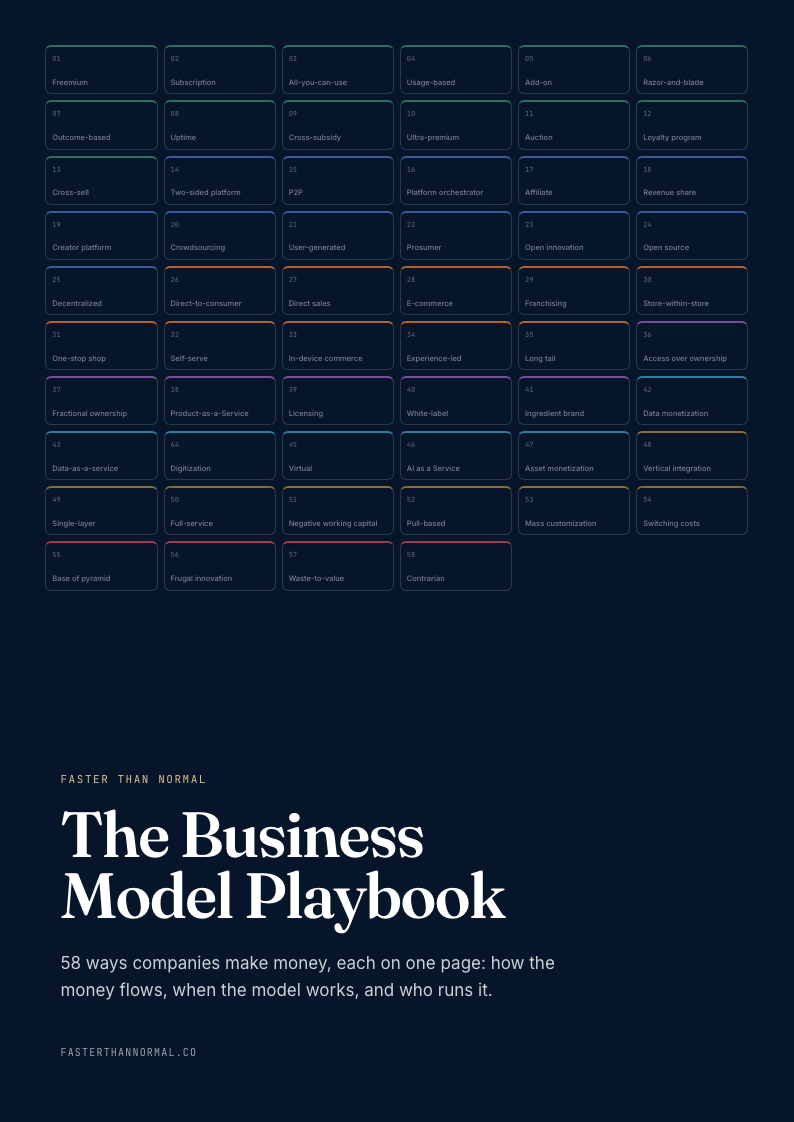
Free playbook
Get The Business Model Playbook
58 business models, one visual page each: how the money flows, the metrics that matter, and who runs it. Free when you join the Faster Than Normal email.
Free. No spam. Unsubscribe anytime.
Part IIIQuotes and Maxims
In Her Words
— Betsy CohenOne of my life's themes is reinventing myself every five years.
— Betsy CohenMy primary motivation to enter the banking industry was to transition away from practicing law!
Maxims
-
A bad name taxes every conversation. FinTech Masala's name led people to ask whether the firm was based in India or invested in restaurants. When the name needs explaining, rename it, as the Cohens did with Cohen Circle.
-
A bank run now moves at phone speed. Cohen's reading of SVB was that when deposits can leave with a phone, regulators have to respond just as fast, and their "moment of pause" drove the outflow. Any crisis plan written for the old pace is already out of date.
-
Clever institutions still fail on Banking 101. SVB went down on the basics: concentrated deposits and undiversified liabilities. Sophistication at the edges does not protect you if the fundamentals are missing.
-
Arrive before the boom, and stay after it. The Cohens were doing SPACs years before the 2020–2021 mania, and Cohen predicted a comeback after the crash. If you understand a structure, you judge it on its mechanics rather than on its reputation that year.
-
You can hate the subject and keep the training. Cohen disliked studying philosophy at Bryn Mawr, but learning how to think outlasted her distaste for the abstractions. A formative education can be useful even when it isn't enjoyable.
-
Careers don't have to run in sequence. She ran State National Bank in Washington while building Jefferson Bank in Philadelphia. Tidy one-job-at-a-time biographies can hide how much capacity a founder actually has.
-
Show up in person. Founders remember when the Cohen Circle team visits their offices. As the team puts it: "We hear that's not so common these days. For us, it's table stakes."
-
Put the skill everywhere, not in one department. Cohen's $5 million gift to Bryn Mawr embedded data science across the humanities and social sciences instead of giving it to one school. A general-purpose skill should be taught as one.
In Their Own Words
Your siblings are the only people in the world who know what it's like to have been brought up the way you were.
One of the best things about being an adult is the realization that you can share with your sister and still have plenty for yourself.
I always say that my greatest pleasure is in making something out of nothing and that is what I think I have been doing my whole life.
For me philosophy, law, and the kind of business that I do are all the same thing: they are problem-solving, they think about paradigms, solutions, and ways in which to approach an issue differently.
If you only needed your telephone in order to take out the deposits, the Treasury, the Fed, the FDIC had an obligation to respond with the same alacrity. And they didn't.— Betsy Cohen, on the 2023 banking crisis


