


Which business models does Nintendo use?
What strategic moats does Nintendo have?
Part IThe Story
In the autumn of 2012, Nintendo launched the Wii U to commercial silence so total it read as a kind of verdict. The console — a confused hybrid that grafted a tablet-like controller onto aging hardware — sold 13.56 million units across its entire lifetime, roughly what the original Wii had moved in a single calendar year. Analysts at the time suggested the obvious: that the 123-year-old Kyoto company should exit the hardware business entirely, become a third-party software publisher, perhaps license its characters to mobile platforms and accept that the future belonged to smartphones and app stores. Nintendo's stock price cratered. Its president, Satoru Iwata — the programmer-turned-executive who had once personally debugged Pokémon Gold and Silver to fit the entire Kanto region onto a Game Boy cartridge — took a 50% pay cut rather than lay off employees.
What happened next defied every reasonable model of corporate behavior. Nintendo did not pivot. It did not restructure. It did not fire its way to profitability. Instead, it spent the next four years quietly building the Switch — a device that, when it launched on March 3, 2017, would go on to sell over 150 million units, becoming the company's best-selling home console ever and one of the most successful consumer electronics products in history. The company that analysts wanted to euthanize was, by 2024, generating over ¥1.7 trillion in annual revenue and sitting on a cash pile so vast it could reportedly operate at a loss for decades without existential risk.
The distance between those two moments — from the industry's unanimous obituary to its most improbable resurrection — contains almost everything you need to understand about Nintendo. This is a company that has, across 136 years, manufactured playing cards, operated taxi services, run love hotels, built laser clay shooting ranges, invented the modern handheld gaming market, been declared dead at least four separate times, and emerged each time with something nobody was asking for but everyone wanted. The pattern is the point. Nintendo doesn't iterate. It disappears into a cocoon of institutional silence and emerges as something else.
By the Numbers
The Nintendo Empire
136Years in continuous operation (founded 1889)
¥1.1TRevenue, H1 FY2025 (Apr–Sep), ~$7B USD
150M+Nintendo Switch units sold (lifetime)
1B+Copies sold of games featuring Miyamoto's creations
98%Annual employee retention rate (Japan)
15 yrsAverage tenure of Japanese employees
19MSwitch 2 units expected by March 2026
+46%Share price increase, 2025 YTD
The Card Maker's Grandson and the Architecture of Control
The origin story matters more than it should. Not because playing cards in 1889 Kyoto are a natural precursor to The Legend of Zelda, but because the family that ran Nintendo for its first century embedded a specific logic into the company's DNA — one that persists, mutated but recognizable, in every strategic decision the company makes today.
Fusajiro Yamauchi began manufacturing hanafuda — flower cards — in Shimogyo-ku, Kyoto, in 1889. The business was modest but durable, surviving two world wars and the complete transformation of Japanese society. Fusajiro passed the company to his son-in-law, who passed it to his son-in-law, establishing a pattern: Nintendo's leadership was a family inheritance, and with it came a family's peculiar blend of conservatism and autocracy.
The figure who remade the company was Hiroshi Yamauchi, Fusajiro's great-grandson, who took control in 1949 at the age of 22 — reportedly after his ailing grandfather extracted a promise that the young man would be given absolute authority over the firm. Yamauchi was not a technologist. He was not a gamer. He was, by most accounts, an imperious executive with preternatural instincts for consumer desire and zero tolerance for consensus-building. His first act was to fire every manager who had served under his predecessor. His second was to consolidate all manufacturing in a single facility. His management philosophy, as recounted in David Sheff's essential Game Over: How Nintendo Conquered the World, was essentially feudal: the lord decides, the vassals execute.
Under Yamauchi, Nintendo tried — and often failed at — a dizzying array of businesses throughout the 1960s. A taxi company. Instant rice. A chain of "love hotels." Each venture probed a different market; none stuck. But the failures taught something that would prove foundational: Yamauchi learned to distinguish between businesses where Nintendo held structural control and businesses where it didn't. The playing card business was shrinking. Taxis were commoditized. Rice was rice. What Yamauchi wanted — though he might not have articulated it in these terms — was a platform. A business where Nintendo didn't just sell a product but controlled the terms on which the entire ecosystem operated.
He found it in toys.
Withered Technology, Lateral Thinking
The phrase belongs to Gunpei Yokoi, and it may be the single most important strategic concept in Nintendo's history. Yokoi — a maintenance-line engineer who Yamauchi plucked from obscurity after noticing him playing with an extendable arm toy he'd built during his lunch break — became the company's first great hardware inventor. His philosophy was deceptively simple: don't chase cutting-edge technology. Take mature, well-understood, cheap components, and find a novel way to combine them that creates a new experience.
— Gunpei Yokoi, as paraphrased by Nintendo historiansThe key is to use well-established technology in a novel way, rather than cutting-edge technology that is expensive and unreliable.
Yokoi's first commercial triumph was the Game & Watch series, launched in 1980 — a line of handheld electronic games built around inexpensive LCD screens and watch batteries. No microprocessors. No backlit displays. Just the cheapest available components arranged in a form factor nobody had thought to try: a portable game that fit in your pocket. The Game & Watch line sold 43.4 million units globally and generated the cash flow that funded Nintendo's assault on the home console market.
The principle recurred with eerie consistency. The original Game Boy, launched in 1989, used a Sharp LR35902 processor — essentially a modified Z80, a chip design already a decade old. Sega's competing Game Gear had a color screen, a backlit display, and superior processing power. Atari's Lynx had it all plus ambidextrous controls. The Game Boy had a two-inch monochrome screen that looked like it belonged in a calculator. It sold 118.69 million units. The Game Gear sold 10.6 million. The Lynx barely registered.
The reason was batteries. The Game Boy ran for 30 hours on four AAs. The Game Gear ate six AAs in three to five hours. Yokoi had understood something that Sega and Atari hadn't: for a portable device, the constraint that mattered was not graphical fidelity but play duration. A child on a road trip doesn't care about pixels. A child on a road trip cares about not running out of game.
This is the throughline. From the Game & Watch to the Game Boy to the DS to the Wii to the Switch, Nintendo's most successful products have been the ones that redefined what the relevant performance axis was — and then won on the new axis by deploying technology so mature it was practically free. The Wii's motion controller used accelerometers that were commodity parts by 2006. The DS's touchscreen was years behind what existed in PDAs. The Switch's hybrid form factor required no component that wasn't readily available in the mobile supply chain. Each device looked, to the spec-sheet obsessed, like it was behind. Each sold in the hundreds of millions.
The failures — the Virtual Boy, the Wii U — were the products that violated the principle. The Virtual Boy chased cutting-edge stereoscopic 3D with immature LED display technology. The Wii U grafted a tablet screen onto a console in a way that was neither truly portable nor truly innovative — it occupied the uncanny valley between Nintendo's lateral thinking and a conventional spec bump. Both died on contact with the market.
The Famicom Doctrine: How to Own a Platform
In 1983, Nintendo launched the Family Computer — the Famicom — in Japan. A year and a half later, a redesigned version arrived in the United States as the Nintendo Entertainment System. What happened next was not merely a product success. It was the construction of an economic architecture that would define the video game industry for decades, and it was done with the ruthlessness of a Kyoto card-game company that understood exactly one thing: the house always wins.
The American video game market had collapsed in 1983. Atari had flooded retail channels with low-quality games — the infamous E.T. cartridge was merely the most symbolic casualty — and retailers had sworn off video games entirely. Yamauchi's insight was that the crash was not a demand problem but a quality-control problem. Consumers still wanted games. They just couldn't trust that any given cartridge would be worth playing.
Nintendo's solution was the 10NES lockout chip — a proprietary authentication system embedded in every NES console and every licensed game cartridge. If a cartridge didn't contain the chip, the console wouldn't play it. This was, functionally, a closed platform: Nintendo controlled which games could exist on its hardware, and it extracted a licensing fee from every publisher for the privilege. Third-party publishers were limited to five titles per year. Nintendo manufactured the cartridges itself, ensuring that publishers couldn't flood the market. And every cartridge carried the "Nintendo Seal of Quality" — a marketing device that was also, functionally, a gatekeeper's stamp.
🎮
The NES Licensing Model
How Nintendo controlled the economics of its platform
| Control Point | Mechanism | Effect |
|---|---|---|
| Hardware authentication | 10NES lockout chip | Only licensed games could run |
| Title limits | 5 games/year per publisher | Prevented market flooding |
| Manufacturing control | Nintendo printed all cartridges | Controlled supply, captured margin |
| Exclusivity clauses | 2-year NES exclusivity for titles | Starved competing platforms |
| Quality branding | "Seal of Quality" on packaging | Rebuilt consumer trust post-crash |
The publishers hated it. They paid the fees anyway. By 1990, Nintendo accounted for 90% of the $3 billion U.S. video game market. The Famicom/NES sold 61.91 million units globally. The licensing fees alone generated margins that most hardware companies could only fantasize about. And the ecosystem effects were self-reinforcing: more players meant more demand for games, which meant more publishers willing to accept Nintendo's terms, which meant more games, which meant more players.
This was the template. Not the specific terms — the licensing model would evolve, the five-game limit would be lifted, the lockout chip would be replaced by other mechanisms — but the logic. Nintendo understood, perhaps before anyone else in consumer electronics, that a platform's value is determined not by its technical specifications but by the degree to which the platform owner controls the relationship between producers and consumers. Apple would arrive at this insight twenty-five years later with the App Store. Nintendo got there with a chip that cost less than a dollar.
The Plumber, the Sword, and the Religion of IP
Shigeru Miyamoto joined Nintendo in 1977 as a staff artist. He had studied industrial design at Kanazawa College of Art. He had no programming experience. He had no particular interest in electronics. What he had was an imagination shaped by the caves and forests around his childhood home in Sonobe, a rural town near Kyoto — an imagination that would, over the next five decades, generate more enduring fictional characters than any single individual in the history of interactive media.
The Miyamoto mythology is well-trodden: how Yamauchi assigned the young artist to rescue a failed arcade game called Radar Scope; how Miyamoto wanted to license Popeye but couldn't secure the rights, so he invented a carpenter, a gorilla, and a damsel in distress; how the carpenter was called "Jumpman" until workers at Nintendo's Tukwila, Washington warehouse started calling him Mario, after their landlord, Mario Segale. Donkey Kong shipped in 1981 and became the best-selling arcade machine in the industry. Miyamoto was 28.
What matters about Miyamoto is not the biographical details but the creative method — and the way Nintendo, almost uniquely among game companies, built an institutional structure to protect and perpetuate that method. Miyamoto designs games by starting with a feel, not a story or a visual. The weight of Mario's jump. The tactile satisfaction of Link's sword slash. The physicality of shaking a Wii Remote. He calls this approach "the experience first, the narrative last," and it produces games that are, in the most literal sense, toys — interactive objects whose pleasure is primarily kinesthetic.
— Shigeru Miyamoto, The Guardian, December 2023I wanted to make something weird.
This creative philosophy has compounding economic implications. Characters designed around feel rather than narrative tend to be remarkably durable — Mario's essential nature (jump, run, explore) is independent of any particular plot, which means the character can be redeployed across genres, platforms, and decades without dilution. Mario has appeared in over 200 games. The franchise has sold over 800 million copies. The Legend of Zelda, Miyamoto's other foundational creation, debuted in 1986 and remains, nearly four decades later, one of the highest-rated franchises in gaming history. The Legend of Zelda: Tears of the Kingdom, released in May 2023, sold over 19 million copies within three months.
Nintendo's IP library — Mario, Zelda, Pokémon, Donkey Kong, Metroid, Kirby, Animal Crossing, Splatoon — is not merely a collection of franchises. It is the company's actual moat. Hardware can be copied. Distribution can be disrupted. But the emotional relationship between a 40-year-old and the first time they played Super Mario Bros. as a child? That is a competitive advantage that compounds with every generation. It is loyalty that looks, from the outside, like religion.
The Console Wars and the Wages of Hubris
By the early 1990s, Nintendo's dominance appeared structural. The NES had rebuilt the American video game market from rubble, and the Super Nintendo Entertainment System — released in 1990 in Japan, 1991 in the U.S. — was the technical and commercial standard-bearer for 16-bit gaming. And then Sega came.
The story of Sega's challenge is told vividly in Blake J. Harris's Console Wars: Sega, Nintendo, and the Battle that Defined a Generation. Tom Kalinske, Sega of America's CEO, attacked Nintendo's flanks with a strategy built on three insights: price aggression (the Genesis launched at $189 versus the SNES's $199), attitude-driven marketing ("Genesis does what Nintendon't"), and a deliberate pivot toward older demographics. Sega's willingness to allow blood in Mortal Kombat — where Nintendo's version substituted grey sweat — signaled that console gaming wasn't just for kids. By 1994, Sega had leapfrogged Nintendo in U.S. market share.
But the console wars' most consequential battle was the one Nintendo lost through arrogance rather than competition. In the early 1990s, Nintendo partnered with Sony to develop a CD-ROM add-on for the SNES. The partnership collapsed — reportedly because Yamauchi, upon learning that Sony would retain control over the CD format's licensing, unilaterally announced a deal with Philips instead, blindsiding Sony's Ken Kutaragi at CES. The humiliation was total and public.
Kutaragi, a Sony engineer whose obsession with gaming hardware bordered on the pathological, channeled the insult into creation. The result was the PlayStation, launched in 1994 — a console that would sell over 102 million units and permanently shatter Nintendo's monopoly on the home console market. The PlayStation's use of CD-ROMs instead of cartridges slashed manufacturing costs for developers, making it trivially easy for publishers to defect from Nintendo's platform. The 3D polygon-based graphics — the same technology that Sega of Japan had rejected when Kalinske proposed partnering with Silicon Graphics — made Nintendo's cartridge-based approach look antique almost overnight.
Nintendo's response was the Nintendo 64, launched in 1996. It was technically superior to the PlayStation in raw polygon-pushing power. It used cartridges. It launched with Super Mario 64, one of the most acclaimed games ever made. And it sold 32.93 million units — less than a third of the PlayStation's total. The N64 was not a failure in isolation. It was a failure of architecture. By choosing cartridges over discs, Nintendo preserved its manufacturing control but ceded its ecosystem to a competitor that offered third-party publishers cheaper distribution, fewer restrictions, and a larger installed base.
1988
Nintendo controls 90% of the U.S. video game market.
1991
Sega Genesis challenges Nintendo's dominance in North America.
1991
Nintendo–Sony CD-ROM partnership collapses at CES.
1994
Sony launches PlayStation; Sega briefly leads U.S. market share.
1996
Nintendo 64 launches with cartridges; sells 32.93M lifetime vs. PlayStation's 102M.
2001
GameCube launches, sells 21.74M — Nintendo's lowest home console total.
The GameCube, released in 2001, compounded the decline. It was Nintendo's first disc-based console, but it was too late — the installed base had migrated to PlayStation 2 (155 million units sold), and Microsoft's Xbox had entered the market with online gaming capabilities that Nintendo couldn't match. The GameCube sold 21.74 million units. Nintendo was, by any conventional metric, losing the console war decisively. It was third in a three-horse race, and the horses ahead of it were backed by two of the largest technology conglomerates on Earth.
What followed was one of the most remarkable strategic pivots in the history of consumer electronics.
The Blue Ocean That Wasn't Blue Enough
The Wii was not an incremental improvement. It was a philosophical rejection of the premise on which the entire console industry had been competing.
Satoru Iwata — who had succeeded Yamauchi as president in 2002, becoming the first non-Yamauchi to lead the company in its history — diagnosed the problem with surgical clarity. The video game industry, Iwata argued, was trapped in a death spiral of diminishing returns: each console generation required more expensive hardware, which required more expensive games, which required higher prices, which shrank the addressable market to an ever-smaller core of devoted gamers. Sony and Microsoft were engaged in a graphical arms race. Iwata decided to leave the battlefield entirely.
— Satoru Iwata, GDC Keynote, 2006The game industry is at risk of dying if it continues down the same path.
Iwata was a programmer by training and by temperament — the kind of executive who could sit across from a game developer and debug code on a whiteboard. Born in Hokkaido in 1959, he had programmed games for HAL Laboratory while still a student at the Tokyo Institute of Technology, eventually becoming HAL's president at 33 and rescuing the studio from near-bankruptcy. Yamauchi, recognizing in Iwata the rare combination of technical depth and strategic vision, brought him into Nintendo as head of corporate planning before naming him president. Iwata's great insight was that Nintendo's competitive advantage was not in silicon but in surprise — the capacity to create experiences that made people who didn't consider themselves gamers suddenly want to play.
The Wii, launched in November 2006, embodied this insight with almost literal simplicity. Its processor was barely more powerful than the GameCube's. Its graphics were a generation behind the Xbox 360 and PlayStation 3. Its marquee feature was a wireless motion controller — a white wand that used off-the-shelf accelerometers to translate physical movement into on-screen action. The pack-in game, Wii Sports, required no gaming literacy whatsoever: you swung the controller like a tennis racket, and your on-screen avatar swung a tennis racket.
The results were staggering. The Wii sold 101.63 million units, outselling the PlayStation 3 (87.4 million) and the Xbox 360 (84 million). In 2008, it became the first console to sell more than 10 million units in a single year in the United States alone. Nintendo's annual revenue peaked at ¥1.84 trillion in FY2009. More importantly, the Wii expanded the market: it was the console your grandmother played, the device that turned retirement communities into bowling leagues. Harvard Business Review published cases on it. Clayton Christensen's acolytes held it up as a textbook disruption.
But the Wii's triumph contained its own vulnerability. The audience Nintendo had captured — the casual, the curious, the non-gamer — was exactly the audience that smartphones and tablets would claim within three years. Apple launched the iPhone in 2007. The App Store opened in 2008. Suddenly, the same people who had picked up a Wii Remote for the first time were playing Angry Birds on a device they already owned. The Wii's blue ocean turned out to be somebody else's fishing ground.
The Programmer Who Believed in Fun
Satoru Iwata died on July 11, 2015, at the age of 55, from a bile duct tumor. He had undergone surgery in 2014 but returned to work within months, appearing visibly thinner in Nintendo Direct videos but still delivering presentations with the gentle, self-deprecating humor that had made him beloved by the gaming community in a way that no other corporate executive has ever quite achieved.
What Iwata built, before he died, was the institutional framework that would produce the Switch. He greenlit the project internally — codenamed NX — and set its strategic direction: a device that would merge Nintendo's home console and handheld businesses into a single product, eliminating the bifurcated development pipeline that had forced the company to split its software resources between two platforms for decades. It was the most consequential product decision in Nintendo's modern history, and Iwata did not live to see it ship.
His legacy is more than the Switch. Iwata established a culture of protectiveness around Nintendo's creative process — a refusal to subordinate game design to financial calendars, a willingness to delay products until they felt right, and an almost pathological aversion to layoffs that has produced the company's extraordinary 98% annual retention rate. Japanese employees at Nintendo have an average tenure of 15 years. The current president, Shuntaro Furukawa, joined the company in 1994 as an accountant. Miyamoto has been there since 1977.
— Keza MacDonald, author of Super NintendoThe people who first made Nintendo's hits are still working at the company. For the last 50 years, these people have been passing down knowledge and training up a new generation of Nintendo creatives.
This institutional continuity is rare in the game industry, where studios routinely expand and contract with each product cycle. Around 10% of game developers reported being laid off in the most recent year surveyed by the Game Developers Conference, and over 40% said they felt the effects of layoffs at their companies. Nintendo operates in a different temporal register. Its developers accumulate decades of craft knowledge. Its creative teams pass down design principles the way a master carpenter passes down joinery techniques. The result is a consistency of creative output that no other game company — not Sony's first-party studios, not Microsoft's sprawling Xbox portfolio, not the AAA publishers — has been able to replicate.
The Switch and the Unified Theory of Play
The Nintendo Switch launched on March 3, 2017, alongside The Legend of Zelda: Breath of the Wild — a game so good that it essentially functioned as a system-seller for a console that had no other launch titles of consequence. The concept was deceptively simple: a tablet-like device with detachable controllers (Joy-Cons) that could be played handheld, docked to a television, or placed on a kickstand for tabletop play. It was not the most powerful console on the market. The PlayStation 4, released in 2013, had significantly better specs. The Xbox One was more capable. The Switch used an Nvidia Tegra X1 processor — a mobile chip. Again: withered technology, lateral thinking.
The strategic brilliance was not in the hardware but in what the hardware unified. For the first time in Nintendo's history, every game the company made — handheld and home console — lived on a single platform. This meant that instead of splitting its development teams between two ecosystems (as it had done with the 3DS and Wii U), Nintendo could concentrate all of its creative firepower on one library. The result was a software attach rate and release cadence that outstripped anything in the company's history. Mario Kart 8 Deluxe sold over 64 million copies. Animal Crossing: New Horizons, released during the COVID-19 lockdowns in March 2020, sold over 45 million copies. Super Smash Bros. Ultimate hit 34 million. The Switch's software library became a flywheel: every great game increased the installed base, and every new console sold created demand for the existing library.
The numbers tell the story in their own language. The Switch crossed 150 million units sold, surpassing the Game Boy and DS family to become one of the best-selling consoles of all time, trailing only the PlayStation 2 (155 million). But the more revealing metric is Nintendo's profitability during the Switch era: unlike Sony and Microsoft, which have historically sold consoles at or near cost and recouped margins on software and services, Nintendo has sold the Switch at a profit from day one. The company's operating margins during the Switch's peak years exceeded 30% — a figure that would be remarkable for a software company, let alone a hardware manufacturer.
The Successor Problem
By 2024, the Switch was deep into its twilight. Hardware sales had slowed to a trickle as consumers waited for the inevitable successor. Nintendo announced the Switch 2 in early 2025 — a device that, true to form, was not a dramatic reinvention but a carefully evolved iteration: bigger screen, more powerful processor (still an Nvidia chip), redesigned Joy-Con controllers with a magnetic attachment mechanism, and backward compatibility with the original Switch's library.
The Switch 2 launched on June 5, 2025, at $449.99 — a significant premium over the original Switch's $299.99 launch price. The increase reflected both inflation, component costs, and Trump-era tariffs on electronics manufactured in East Asia. Nintendo of America President Doug Bowser acknowledged the tariff risk publicly, and the company briefly delayed preorders amid uncertainty about reciprocal trade policy. But the demand was overwhelming: the Switch 2 set sales records in its opening weeks, and Nintendo raised its fiscal year forecast to 19 million units by March 2026.
The financial results were immediate. In the six months ending September 2025, Nintendo reported ¥1.1 trillion ($7 billion) in revenue — more than double the same period a year earlier — and ¥199 billion ($1.3 billion) in profit, an 83% jump. Shares climbed 46% for the year. The launch title, Mario Kart World, joined forthcoming titles like Donkey Kong Bananza and The Duskbloods in what appeared to be the most robust first-year lineup in the company's history.
But the successor problem is never really about the first year. It's about the fifth. The Switch succeeded because it unified Nintendo's development resources and rode a concept — portable-home hybrid — that had no direct competitor. The Switch 2 succeeds because it inherits that concept plus a massive backward-compatible library. The question is whether Nintendo can sustain the flywheel without the kind of paradigm-defining surprise that characterized the Wii and the Switch. A better version of the same thing is a bet that the same audience will keep paying — a bet that, for Nintendo, has historically been the precursor to stagnation.
Beyond the Screen: The Miyamoto Doctrine Goes Physical
In 2023, The Super Mario Bros. Movie — produced by Illumination in collaboration with Nintendo — grossed over $1.3 billion at the global box office, making it the highest-grossing video-game-based film in history and the second-highest-grossing animated film of the year. Nintendo had spent decades resisting Hollywood. The 1993 live-action Super Mario Bros. film, starring Bob Hoskins and Dennis Hopper, was a disaster so complete it became a cautionary tale about brand dilution. Miyamoto reportedly carried the trauma of that experience for thirty years.
What changed was control. Nintendo's deal with Illumination gave the company unprecedented creative oversight — Miyamoto himself served as a producer, reviewing scripts, approving character designs, vetoing choices that violated his sense of what Mario should feel like. The result was a film that was, in the most generous reading, a 90-minute Nintendo commercial — and in the most practical reading, a proof of concept for Nintendo's transformation from a video game company into an intellectual property company with a gaming division.
Super Nintendo World — the theme park expansion at Universal Studios — extended the logic further. The first location opened at Universal Studios Japan in 2021; a second opened at Universal Studios Hollywood in 2023; a third, the most ambitious yet, opened at Universal's Epic Universe in Orlando in May 2025. Miyamoto was personally involved in the design, treating the physical spaces with the same obsessive attention to interactive feel that he brought to game design. The parks are not passive experiences. Visitors wear Power-Up Bands, punch question-mark blocks, and accumulate digital coins — the boundary between game and physical space deliberately blurred.
— Shigeru Miyamoto, The Washington Post, May 2025I wanted to share what I call a little bit of a strange story.
The economic implications are significant. Theme parks generate recurring revenue streams that are uncorrelated with the console cycle — the periodic boom-and-bust pattern that has defined Nintendo's financial profile for decades. Films create marketing events that drive game sales. Games create characters that fill theme parks. The flywheel is expanding beyond the screen, and the asset at the center — the IP itself — appreciates with each rotation.
The Company That Won't Hurry
There is something irreducible about Nintendo's relationship with time. Most technology companies operate on a clock set by Moore's Law, competitive dynamics, or investor expectations. Nintendo operates on its own clock — a Kyoto clock, if you will, set by the tempo of creative development and the patient accumulation of institutional craft.
The company still does not hold regular analyst calls. It does not optimize for quarterly guidance. Its president, Shuntaro Furukawa, is an accountant by training who joined in 1994 and rose through corporate planning — a background that, at any other company, might signal financial conservatism but at Nintendo signals something closer to stewardship. Furukawa's job is not to maximize near-term shareholder value. His job is to protect the conditions under which Miyamoto's successors can do their best work.
The cash reserves are part of this logic. Nintendo maintains a balance sheet so conservative it borders on the absurd — billions in cash and short-term investments, minimal debt, the capacity to weather multiple consecutive product failures without restructuring. The company has said, in various formulations over the years, that it always operates with the understanding that its next product might not be a hit. This is not false modesty. It is institutional memory. The company that survived the Wii U, the Virtual Boy, the GameCube era — that thrived after each failure — builds its financial structure for the next one.
Miyamoto, now in his seventies, still comes to work. Still reviews games. Still visits the theme parks he helped design. He has been at Nintendo for nearly fifty years. The designers he trained are now training the next generation. The knowledge transfer is not documented in playbooks or process manuals. It happens the way it has always happened in craft traditions: through proximity, repetition, and the slow accretion of shared instinct.
Nintendo's headquarters in Minami-ku, Kyoto, is conspicuously bland — two mid-rise white buildings with a grey logo outside each. A small basket of Mario plush toys on the receptionist's desk is the only clue as to what's made there. Visitors are told, politely but firmly, that nobody goes upstairs.
Part IIThe Playbook
Nintendo's 136-year history is a masterclass in strategic heterodoxy — a company that has repeatedly defied the competitive logic of its industry and won not by being better at the prevailing game but by changing what game was being played. The principles below distill the operating philosophy that has allowed a Kyoto playing card manufacturer to become one of the most valuable entertainment companies on Earth, survive at least four near-death experiences, and maintain creative relevance across six decades of technological disruption.
The principles
- 1.Compete on a different axis.
- 2.Own the platform, not just the product.
- 3.Treat IP as the permanent asset; treat hardware as the disposable vehicle.
- 4.Build for the person who doesn't exist yet.
- 5.Keep the fortress stocked for winter.
- 6.Retain your craftspeople at all costs.
- 7.Unify your development surface.
- 8.Let the toy lead.
- 9.Fail cheap, pivot fast, but never panic.
- 10.Expand the IP radius without diluting the core.
Principle 1
Compete on a different axis.
The most dangerous move in business is to accept your competitor's definition of what matters. Sony and Microsoft competed on teraflops, polygon counts, and online services. Nintendo competed on how play feels. The Wii didn't beat the PlayStation 3 on any technical specification. It beat it by redefining the question from "how realistic are the graphics?" to "can my grandmother pick this up and have fun?"
Gunpei Yokoi's "withered technology, lateral thinking" is not merely a cost-saving philosophy. It is a strategic framework for asymmetric competition. By using mature, inexpensive components, Nintendo achieves two things simultaneously: it sells hardware at a profit from day one (unlike Sony and Microsoft, which subsidize consoles), and it forces competitors to respond on unfamiliar terrain. When the Wii launched, Microsoft and Sony had no institutional capability to design for non-gamers. Their entire development pipelines, third-party ecosystems, and marketing apparatuses were optimized for the core gamer. Nintendo had, effectively, walked around the army.
🎯
The Axis Shift
How Nintendo redefined competition in each generation
| Console | Industry Axis | Nintendo's Axis | Result |
|---|---|---|---|
| Game Boy (1989) | Color, backlit screen | Battery life, portability | 118.69M sold |
| DS (2004) | Processing power | Dual screens, touchscreen | 154.02M sold |
| Wii (2006) | Graphics fidelity | Motion control, accessibility | 101.63M sold |
| Switch (2017) | Performance benchmarks | Home-portable hybrid | 150M+ sold |
Benefit: Asymmetric competition makes you impossible to respond to without self-disruption. Sony couldn't build a casual-friendly console without alienating its core audience. Microsoft couldn't build a portable hybrid without undermining its Xbox infrastructure.
Tradeoff: If you pick the wrong axis, you look foolish. The Virtual Boy competed on "3D immersion" when the technology was years from being viable. The Wii U tried to compete on "second-screen experience" and landed in no-man's-land.
Tactic for operators: Before entering a competitive market, map the performance axes your competitors are optimizing for. Then ask: what axis does the customer actually care about that nobody is serving? Build for that. The danger is intellectual seduction — convincing yourself the new axis matters when it doesn't. Validate with prototypes, not slide decks.
Principle 2
Own the platform, not just the product.
Nintendo's 10NES lockout chip was a technical implementation of a strategic principle that has defined the company across every era: control the point of interaction between creators and consumers, and you control the economics of the entire ecosystem. The NES didn't just play games. It was a tollbooth. Every cartridge manufactured, every license granted, every seal of quality stamped — each was an extraction point that enriched Nintendo while simultaneously raising the bar for content quality.
This principle has evolved but never been abandoned. The Switch eShop is a digital storefront where Nintendo controls discoverability, pricing tiers, and the revenue split with third-party publishers. The Switch 2's backward compatibility ensures that the existing library — and the ecosystem built around it — transfers to the new platform, raising switching costs for consumers who have invested in digital purchases.
Benefit: Platform control generates recurring revenue, creates switching costs, and gives you leverage over every participant in your ecosystem.
Tradeoff: Excessive control alienates partners. Nintendo's draconian NES licensing terms drove publishers toward Sega in the early 1990s, and its insistence on cartridges for the N64 pushed third-party developers to the PlayStation.
Tactic for operators: If you're building a product that sits between suppliers and consumers, ask whether you can become the infrastructure rather than just the application. But calibrate your extraction rate carefully — platform owners who over-extract accelerate the emergence of alternatives.
Principle 3
Treat IP as the permanent asset; treat hardware as the disposable vehicle.
Nintendo has released over a dozen distinct console platforms since 1977. Several have failed. The IP has survived all of them. Mario debuted in 1981 on an arcade cabinet, has appeared on every Nintendo platform since, and now stars in films, theme parks, and consumer products. The character's value compounds with each new medium and each new generation of children who encounter him.
This is not accidental. Nintendo's creative process — designing characters around feel and play rather than narrative or visual style — produces IP that is remarkably portable across technologies. Mario's essential identity (jumping, exploring, bouncing off enemies) is independent of resolution, polygon count, or controller type. This means the character migrates to new platforms without losing its essence, unlike IP that is defined by a specific technological context.
Benefit: IP that outlasts hardware creates a compounding asset. Each new medium (games, films, parks, merchandise) reinforces the others without additional creative investment proportional to the returns.
Tradeoff: Over-reliance on legacy IP can calcify the creative pipeline. Nintendo has created relatively few new franchise-level characters in the last two decades — Splatoon's Inklings (2015) are arguably the most recent genuine addition.
Tactic for operators: Design your core product's identity around attributes that are technology-independent. If your product's value is entirely a function of a specific technological context (e.g., "the best graphics engine"), you are building a depreciating asset. If it's a function of an emotional relationship, you are building a compounding one.
Principle 4
Build for the person who doesn't exist yet.
Nintendo's greatest commercial successes — the NES, the Game Boy, the DS, the Wii, the Switch — all expanded the addressable market rather than competing for existing consumers. The NES rebuilt a market that had been declared dead. The Game Boy created portable gaming where none existed. The Wii turned non-gamers into gamers. The DS introduced touchscreen interaction to audiences who had never used a stylus.
Iwata articulated this as a deliberate strategy: the video game industry was shrinking its own market by targeting increasingly sophisticated demands of existing gamers. The Harvard Business Review case studies on the Wii explicitly frame this as "competing against non-consumption" — a Christensen disruption applied to consumer electronics.
Benefit: Expanding the market means you don't have to steal share from entrenched competitors. You create demand that didn't previously exist and own it by default.
Tradeoff: New-market creation is inherently uncertain. The customers you're building for don't know they want your product yet, which means you can't validate demand through conventional market research. And the new market you create may be captured by faster followers — as smartphones captured the Wii's casual audience.
Tactic for operators: Look for "non-consumers" — people who have a latent need but are excluded by the complexity, cost, or form factor of existing solutions. Design for their constraints, not for the power-user's wishlist.
Principle 5
Keep the fortress stocked for winter.
Nintendo's balance sheet is a strategic weapon disguised as fiscal conservatism. The company maintains cash reserves so substantial that it could reportedly operate at a loss for extended periods without existential risk. This is not an accident of Japanese corporate culture. It is a direct consequence of institutional memory.
Nintendo has experienced at least four severe downturns: the post-NES erosion of the mid-1990s, the GameCube era, the Wii U debacle, and the smartphone disruption of its casual gaming audience. In each case, the company's reserves gave it the runway to develop the next product without the panic-driven cost-cutting that would have destroyed its creative capabilities. Iwata's 50% pay cut during the Wii U era — rather than layoffs — was only possible because the balance sheet could absorb the losses.
Benefit: Financial reserves convert existential crises into strategic opportunities. Competitors who are forced to restructure during downturns lose talent and institutional knowledge. Nintendo, because it never lays off, retains both.
Tradeoff: Excessive conservatism can represent an opportunity cost. Nintendo's reluctance to invest aggressively in online services, mobile gaming, and cloud infrastructure has left it perpetually behind in categories that competitors dominate.
Tactic for operators: Build your financial reserves during boom periods as deliberately as you build your product pipeline. The companies that survive cyclical downturns are the ones that enter them with the runway to keep their best people employed and their best projects funded.
Principle 6
Retain your craftspeople at all costs.
Nintendo's 98% annual retention rate — with an average employee tenure of 15 years in Japan — is not a HR metric. It is a competitive moat. In an industry where studios routinely expand and contract with each product cycle, where 10% of developers report being laid off annually, Nintendo's stability produces something that cannot be hired: institutional craft knowledge.
Miyamoto joined in 1977. The designers he trained in the 1980s trained the designers who built the Switch in the 2010s, who are now training the generation that will build whatever comes after the Switch 2. The knowledge transfer is apprenticeship-based, not process-based — it happens through proximity, collaboration, and the slow accretion of shared sensibility. This is why Nintendo games have a consistency of feel across decades that no other studio can replicate.
👥
Nintendo's Human Capital Advantage
Retention vs. industry benchmarks
| Metric | Nintendo | Industry Avg |
|---|---|---|
| Annual retention rate | 98% | ~85–90% (est.) |
| Average employee tenure (Japan) | 15 years | ~4–6 years |
| Layoffs during downturns | Near zero | 10%+ annually |
| Key creative leader tenure | Miyamoto: 48 years | Highly variable |
Benefit: Institutional knowledge compounds. A 15-year veteran understands not just how to build a game but why certain design choices succeed at Nintendo specifically — an understanding that cannot be extracted, documented, or transferred through onboarding.
Tradeoff: Long tenure can breed insularity. Nintendo has been criticized for being slow to adopt online multiplayer, voice chat, and modern networking standards — failures that may partly reflect an organization where too many decision-makers came of age in a pre-internet era.
Tactic for operators: Treat your retention strategy as a capital allocation decision. Every departure of a senior employee represents a write-down of accumulated institutional knowledge. Design compensation, culture, and project structures to make staying the path of least resistance for your best people.
Principle 7
Unify your development surface.
For decades, Nintendo split its software development across two simultaneous platforms — a home console and a handheld. The SNES and Game Boy. The N64 and Game Boy Color. The GameCube and Game Boy Advance. The Wii and DS. The Wii U and 3DS. Each generation required separate development teams, separate game libraries, and separate marketing strategies. This bifurcation effectively halved Nintendo's creative bandwidth.
The Switch eliminated this structural inefficiency entirely. By creating a single device that functioned as both home console and handheld, Nintendo concentrated every first-party development team on one platform. The result was a software release cadence — and a software attach rate per console — that dramatically outperformed any previous Nintendo generation. The unification principle extends to the Switch 2's backward compatibility, which ensures that the library compounds rather than resets with each hardware generation.
Benefit: Concentration of creative resources produces better software faster. Every game contributes to one library, which grows the value of one installed base, which drives sales of one device.
Tradeoff: A single-platform strategy is an all-in bet. If the Switch had failed, there was no handheld business to fall back on.
Tactic for operators: Audit your product portfolio for structural bifurcation — places where you're splitting engineering or creative resources across parallel platforms that serve overlapping audiences. The act of unification itself often generates more value than any feature improvement.
Principle 8
Let the toy lead.
Miyamoto's creative process starts with the toy — the physical interaction, the controller mechanic, the way an input feels in your hands — not with the story, the visual design, or the market opportunity. Wii Sports was not designed to sell the Wii concept. The Wii Remote's motion-sensing capabilities were the concept; Wii Sports was the proof. Super Mario 64 was not a game that happened to use an analog stick. It was the analog stick — the N64 controller's innovative thumbstick — searching for a game that would justify its existence.
This toy-first philosophy has a subtle but powerful economic effect: it makes each Nintendo product defensible against imitation. Competitors can copy specifications. They cannot copy the emergent relationship between a specific controller design and the software built to exploit it. The Joy-Con's HD Rumble feature is meaningless in isolation. Paired with 1-2-Switch or Super Mario Odyssey, it becomes part of an integrated experience that cannot be decomposed.
Benefit: Hardware-software integration creates moats that pure software companies and pure hardware companies cannot replicate. The whole is greater than the sum of its components.
Tradeoff: Toy-first development is inherently unpredictable. Some toys don't find their game (the Wii U GamePad). Some games don't need a new toy (most Switch titles work fine with conventional controls). The hit rate is high but not guaranteed.
Tactic for operators: If you make both the platform and the application, design them together rather than sequentially. The deepest product moats emerge when hardware capabilities and software experiences are co-evolved rather than optimized independently.
Principle 9
Fail cheap, pivot fast, but never panic.
Nintendo's history is littered with failures: the Virtual Boy (770,000 units sold), the Wii U (13.56 million), the e-Reader, the Game Boy Micro, the 64DD. The company fails regularly and, crucially, cheaply. Because Nintendo uses mature components and maintains conservative cost structures, the financial exposure from a hardware failure is manageable. The Wii U was a disaster, but it didn't threaten the company's solvency.
More importantly, Nintendo treats failures as information rather than crises. The Virtual Boy taught the company that immersive 3D was premature. The Wii U's tablet controller concept — a second screen that extended gameplay — was a failure as a product but a conceptual precursor to the Switch's hybrid form factor. The DS's dual screens were initially mocked; the product sold 154 million units.
Benefit: Cheap failure creates option value. Each failed experiment generates knowledge that reduces the risk of the next attempt.
Tradeoff: A tolerance for failure can become a tolerance for mediocrity if the feedback loops are too slow. The Wii U stayed on the market for nearly five years despite its evident failure, consuming development resources that could have been redirected sooner.
Tactic for operators: Structure your experiments to fail fast and cheaply. Use mature, low-cost inputs. Define kill criteria in advance. But also: don't over-index on the failure itself. Look for the concept inside the failure that, given different implementation or timing, might succeed.
Principle 10
Expand the IP radius without diluting the core.
The Super Mario Bros. Movie's $1.3 billion gross and the expansion of Super Nintendo World into three continents represent a new phase of Nintendo's strategy: extending its IP into non-gaming media while maintaining creative control so tight it borders on paranoia. Miyamoto's 30-year reluctance to return to Hollywood — rooted in the trauma of the 1993 film — broke only when Nintendo secured a deal structure that gave it veto power over every creative decision.
This is the critical distinction. Nintendo is not licensing its characters. It is producing experiences in other media using its own creative standards. The theme parks are not branded environments designed by Universal's imagineers. They are interactive spaces co-designed by Miyamoto with the same attention to feel — the weight of a punch on a question-mark block, the digital-physical integration of the Power-Up Band — that characterizes Nintendo's games.
Benefit: Non-gaming media creates revenue streams that are uncorrelated with the console cycle while simultaneously reinforcing demand for the games. The movie makes kids want to play Mario. The theme park makes parents want to buy a Switch.
Tradeoff: Creative control at this level is resource-intensive and does not scale well. Miyamoto cannot personally approve every decision in every park and every film forever. The question is whether Nintendo can institutionalize his standards as he transitions from active creator to creative elder.
Tactic for operators: When extending your brand into adjacent categories, insist on creative control proportional to the brand risk. Licensing is fast revenue. Production is durable equity. The former generates cash; the latter compounds the asset.
Conclusion
The Toymaker's Paradox
Nintendo's playbook is a sustained argument against the logic of the technology industry — against the assumption that more processing power is always better, that first-mover advantage in emerging technology is decisive, that lean workforces and rapid iteration produce the best products, that financial leverage accelerates growth.
The company succeeds not because it ignores these principles but because it has found the specific conditions under which their opposites hold. Withered technology works when the relevant constraint is experience, not specification. Platform control works when you have IP worth controlling access to. Conservative balance sheets work when your industry is cyclical and your core asset — creative talent — is destroyed by layoffs. Institutional tenure works when the knowledge that matters is tacit, embodied in hands and habits rather than documented in wikis.
The paradox is that these principles cannot be easily extracted from the organism that produced them. They work at Nintendo because of Nintendo — because of its specific history, its Kyoto insularity, its family-dynasty governance, its five-decade relationship with a single creative genius. They are, in the deepest sense, withered strategies applied with lateral thinking. Which is, of course, the most Nintendo thing of all.
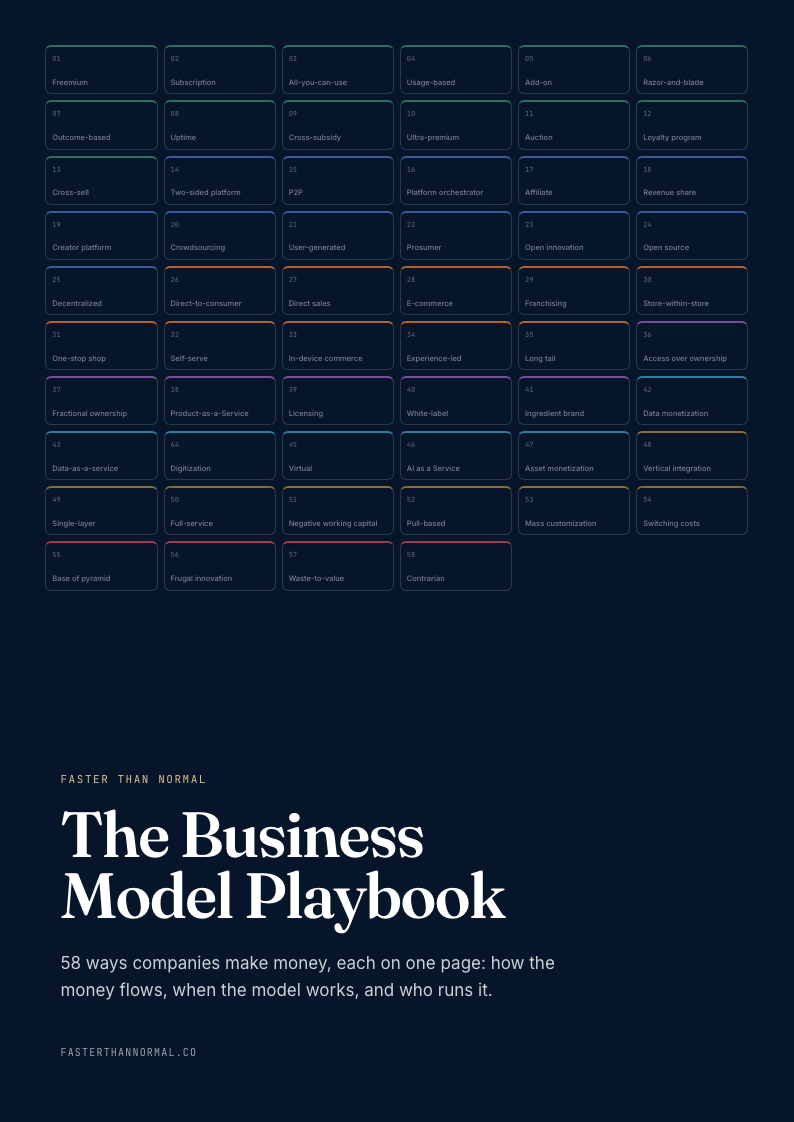
Free playbook
Get The Business Model Playbook
58 business models, one visual page each: how the money flows, the metrics that matter, and who runs it. Free when you join the Faster Than Normal email.
Free. No spam. Unsubscribe anytime.
Part IIIBusiness Breakdown
The Business at a Glance
Current Vital Signs
Nintendo Co., Ltd.
¥1.1TRevenue, H1 FY2025 (Apr–Sep 2025), ~$7B
¥199BOperating profit, H1 FY2025 (~$1.3B), +83% YoY
150M+Switch lifetime unit sales
19MSwitch 2 units forecast by March 2026
~7,300Estimated employees (Japan-based)
~$85BApproximate market capitalization (Dec 2025)
+46%Share price appreciation, 2025 YTD
Nintendo is, structurally, a hybrid: a hardware manufacturer, a first-party game developer, an IP licensor, and an increasingly diversified entertainment company. It trades on the Tokyo Stock Exchange (7974.T) and is a constituent of the Nikkei 225 and multiple global gaming indices. The company is headquartered at 11-1 Hokotate-cho, Kamitoba, Minami-ku, Kyoto — a location it has occupied since 2000, roughly a half-hour walk from Kyoto's central station.
The Switch 2 launch has propelled the company into what may be its strongest financial position in a decade. The doubling of H1 revenue year-over-year reflects both pent-up hardware demand and the pull-forward effect of a console transition. The 83% profit increase is even more telling: it suggests that the Switch 2's $449.99 price point preserves healthy hardware margins despite tariff headwinds and component cost inflation. Nintendo is one of the vanishingly few consumer hardware companies that has consistently sold consoles at a profit rather than subsidizing them to build installed base.
How Nintendo Makes Money
Nintendo's revenue model is deceptively simple — it sells hardware, sells software, and increasingly licenses its IP for non-gaming media — but the interactions between these streams create a flywheel effect that amplifies each component's value.
💰
Revenue Streams
Estimated breakdown based on historical reporting and H1 FY2025 disclosures
| Revenue Stream | Description | Estimated % of Revenue | Trend |
|---|---|---|---|
| Hardware sales | Switch family + accessories | ~40–45% | Growing (Switch 2 cycle) |
| First-party software | Nintendo-developed titles (physical + digital) | ~30–35% | Growing |
| Third-party royalties | Licensing fees from publishers on Nintendo platforms | ~10–15% | Stable |
| IP licensing / media | Film revenue share, theme park royalties, merchandise | ~5–10% | Rapidly growing |
| Digital services | Nintendo Switch Online subscriptions, DLC, eShop | ~5–8% | Growing |
Hardware is the foundation. Unlike Sony's PlayStation and Microsoft's Xbox divisions, which have historically sold consoles at or near cost, Nintendo prices hardware to generate positive gross margins from launch. The Switch 2's $449.99 price point — $150 higher than the original Switch's 2017 launch price — reflects both Nintendo's pricing power and its refusal to accept the industry's conventional "razors and blades" model. The installed base drives software sales, but the hardware itself is profitable.
First-party software is where Nintendo's margins are richest. Games like Mario Kart 8 Deluxe (64+ million copies), Animal Crossing: New Horizons (45+ million), and Zelda: Tears of the Kingdom (19+ million in the first quarter) generate software revenue at estimated gross margins north of 80% for digital sales. Nintendo's first-party attach rate — the number of Nintendo-published games sold per console — consistently exceeds any competitor's, because the company's IP library is the primary purchase driver for its hardware.
Third-party royalties are the platform tax. Every publisher that releases a game on a Nintendo console pays a licensing fee. This revenue stream is comparatively smaller than Sony's or Microsoft's because Nintendo's platforms attract fewer third-party blockbusters — a consequence of lower hardware specifications that make certain AAA titles difficult to port.
IP licensing and media is the fastest-growing stream, though still the smallest in absolute terms. The Super Mario Bros. Movie's $1.3 billion gross, Super Nintendo World's expanding theme park footprint, and a growing merchandise business are transforming Nintendo's revenue profile from console-cycle-dependent to something closer to a diversified entertainment company.
Digital services, primarily Nintendo Switch Online, represent a recurring revenue stream that didn't exist in previous console generations. The subscription service offers access to a library of classic NES, SNES, N64, and Game Boy titles, as well as online multiplayer functionality.
Competitive Position and Moat
Nintendo occupies a unique position in the gaming industry: it competes with Sony and Microsoft on the hardware level but is not truly in the same business. Sony's PlayStation and Microsoft's Xbox compete with each other on specifications, online services, and third-party game libraries. Nintendo competes with both on the decision to buy a gaming device — but it serves a fundamentally different use case (portable-hybrid, family-oriented, first-party-IP-driven) that makes direct comparison misleading.
🏰
Competitive Landscape
Console hardware comparison as of late 2025
| Metric | Nintendo | Sony (PlayStation) | Microsoft (Xbox) |
|---|---|---|---|
| Current-gen console | Switch 2 ($449.99) | PS5 ($499.99) | Xbox Series X ($499.99) |
| Hardware profitability | Profitable from launch | Near cost / loss initially | Loss initially |
| Exclusive IP strength | Mario, Zelda, Pokémon, etc. | Spider-Man, God of War, etc. | Halo, Forza, + Activision Blizzard |
| Form factor | Portable-home hybrid | Home console only | Home console + cloud |
| Third-party library depth | Limited (lower specs) | Deep | Deep |
| Online services maturity | Basic | Advanced (PS Plus) | Advanced (Game Pass) |
Nintendo's moat sources:
-
Irreplaceable first-party IP. Mario, Zelda, Pokémon, Animal Crossing, and Splatoon have no substitutes. A consumer who wants to play The Legend of Zelda: Tears of the Kingdom must own a Nintendo device. This IP exclusivity is the single most powerful driver of hardware sales and the reason Nintendo can sell underpowered hardware at premium prices.
-
Integrated hardware-software design. Nintendo's practice of co-developing hardware and software — designing the controller mechanic and the game simultaneously — creates experiences that cannot be replicated on competing platforms. The Joy-Con's motion sensing and HD Rumble are meaningless without the software built to exploit them.
-
Brand trust and multi-generational loyalty. Nintendo's "family-friendly" positioning is not a marketing choice but a moat. Parents who played Mario as children buy Switches for their own children. This generational compounding of brand loyalty is unique in gaming and nearly impossible to manufacture.
-
Conservative financial structure. The cash fortress enables Nintendo to absorb hardware failures without restructuring, giving it the runway to take creative risks that debt-laden competitors cannot.
-
Employee retention and institutional knowledge. The 98% retention rate means that the craft knowledge accumulated over five decades stays inside the company, producing a consistency of creative output that competitors cannot replicate through hiring.
Where the moat is weak:
-
Online services. Nintendo Switch Online is widely regarded as inferior to PlayStation Plus and Xbox Game Pass in terms of features, multiplayer infrastructure, and value proposition. Nintendo's institutional DNA is oriented toward local, shared-screen play — a strength that becomes a liability as gaming moves online.
-
Third-party support. The Switch 2's improved specifications should narrow the gap, but historically, Nintendo platforms have struggled to attract the graphically intensive AAA multiplatform titles that dominate Sony and Microsoft's libraries. This limits the Switch's appeal to gamers who want one console.
-
Mobile and cloud gaming. Nintendo's mobile strategy has been tentative and inconsistent. The Pokémon Go partnership (through Niantic, in which Nintendo held an indirect stake) was a cultural phenomenon, but Nintendo's own mobile titles — Miitomo, Super Mario Run, Fire Emblem Heroes — have generated modest revenue relative to the company's IP value.
The Flywheel
Nintendo's flywheel is a reinforcing cycle that compounds across hardware generations, but unlike the flywheels of platform companies like Amazon or Google, it is driven primarily by creative output rather than network effects.
🔄
The Nintendo Flywheel
How each element reinforces the next
Step 1
Nintendo develops iconic first-party IP (Mario, Zelda, Pokémon) that has no substitute.
Step 2
Exclusive IP drives hardware sales — consumers buy Nintendo devices specifically to play Nintendo games.
Step 3
Growing installed base attracts third-party publishers, expanding the software library.
Step 4
Larger software library increases the value proposition of the hardware, driving additional hardware sales.
Step 5
Hardware profit + software royalties + digital services generate cash reserves.
Step 6
Cash reserves fund sustained R&D investment in both hardware innovation and first-party game development without financial pressure.
Step 7
IP extends into film, theme parks, and merchandise — creating new awareness and emotional attachment that feeds back into game and hardware demand.
The critical link in the chain — and the one that distinguishes Nintendo's flywheel from a conventional platform flywheel — is Step 1. The flywheel starts with creative output, not with price subsidies, user acquisition, or data network effects. If Nintendo stops making great games, the flywheel degrades regardless of installed base. This makes the flywheel more fragile than, say, Apple's iOS ecosystem (where switching costs are structural) but also more defensible against commoditization (because the creative output cannot be replicated by throwing capital at the problem).
The IP expansion into media (Step 7) is the newest and potentially most powerful addition to the flywheel. The Super Mario Bros. Movie functions as a $1.3 billion marketing event for Nintendo's game library. Super Nintendo World functions as a physical embodiment of the brand that creates emotional memories — the kind that, decades later, manifest as purchase decisions. Each new medium adds a point of contact without requiring Nintendo to give up creative control.
Growth Drivers and Strategic Outlook
1. Switch 2 cycle ramp. The most immediate growth driver is the Switch 2's hardware cycle. Nintendo expects to sell 19 million units by March 2026. Historical patterns suggest a console's peak sales year is typically the second or third after launch. If the Switch 2 follows the original Switch's trajectory, cumulative sales could exceed 100 million over the device's lifetime. The $449.99 price point, combined with probable hardware cost reductions over time, should generate expanding margins through the cycle.
2. Backward compatibility as a library flywheel. The Switch 2's ability to play original Switch games is a first for Nintendo's home console line. This means the new console launches not with a handful of titles but with the entirety of the Switch's library — over 4,000 games — instantly available. This dramatically reduces the typical "launch window drought" and increases the value proposition for day-one adopters.
3. IP expansion into media and experiences. A sequel to The Super Mario Bros. Movie is reportedly in development. Super Nintendo World is expanding to three continents. Merchandise revenue is growing. The TAM for Nintendo's IP in non-gaming media is vast — the global theme park industry alone exceeds $80 billion annually, and animated film franchises routinely generate billions across theatrical, streaming, and home video.
4. Digital revenue mix shift. As the Switch eShop matures and Nintendo Switch Online grows its subscriber base, the proportion of revenue coming from high-margin digital sources should increase. Digital game sales carry margins dramatically higher than physical (no manufacturing, shipping, or retailer markup). Each incremental percentage point of digital mix improvement drops almost entirely to the bottom line.
5. Emerging markets. Nintendo's penetration in markets like India, Southeast Asia, and Latin America remains relatively low compared to mobile gaming platforms. The Switch 2's portable form factor and Nintendo's family-friendly brand position it well for markets where television-based gaming infrastructure is less developed but mobile device usage is ubiquitous.
Key Risks and Debates
1. Console cycle dependency. Nintendo's financial profile remains fundamentally cyclical. Revenue roughly doubled in H1 FY2025 because of the Switch 2 launch — which means it roughly halved in the preceding period as the original Switch aged out. The media expansion strategy may eventually smooth this cycle, but for now, Nintendo's earnings are hostage to hardware transitions in a way that Sony (with its PlayStation Plus recurring revenue) and Microsoft (with Game Pass) are increasingly not.
2. The Miyamoto succession. Shigeru Miyamoto is 72. He remains active but has pulled back from day-to-day game direction. His creative judgment has been the company's north star for nearly five decades. While Nintendo's apprenticeship culture is designed to perpetuate his standards, no individual successor has demonstrated comparable influence over both hardware and software design. The risk is not that Nintendo will produce bad games without Miyamoto. It is that it will produce competent games that lack the element of surprise — the "weirdness," as Miyamoto himself put it — that has defined the company's greatest hits.
3. Trade policy and tariff exposure. Nintendo manufactures hardware in East Asia (primarily Vietnam and China) and sells it globally. The Trump administration's tariff regime on electronics imports directly impacts console pricing and margins. The Switch 2 preorder delay in April 2025, triggered by tariff uncertainty, was a preview of the vulnerability. A sustained trade war could force Nintendo to choose between margin compression and price increases that slow adoption.
4. Cloud gaming and platform erosion. Microsoft's investment in Xbox Cloud Gaming and Sony's PlayStation Portal represent a strategic bet that the future of gaming is platform-agnostic — that consumers will stream games to any device rather than buying dedicated hardware. If this thesis proves correct, Nintendo's integrated hardware-software model loses its structural advantage. The counter-argument is that Nintendo's games are designed for specific hardware interactions (motion controls, haptic feedback, portable form factor) that cloud streaming cannot replicate. But the risk is directional and real.
5. Online services gap. Nintendo Switch Online remains rudimentary compared to PlayStation Plus and Xbox Game Pass. Features that are standard on competing platforms — robust voice chat, cloud saves across all games, a deep subscription library of modern titles — are absent or limited on Nintendo's platform. This gap risks alienating the core gamer segment that Nintendo needs to complement its casual audience, particularly as the Switch 2's higher price point implicitly promises a more premium experience.
Why Nintendo Matters
Nintendo matters to operators and investors not because it is a particularly complex or financialized business — it is, in many ways, refreshingly simple — but because it embodies a set of strategic principles that run counter to almost every instinct of modern technology management. It is proof that you can compete against larger, better-funded, more technologically sophisticated rivals by refusing to compete on their terms. That employee retention, not headcount flexibility, can be a source of compounding competitive advantage. That financial conservatism, not leverage, creates the conditions for creative risk-taking. That the most valuable assets in a technology business might not be technology at all, but the characters and experiences that technology enables.
The company that began making flower cards in Kyoto in 1889 now operates one of the most valuable intellectual property portfolios in entertainment, sells hardware at a profit while its competitors subsidize, and retains employees for an average of 15 years in an industry that churns through talent like disposable cartridges. The playbook is specific to Nintendo — the Kyoto insularity, the family-dynasty governance, the five-decade relationship with a singular creative genius — but the principles beneath it are universal.
Build for the customer who doesn't exist yet. Use old tools in new ways. Protect the people who know how to make the thing. And keep enough cash on hand that when your next product fails — because it will — you can afford to try again without breaking what matters.
Nintendo's headquarters is still those two bland white buildings, half an hour from Kyoto station. A small basket of Mario plush toys sits on the receptionist's desk. Nobody goes upstairs.


