


Which business models does Ferrari use?
What strategic moats does Ferrari have?
Part IThe Story
The Ticker That Says Everything
On October 21, 2015, a company that had shipped exactly 7,255 cars the prior year — fewer vehicles than a midsize Toyota dealership moves in a decade — began trading on the New York Stock Exchange under the symbol RACE. The ticker was not subtle, and it was not meant to be. Fiat Chrysler Automobiles, the parent company, sold 17,175,000 common shares at $52 apiece, raising $893.1 million from investors who were not buying into an automaker in any conventional sense of the term. The auto industry, as Fiat Chrysler's own CEO Sergio Marchionne had argued with unusual candor for years, was structurally broken — capital-intensive, cyclically punished, and collectively incapable of earning its cost of capital. Marchionne had spent a decade trying to fix that problem through mergers and scale. With Ferrari, he had discovered something more elegant: you could simply leave the industry.
At $52 a share, Ferrari's implied market capitalization was approximately $9.8 billion. A company generating roughly €2.8 billion in revenue was being valued at a premium that no other automaker on earth could dream of touching. Volkswagen Group, which sold nearly ten million cars per year, carried a market capitalization that was barely three times larger. The gap had nothing to do with cars as transportation and everything to do with something else — the architecture of desire, the economics of scarcity, and the extraordinary fact that a company founded by a former racing driver in a bombed-out factory in the Emilia-Romagna countryside had become, by the middle of the twenty-first century, the most valuable brand in luxury goods per unit of anything it sold.
Within a decade of that IPO, the share price would exceed $500. The market capitalization would approach $80 billion. And Ferrari would ship just over 14,000 cars — roughly double its 2014 volume, but still fewer than Porsche sells in a single month.
The question the market was answering — the question this profile tries to inhabit — is deceptively simple: How does a company that makes almost nothing become worth almost everything?
By the Numbers
The Prancing Horse Empire
€6.68BFY2024 net revenues
14,004Cars shipped in 2024
~€477KApproximate revenue per car shipped
28.6%FY2024 EBIT margin
~$75BApproximate market capitalization (early 2025)
~5,000Employees worldwide
16F1 Constructors' World Championships
1947Year first car bore the Ferrari name
A Man Who Sold Speed to Buy More Speed
Enzo Anselmo Giuseppe Maria Ferrari was born on February 18, 1898, in Modena, a flat, fog-bound city in Italy's Po Valley where the local economy ran on agriculture and the local obsession ran on velocity. His father ran a small metalworking business. His brother, Alfredo, and his father both died in 1916 — the brother from illness contracted during military service, the father from the same affliction days later. Enzo was eighteen, bereaved twice over, and entirely without a plan. He drifted toward the only thing that had ever animated him: cars, competition, the noise and risk of racing.
After World War I, he found work as a test driver in Milan, and by 1920 he was racing for Alfa Romeo. He was competent but not great — a coordinator and impresario more than a natural behind the wheel. He called an end to his driving career after 1931, having recognized that his genius was organizational: assembling drivers, mechanics, sponsors, and machines into a coherent racing operation. In 1929, he had already founded Scuderia Ferrari in Modena — scuderia meaning "stable," the term itself a deliberate echo of aristocratic horse-racing culture — to prepare and field Alfa Romeo race cars. The name was aspirational. The ambition was total.
The Prancing Horse logo, which would become perhaps the most recognized emblem in global luxury, originated not from Ferrari himself but from the coat of arms of Francesco Baracca, Italy's most celebrated World War I fighter ace. Baracca's mother, Countess Paolina, reportedly suggested that Ferrari use her late son's insignia on his racing cars, believing it would bring good luck. As scholars at City, University of London have documented, Ferrari's adoption of the Prancing Horse was an act of strategic cultural branding — repurposing a military symbol saturated with patriotic meaning into the context of motorsport, gaining immediate institutional legitimacy and emotional resonance in an era when Italian national identity and technological prowess were tightly entwined.
The relationship with Alfa Romeo defined Ferrari's first era and contained the seeds of his eventual independence. Through the early and mid-1930s, Scuderia Ferrari essentially was Alfa Romeo's racing program, winning championships and accumulating prestige. But in 1937, Alfa moved to bring its racing operation under direct factory control, buying out most of the Scuderia. Ferrari was retained as an adviser. The arrangement lasted two years. In 1939, they parted ways, and a clause in the separation agreement prevented Ferrari from using his own name or rebuilding the Scuderia for several years.
He was forty-one years old, flush with cash, and free. He created Auto Avio Costruzioni (AAC), which built and repaired cars while supplying the Italian military during World War II. AAC's first car — the Tipo 815, assembled in months from another manufacturer's components for the 1940 Mille Miglia — was not technically a Ferrari. Neither of the two 815s that started the race finished. A perfect origin story for a company whose founding mythology would always be shaped more by ambition than by initial results.
Maranello, or the Geography of Obsession
In 1942, anticipating Allied bombing raids on Modena, Ferrari moved his company to the nearby town of Maranello. The Allies bombed his new factory twice anyway. But the choice of Maranello — small, rural, removed from the industrial centers of Milan and Turin — proved defining. Ferrari would design, engineer, and manufacture its cars in this single place for the next eight decades and counting. The decision embedded a kind of geographic essentialism into the brand: a Ferrari is not merely Italian but Maranellese, a product of a specific terroir, the way Burgundy wine is inseparable from its soil.
The first car to bear the Ferrari name — the 125 S, powered by a V-12 engine that would become the company's sonic and mechanical signature — emerged in 1947. It won its first Grand Prix, in Rome, that May. The V-12 was not an obvious choice; it was complex, expensive to manufacture, and fragile. But it produced a sound — a high, tearing shriek — that was unlike anything else on a racetrack. From the very beginning, the sensory experience of a Ferrari was inseparable from its engineering identity. The engine was not merely a means of propulsion. It was the product.
— Enzo Ferrari, quoted in The New York Times obituary, 1988Racing is a great mania to which one must sacrifice everything, without reticence, without hesitation.
That sacrifice was literal. Ferrari's first decade as a racing marque was a period of shattering speed and shattering loss. The company was racing under the Scuderia Ferrari name in Formula One from the inaugural 1950 season. Its cars won prolifically. Its drivers died with horrifying regularity. Alberto Ascari in 1955. Eugenio Castellotti, Luigi Musso, and Peter Collins in 1957–58. Alfonso de Portago and his navigator in the 1957 Mille Miglia — a crash that killed at least nine spectators, ended Italy's most famous road race permanently, and led to manslaughter charges against Enzo Ferrari. He was acquitted, but the Italian press had already delivered its verdict, casting him as Saturn devouring his sons.
The cruelty of the metaphor was compounded by personal tragedy. Enzo's legitimate son, Alfredo — known as Dino, named for the father and brother Enzo had lost in 1916 — died in 1956 at age twenty-four from muscular dystrophy. Dino had been working at the company, had designed the 750 Monza, and was being positioned as Enzo's successor. Meanwhile, Enzo's extramarital relationship with Lina Lardi had produced another son, Piero, in 1945 — a child Enzo would not publicly acknowledge until after his wife Laura's death in 1978.
The 1950s, then, were simultaneously Ferrari's golden age and its crucible. The company's identity crystallized in this decade: magnificent, dangerous, intoxicating, cruel. The racing program was not a marketing appendage. It was the company's reason for being. Road cars existed — beautiful, ferociously fast, built in tiny numbers — but they existed to fund the racing. "That old Ferrari hokum," an English journalist would grumble three decades later, recognizing even as he said it that the hokum was the point. The legend was the product.
The Fiat Marriage and the Architecture of Controlled Growth
By the late 1960s, Ferrari was world-famous and financially precarious. The racing program consumed enormous resources. The road-car business, though increasingly profitable, was tiny. Enzo's management style — autocratic, secretive, driven by the next race rather than the next quarterly report — was not built for scale. In 1969, he sold a 50% stake to Fiat SpA, the industrial colossus controlled by the Agnelli family.
The deal was one of the great strategic marriages in European business. Fiat brought capital, manufacturing expertise, supply chain infrastructure, and the kind of bureaucratic stability that a company led by a septuagenarian racing fanatic desperately needed. Ferrari brought brand equity that was, in financial terms, essentially incalculable. The arrangement gave Ferrari access to Fiat's resources while preserving its operational independence — Enzo remained president until 1977 and retained control over Scuderia Ferrari's racing operations until his death. Fiat increased its ownership to 90% in 1988, with the Ferrari family — eventually Piero Ferrari alone — holding the remaining 10%.
🏁
Ferrari Under Three Eras of Ownership
Key ownership transitions
1947
Enzo Ferrari founds the company in Maranello. Road cars fund the racing program.
1969
Fiat SpA acquires 50% stake. Enzo retains operational control.
1988
Fiat increases stake to 90%. Enzo dies on August 14, aged 90. Piero Ferrari holds 10%.
2014
Fiat Chrysler Automobiles separates Ferrari as a standalone entity.
2015
Ferrari IPO on NYSE under ticker "RACE" at $52/share. Market cap: ~$9.8B.
2016
FCA distributes remaining Ferrari stake to shareholders. Full separation complete.
Enzo Ferrari died on August 14, 1988, in Modena. He was ninety years old. His will named Piero as his heir. Piero, who had been working at Ferrari under his mother's surname since the 1960s, adopted the Ferrari name and eventually became the company's vice chairman, a role he holds to this day. The 10% stake he inherited would, by 2025, be worth roughly $7.5 billion — a fortune derived entirely from the strategic insight that the most valuable asset in the automotive industry is not a factory, a patent portfolio, or a distribution network, but a name that makes people feel something when they say it.
Marchionne's Inversion
For much of the Fiat era, Ferrari was a jewel inside a sprawling industrial conglomerate — profitable, prestigious, but strategically subordinate to the parent's broader concerns. The transformation of Ferrari from a Fiat subsidiary into a freestanding luxury empire was the work of Sergio Marchionne, one of the most unconventional CEOs in automotive history.
Marchionne was born in Chieti, Italy, in 1952, raised in Toronto from age fourteen, and trained as both a lawyer and an accountant — an Italian-Canadian hybrid whose perpetual uniform of a black sweater signaled his contempt for the conventions of corporate life. He took control of Fiat in 2004, when the company was hemorrhaging cash and widely expected to collapse, and proceeded to execute one of the great turnarounds in European industrial history. He merged Fiat with Chrysler, restructured operations across three continents, and articulated, more clearly than any auto executive of his generation, the central paradox of the car business: it generated enormous revenue and destroyed enormous value.
Ferrari was his answer. Or rather, Ferrari was the proof that the car business did not have to be the car business. Marchionne understood that Ferrari, properly structured, was not an automaker but a luxury brand that happened to express itself through automobiles — closer to Hermès than to Honda. The implications were radical. If Ferrari could be separated from FCA, listed independently, and valued by the market as a luxury company rather than an auto company, the result would be an enormous unlocking of shareholder value.
He was right. The IPO in October 2015, followed by the distribution of FCA's remaining Ferrari stake to shareholders in January 2016, completed the separation. Between 2015 and 2017, Ferrari shipments increased roughly 10%, but the share price more than doubled. The market was not paying for car shipments. It was paying for the architecture of the business: margins that no automaker could match, a brand that no competitor could replicate, and a strategy that inverted every assumption the auto industry held dear.
Marchionne also began the strategic expansion of production beyond what had been a self-imposed ceiling of approximately 7,000 cars per year. This was controversial. The entire logic of Ferrari's brand — the Hermès analogy that Marchionne himself had championed — depended on scarcity. More cars meant more revenue, but it also meant, potentially, a dilution of the exclusivity that justified Ferrari's pricing power. The tension between growth and scarcity would define every strategic debate at Ferrari for the next decade.
Marchionne died suddenly on July 25, 2018, at age sixty-six, following complications from shoulder surgery. He did not live to see the full flowering of the entity he had liberated.
The Physicist in the Factory
The choice of Marchionne's eventual successor as CEO — after an interim period under Louis Camilleri — landed on one of the most unexpected figures in luxury goods history. In June 2021, Ferrari announced the appointment of Benedetto Vigna as Chief Executive Officer, effective September 1, 2021.
Vigna was not from the auto industry. He was not from luxury. He was a physicist. Born in the Basilicata region of southern Italy, he had spent twenty-six years at STMicroelectronics, the European semiconductor company, where he helped pioneer MEMS (micro-electro-mechanical systems) motion-sensing technology — the chips that tell your smartphone which way is up. He holds more than 200 patents. His career had been spent building a multi-billion-dollar business within a chipmaker, not curating Italian craftsmanship. When the appointment was announced, the market blinked. What could a semiconductor physicist possibly bring to a company whose soul was expressed in leather, exhaust notes, and the hand-stitched interiority of a V-12 berlinetta?
The answer, as it turned out, was a great deal. The appointment was the decision of John Elkann, chairman of Ferrari and heir to the Agnelli dynasty. Elkann — born in New York in 1976, raised across Brazil, France, and Italy, appointed to Fiat's board at twenty-one, and thrust into effective control of the family empire after his grandfather Gianni Agnelli's death in 2003 — understood that Ferrari's next strategic era would be defined not by tradition preservation but by technological transformation. The electric vehicle revolution, tightening emissions regulations, and the arrival of well-funded competitors from the tech sector all threatened to render Ferrari's core competency — the internal combustion engine, refined to a state of art — strategically irrelevant. Elkann wanted someone who could think about transitions, about sensors and software and systems architecture, without being paralyzed by automotive convention.
— Benedetto Vigna, CEO, Ferrari, interview with Global Finance Magazine, 2025The CEO of Ferrari, like any leader in high-tech, must be an innovator. The key difference here is the strong heritage that must be honored and interpreted.
Vigna's approach has been to flatten the organization, expand Ferrari's external network of suppliers and technology partners, and reframe sustainability not as a regulatory burden but as a catalyst for innovation. Under his leadership, Ferrari committed to carbon neutrality by 2030, began construction of a new e-building adjacent to the Maranello campus to house electric and hybrid powertrain production, and initiated the development of the company's first fully electric vehicle — the Elettrica — announced in October 2025 and slated for delivery in 2026.
The financial results under Vigna have been startling. FY2024 net revenues reached €6.68 billion, with an EBIT margin of approximately 28.6%. Every financial target from the company's 2022 guidance was exceeded one year ahead of schedule. The stock price, which was around $200 when Vigna was appointed, pushed above $500 before a correction following the October 2025 Capital Markets Day, where the company revised its 2030 EV production mix target downward — from 40% to 20% of total shipments — and offered a lower-than-expected margin forecast. Shares fell roughly 15% on the day. The market, for once, was more bullish on Ferrari's electric future than Ferrari itself.
The Hermès of Horsepower
To understand Ferrari's financial exceptionalism, it helps to think about what the company is not. It is not a volume automaker. It shipped 14,004 cars in FY2024. General Motors shipped 6.2 million. Stellantis shipped 6.4 million. Ferrari's entire annual production would constitute approximately two hours of Toyota's global output.
What Ferrari shares with Hermès, and to a lesser degree with Patek Philippe and certain haute couture houses, is a strategic commitment to manufacturing less than the market demands. Waiting lists for new Ferrari models routinely stretch beyond two years. Allocation is controlled with extraordinary discipline: the company decides who may purchase a new model, not the other way around. First-time buyers are generally limited to the entry-level range; access to special series and limited-edition models is reserved for collectors with an established purchase history. The F80 hypercar, revealed in 2024, carries a reported price exceeding $3 million, and its production run is fixed in advance. Every unit is spoken for before the first one rolls off the line.
This is deprivation marketing at industrial scale, and its economics are extraordinary. Ferrari's average revenue per car shipped in FY2024 was approximately €477,000 — a figure inflated by personalization, special series pricing, and the growing mix of higher-priced models. The Tailor Made personalization program, which allows clients to specify everything from stitch patterns to exterior liveries inspired by historical racing cars, generates margins that dwarf the base vehicle. HBS professor Stefan Thomke, granted rare access to the company, documented what he termed "the Ferrari Way": a deliberate refusal to follow industry trends, a willingness to add weight where it improves the sensory experience, and an engineering culture that will "go crazy trying to make a turbo engine sound good" — an effort most manufacturers would never bother with.
— Benedetto Vigna, CEO, Ferrari, Fortune interview, 2025If the client is happy, the investor is happy. The other way around is not always true.
The client hierarchy is, in effect, an economic funnel. Entry-level models like the Roma or the 296 GTB — priced around $250,000 — are accessible to a broad (by Ferrari standards) pool of ultra-high-net-worth individuals. These clients are then cultivated upward through the range: through V-12 grand tourers, through the Purosangue (Ferrari's first four-door, four-seat model, which the company insistently refuses to call an SUV), through special series models, and ultimately into the Icona and supercar programs, where prices start in the millions and availability is measured in the hundreds. At each level, the economics improve: higher prices, higher personalization revenue, higher margins, and — critically — deeper client loyalty.
The Track as the Laboratory, the Billboard, and the Soul
Formula One is not a hobby for Ferrari. It is not a marketing expense, though it functions magnificently as one. It is the beating, furious, occasionally heartbreaking center of the enterprise.
Scuderia Ferrari has competed in Formula One since the inaugural 1950 season — the only team to have participated in every single season of the championship. It has won 16 Constructors' World Championships and 15 Drivers' World Championships. From the perspective of a financial analyst, the F1 team is a brand amplification engine of unmatched power: Ferrari's Prancing Horse appears on global television hundreds of hours per year, in front of an estimated 1.5 billion cumulative viewers, without the company spending a euro on traditional advertising. The sponsorship revenue flows in — from title partner Hewlett-Packard to a deep roster of luxury and technology brands — rather than out.
But the F1 program's deeper significance is structural. Technology developed for the racing program — hybrid powertrains, aerodynamic innovations, advanced materials, telemetry and data systems — migrates to the road car program. The SF90 Stradale, Ferrari's first series-production plug-in hybrid, derived its powertrain architecture directly from F1 hybrid technology. The 296 GTB's V-6 turbo-hybrid layout was explicitly a translation of racing learnings into a road car format. This technology transfer pipeline — from track to road, from competition to commerce — is the mechanism that justifies Ferrari's claim that its racing and its business are inseparable.
The 2025 F1 season brought its own kind of drama: the signing of Lewis Hamilton, the seven-time world champion, from Mercedes. Hamilton's move to Ferrari — announced in early 2024 and effective for the 2025 season — was one of the most symbolically charged transfers in F1 history. Hamilton, a British driver at the twilight of his career, joining the most storied Italian team, in pursuit of a record eighth championship. The early results were mixed. But the commercial impact — the global attention, the narrative electricity, the merchandise revenue — was immediate and enormous. Ferrari understood, as it always has, that F1 is storytelling as much as engineering.
The Purosangue Paradox
When Ferrari launched the Purosangue in 2022, the company went to considerable lengths to avoid calling it an SUV. Officially, it is a "four-door, four-seat car" — never mind that it stands taller than a Roma, rides on larger wheels, and competes directly with the Lamborghini Urus and the Bentley Bentayga. The semantic gymnastics were revealing. Ferrari's entire brand architecture depends on the proposition that it does not follow trends; it sets them. The SUV segment, driven by consumer demand and pioneered in the luxury space by Porsche's Cayenne (which effectively saved Porsche from financial ruin in the early 2000s), represented the most obvious growth opportunity for any premium automaker — and the most dangerous one for a company whose brand equity was built on low-slung, two-seat, mid-engine berlinettas.
The Purosangue has been a commercial sensation. Demand so exceeded supply that Ferrari temporarily suspended orders to manage the waiting list. Starting at roughly €390,000, it brought a new cohort of buyers into the Ferrari ecosystem — many of them clients who would never have purchased a traditional sports car. The model pushed Ferrari's total shipments to 14,004 in FY2024, up from 13,663 in FY2023, and its per-unit revenue contribution is among the highest in the range thanks to aggressive personalization uptake.
But the paradox remains. Each Purosangue sold strengthens Ferrari's near-term financials and weakens, however marginally, the totemic purity of the brand. The company has announced it will cap the Purosangue at no more than 20% of total production — a guardrail that concedes the tension without resolving it. The question is whether the next generation of Ferrari clients, the ones who entered the brand through a four-door car, will eventually ascend to the berlinettas and the hypercars, or whether they will simply remain Purosangue buyers, their loyalty tethered to the most un-Ferrari Ferrari in the lineup.
The Electric Question
In early October 2025, Ferrari announced its first fully electric vehicle: the Elettrica. Details remained sparse ahead of a planned spring 2026 launch, but the company confirmed a 0-to-62 mph time of 2.5 seconds, a battery capacity of 122 kWh, a range of 323 miles per charge, and a recharging capability of as little as eight minutes. The design, developed in collaboration with Jony Ive's LoveFrom studio (a partnership initiated in 2021), remained under wraps. The price was undisclosed but widely expected to exceed €500,000.
The EV transition represents the most significant strategic risk Ferrari has faced since Enzo's death. The internal combustion engine — particularly the naturally aspirated V-12 — is not merely a component of a Ferrari. For seventy-eight years, it has been the defining sensory experience: the sound, the vibration, the progressive build of power through a rev range. An electric powertrain eliminates all of this. What replaces it? The engineering challenge is immense. The brand challenge is existential.
Vigna's framing is deliberate: EVs are "in addition to" and not "in replacement of" internal combustion models. At the October 2025 Capital Markets Day, Ferrari revised its 2030 powertrain mix guidance to approximately 20% fully electric, with the remainder split between internal combustion and hybrid models — down from an earlier projection of 40% electric. The revision acknowledged a cooling EV market: Lamborghini had delayed its first EV by one year to 2029, and consumer demand for luxury EVs had softened across the industry.
The market's reaction — a 15% single-day stock decline — suggested that investors had been pricing in a more aggressive electric transition. The irony was thick: Ferrari was punished for being cautious about the very technology shift that threatens its core identity. The company's challenge is to electrify enough to satisfy regulators and attract a new generation of buyers while preserving the mechanical soul that justifies a $75 billion market capitalization.
The Weight of the Name
The ownership structure of Ferrari is itself a study in controlled complexity. Following the 2016 separation from FCA, Ferrari N.V. — incorporated in the Netherlands, headquartered in Maranello, listed in New York and Milan — is majority-influenced by Exor N.V., the Agnelli family's investment vehicle controlled by John Elkann. Exor holds approximately 24% of Ferrari's common shares but commands a significantly larger voting share through a loyalty voting program that awards two votes per share to long-term holders. Piero Ferrari, Enzo's surviving son, holds approximately 10% of common shares with similar enhanced voting rights. The combined effect is that the Elkann/Agnelli family and the Ferrari family jointly exercise dominant influence over the company — a governance structure that provides strategic continuity and shields management from short-term market pressures, but also concentrates power in ways that can limit outside accountability.
Piero Ferrari is now eighty years old. His presence on the board and in the company's life is a living connection to the founder — a man who grew up in the shadow of a legend, worked under his mother's surname for decades, and inherited both a name and a 10% stake that became one of the great fortunes in Italian business. His vice chairmanship is as much symbolic as operational, a reminder that the family's claim on the company is not merely financial but existential.
The institutional shareholders — the fund managers and sovereign wealth funds who own the free float — are, in effect, paying for the privilege of co-owning an entity whose strategic direction is set by a family dynasty and a founding bloodline. This is either a moat or a vulnerability, depending on whether you trust the stewards.
What the Factory Floor Reveals
Walk through the Maranello factory — as Stefan Thomke did for his Harvard Business School case study, and as a handful of journalists are occasionally permitted to do — and the first thing that strikes you is how small it is. Ferrari employs approximately 5,000 people. The production line, if you can call it that, moves at a pace that would horrify a Toyota engineer: each car spends weeks in assembly, with significant hand-finishing of leather, paint, and mechanical components.
The factory has a quality that the Autosport journalist who visited Maranello in 1986 described as "cheerful, lived-in" — "not immaculate in a McLaren sense." This is not sloppiness. It is the deliberate preservation of artisanal character in an age of industrial optimization. Ferrari could automate more than it does. It chooses not to, because the handmade quality of each car — the visible evidence of human craft in every stitch and surface — is itself a component of the product's value proposition. A Ferrari is not merely manufactured. It is made, the way a Savile Row suit is made, by people whose hands leave invisible signatures in the material.
The new e-building, under construction adjacent to the main campus, will house production of electric and hybrid powertrains. It represents a significant capital investment and a physical commitment to the electrified future. But its location — within sight of the original factory, connected to the same campus where V-12 engines are still hand-assembled — is a spatial metaphor for Vigna's strategic philosophy: the future does not replace the past. It sits next to it.
— Enzo Ferrari, from Le mie gioie terribili (My Terrible Joys), 1962At Ferrari the most beautiful victory is always the next one.
Fourteen Thousand Acts of Refusal
The number to hold in your mind is 14,004. That is how many cars Ferrari shipped in FY2024. It is a number that, in the context of the global auto industry, is a rounding error. It is also, in the context of Ferrari's business model, the single most important number the company produces — more important than revenue, more important than EBIT margin, more important than the share price. Because 14,004 is not a production figure. It is a statement of intent. It says: we could make more, and we choose not to.
Every car Ferrari does not build is a car that someone wanted to buy and was told to wait. That waiting — the list, the allocation process, the years of cultivation required to earn the right to purchase a special-series model — is the engine of the business. It is the mechanism that converts aluminum, leather, and carbon fiber into desire. Remove the constraint, flood the market, and you become Maserati: a brand that chased volume, diluted exclusivity, and destroyed itself.
The discipline required to maintain this posture is extraordinary, because the short-term incentive to grow production is overwhelming. Each additional car shipped generates hundreds of thousands of euros in revenue at margins that exceed most luxury goods companies. The temptation to ship 15,000, then 16,000, then 20,000 — to capture waiting-list demand, to expand into new segments, to satisfy investors hungry for top-line growth — is constant and corrosive. Ferrari's response, codified at the Capital Markets Day in October 2025, was to provide a "clear floor for both top-line and margins until 2030" while explicitly limiting the pace of volume expansion.
On a clear day in Maranello, if you stand on the roof of the factory and look across the flat Emilian plain toward Modena, you can see the spires of the cathedral where Enzo Ferrari was baptized in 1898. Inside the factory below, a 122 kWh battery pack is being prepared for the company's first electric vehicle. The cathedral is eleven miles away. The future, as always at Ferrari, is closer.
Part IIThe Playbook
Ferrari's strategic architecture is frequently described as "the luxury model applied to automobiles," but this undersells the specificity and discipline of its execution. The following principles, distilled from nearly eight decades of operation and three distinct leadership eras, constitute the operating playbook of a company that has turned artificial scarcity into one of the most durable competitive advantages in global business.
The principles
- 1.Manufacture less than the market demands — always.
- 2.Make the customer earn the product.
- 3.Race on Sunday, sell on Monday — but never admit the second part.
- 4.Own the sensory signature.
- 5.Expand the portfolio without expanding the soul.
- 6.Keep the factory small and the margins enormous.
- 7.Let the founder's mythology do the work of a billion-dollar ad budget.
- 8.Hire the heretic to protect the temple.
- 9.Price to the dream, not to the bill of materials.
- 10.Treat governance as a moat.
Principle 1
Manufacture less than the market demands — always.
The core of Ferrari's business model is a production constraint that is self-imposed, strategically deliberate, and ruthlessly maintained. In FY2024, Ferrari shipped 14,004 cars into a market that would have absorbed substantially more. Waiting lists for popular models exceed two years. Special series and limited-edition models are fully allocated before production begins. The company's October 2025 Capital Markets Day affirmed that volume growth would remain measured, with management providing margin and revenue floors rather than aggressive production targets.
The economic logic is counterintuitive only if you think like an automaker. In volume manufacturing, fixed costs are spread across more units, and the path to profitability is scale. Ferrari inverts this: by restricting supply, the company ensures that every unit carries maximum brand premium, that residual values remain high (protecting the investment of existing owners), and that demand permanently exceeds supply. This creates a self-reinforcing cycle: scarcity drives desirability, desirability drives pricing power, pricing power drives margins, and margins fund the innovation and racing programs that sustain the brand.
Benefit: Pricing power that is virtually unmatched in the automotive industry. Ferrari's average revenue per unit in FY2024 was approximately €477,000, and its EBIT margin of ~28.6% dwarfs the auto industry average of 5–8%. Residual values remain high, which protects client wealth and reinforces loyalty.
Tradeoff: Revenue growth is structurally capped. Ferrari cannot scale like a technology company or even a traditional luxury goods house that can expand through leather goods, cosmetics, or hospitality. The ceiling creates vulnerability: if the brand ever needs rapid revenue growth — to fund a major technology transition, for instance — the production constraint becomes a straitjacket.
Tactic for operators: Identify the one metric in your business that you should be willing to cap below market demand. For most companies, this feels irrational. But in brand-driven businesses, the discipline to say "no" to revenue today is the mechanism that builds pricing power tomorrow. The key is to formalize the cap — make it a governing principle, not a quarterly judgment call.
Principle 2
Make the customer earn the product.
Ferrari does not operate a conventional retail model. The company controls allocation: it decides which clients are offered which models, based on purchase history, brand engagement, and — less formally but no less real — the client's perceived value to the Ferrari ecosystem. First-time buyers are generally limited to entry-level models. Access to special series, Icona models, and hypercars requires years of demonstrated loyalty, often including participation in Ferrari's Corse Clienti track programs, Corso Pilota driving courses, and lifestyle events.
This inversion of the buyer-seller relationship — where the company, not the customer, holds the power — is the social mechanism that converts car ownership into community membership. A Ferrari client is not merely a consumer; they are a participant in an exclusive ecosystem with its own rituals, hierarchies, and rewards.
🔑
The Client Ascension Ladder
How Ferrari cultivates lifetime value
| Tier | Typical Models | Access Requirements |
|---|---|---|
| Entry | Roma, 296 GTB/GTS | Financial qualification; dealer relationship |
| Core | 812 Superfast, Purosangue | Prior purchase history; personalization engagement |
| Special Series | 812 Competizione, SF90 XX | Multi-car ownership; Corse Clienti participation |
| Icona / Supercar | Daytona SP3, F80 | Longstanding collector status; invitation-only |
Benefit: Creates enormous lifetime customer value. A client who enters at the Roma level and ascends through the hierarchy may purchase 5–10+ cars over a decade, with increasing personalization spend and emotional attachment at each step. Churn is minimal because the social and financial cost of leaving the ecosystem is high.
Tradeoff: The allocation system can create resentment among wealthy buyers who are accustomed to getting what they want when they want it. It also creates a grey market for allocations, where clients who receive coveted spots "flip" cars at premiums — enriching individuals but potentially commoditizing the brand experience.
Tactic for operators: Design your customer journey as an escalation of access, not just an expansion of features. The most powerful loyalty mechanism is not a discount or a reward; it is the promise that, if you stay, you will be given access to something that others cannot have.
Principle 3
Race on Sunday, sell on Monday — but never admit the second part.
Scuderia Ferrari is the only team to have competed in every Formula One season since 1950. It has won more Constructors' and Drivers' Championships than any other team. The F1 program generates direct revenue through sponsorships and prize money, but its true value is as a brand engine: hundreds of hours of global television exposure, narrative drama that no advertising campaign could replicate, and a technology transfer pipeline that feeds innovation into the road car program.
The SF90 Stradale's hybrid powertrain architecture descended from F1 energy recovery systems. The 296 GTB's V-6 turbo-hybrid layout was an explicit track-to-road translation. The signing of Lewis Hamilton for 2025 was a commercial masterstroke disguised as a sporting move — instantly generating global media attention and attracting a new demographic of fans and potential clients.
Benefit: A brand amplification engine that costs the company relatively little net of sponsorship and prize money, while generating cultural relevance that money cannot buy. The technology transfer pipeline accelerates road car innovation and provides a credible narrative for hybrid and electric technology adoption.
Tradeoff: F1 performance is volatile. Extended periods of non-competitiveness — Ferrari endured title droughts from 2008 to 2024 — erode the racing mythology and create negative press cycles. The F1 budget cap (introduced in 2021) constrains spending, but the operational complexity of running a competitive F1 team remains enormous.
Tactic for operators: Find the "racing program" for your industry — the high-visibility, high-intensity activity that generates both R&D value and brand equity simultaneously. This could be an open-source project, a public competition, a research partnership, or a content franchise. The key is that it must be genuinely difficult and genuinely visible: the brand benefit comes from competing at the edge, not from showing up.
Principle 4
Own the sensory signature.
A Ferrari is identifiable without a badge. The sound of a naturally aspirated V-12 at high RPM is one of the most distinctive auditory signatures in industrial design. The specific red of Rosso Corsa — Italian racing red, the color assigned to Italian entries in early international motorsport — is as immediately recognizable as Tiffany blue. The tactile experience of a Ferrari interior — the weight of the steering wheel, the resistance of the gearshift paddles, the specific grain of the leather — is engineered with a precision that borders on obsession.
HBS's Thomke documented Ferrari's willingness to compromise conventional engineering metrics in pursuit of sensory perfection: adding weight where a lighter material would feel wrong, spending months tuning a turbocharged engine's exhaust note to recapture the emotional quality of a naturally aspirated predecessor. "Most manufacturers wouldn't bother," Thomke observed. "It's too much effort to find that perfect compromise."
Benefit: Creates a product experience that is irreducible and inimitable. Competitors can match specifications — horsepower, 0-60 times, lap times — but they cannot replicate the specific emotional response that a Ferrari produces. This is the deepest layer of the brand's moat.
Tradeoff: Sensory signatures tied to internal combustion are threatened by the EV transition. An electric Ferrari will not sound like a V-12. The challenge of creating a new sensory identity for electric models — one that is distinctively Ferrari while being fundamentally different from everything that preceded it — is perhaps the company's most important unsolved design problem.
Tactic for operators: Identify the sensory experience that defines your product and invest disproportionately in it, even at the expense of metrics that benchmarking would prioritize. The goal is to create a product that customers can identify with their eyes closed.
Principle 5
Expand the portfolio without expanding the soul.
Ferrari's model lineup has grown significantly over the past decade. The Roma brought a more "everyday" grand touring character. The Purosangue introduced a four-door, four-seat format that would have been unthinkable in Enzo's era. The 296 GTB replaced a V-8 with a V-6 hybrid. Each expansion tested the boundaries of what a Ferrari could be — and each was accompanied by carefully calibrated messaging designed to frame the new model as an expression of Ferrari's core identity rather than a departure from it.
The Purosangue was never called an SUV. The 296 GTB's smaller engine was positioned as a technological advance, not a compromise. The forthcoming Elettrica is described as "in addition to" and not "in replacement of" internal combustion models. This is not mere spin; it reflects a deliberate portfolio strategy in which each new segment is introduced as an extension of the brand's existing logic — speed, beauty, exclusivity — rather than a concession to market trends.
🏎️
Portfolio Expansion Under Discipline
Key model expansions and their strategic framing
2019
Ferrari Roma — GT positioning, "La Nuova Dolce Vita." Broadens appeal without entering mass market.
2020
SF90 Stradale — First series-production plug-in hybrid. Racing-derived powertrain legitimizes electrification.
2022
Purosangue — Four-door, four-seat model. Never called an "SUV." Capped at ≤20% of production.
2022
296 GTB — V-6 turbo-hybrid replaces V-8. Framed as technological evolution, not downsizing.
2025
Elettrica announced — First fully electric Ferrari. Positioned as additive, not substitutive.
Benefit: Opens new revenue streams and client segments without cannibalizing the core identity. The Purosangue brought new buyers into the ecosystem; the hybrid models position Ferrari as a technology leader; the EV will address regulatory requirements and attract sustainability-conscious clients.
Tradeoff: Each expansion creates a new test of brand coherence. If 20% of production is a four-door car and 20% is electric, the "traditional" Ferrari — a two-seat, mid-engine, internal-combustion sports car — may represent a shrinking minority of the lineup. The cumulative effect of expansion could eventually dilute the very identity that justifies the premium.
Tactic for operators: When expanding into adjacent categories, frame the new product as a natural expression of your existing value proposition, not a response to competitive pressure. The narrative must be "this is who we've always been, expressed in a new form" — never "we had to do this to survive."
Principle 6
Keep the factory small and the margins enormous.
Ferrari employs approximately 5,000 people and manufactures all of its cars in a single factory complex in Maranello. The production process retains significant handcraft elements that are deliberately preserved as both a quality differentiator and a brand asset. The result is an operating model that is radically different from volume automakers: low fixed costs, high variable value per unit, and margins that belong in the luxury goods sector rather than the auto sector.
FY2024 EBIT margin of approximately 28.6% compares to Porsche's ~18%, BMW's ~12%, and the broader auto industry average of 5–8%. Free cash flow generation is strong, enabling both significant R&D investment and a substantial share buyback program.
Benefit: Operational resilience. Ferrari's cost structure makes it far less vulnerable to cyclical downturns than volume automakers. During the COVID-affected 2020 — when shipments fell and Ferrari sank to its worst F1 performance in four decades — the company still generated positive EBIT.
Tradeoff: The single-factory model creates concentration risk. Any disruption to the Maranello facility — supply chain interruption, natural disaster, labor action — would shut down the entire company. The artisanal production process also limits the speed at which new models can be ramped up.
Tactic for operators: Resist the instinct to scale headcount in proportion to revenue. If your margins are high enough, a smaller, more skilled workforce producing a premium product will generate superior economic returns — and create a culture of craftsmanship that becomes a competitive advantage in its own right.
Principle 7
Let the founder's mythology do the work of a billion-dollar ad budget.
Ferrari spends essentially nothing on traditional advertising. It does not need to. The brand is sustained by a self-reinforcing mythology that began with Enzo Ferrari's racing exploits in the 1920s and has been continuously elaborated by seven decades of competition, tragedy, triumph, and cultural ubiquity. Michael Mann's 2023 film Ferrari, the 2019 Ford v Ferrari, and countless documentaries and books — including Richard Williams's Enzo Ferrari: A Life and Brock Yates's Enzo Ferrari: The Man and the Machine — perpetuate the narrative without Ferrari needing to commission or finance them.
The Prancing Horse logo, the Rosso Corsa red, the Maranello mystique — these are cultural assets that compound with time. Every F1 race, every celebrity spotted in a Ferrari, every auction record set by a vintage model adds to the mythology. The brand's cultural value is, in effect, an externality generated by the world at no cost to the company.
Benefit: Marketing efficiency that is essentially unmatched. Ferrari's brand awareness and cultural cachet are generated organically, freeing capital for R&D and operations.
Tradeoff: Mythology is fragile. A sustained period of F1 failure, a major quality scandal, or a tone-deaf strategic decision — flooding the market, cheapening the brand, or mishandling the EV transition — could erode decades of accumulated cultural capital faster than it was built.
Tactic for operators: Invest in the creation of origin stories, rituals, and symbols that can compound over time. The goal is to build a brand that generates its own media, its own mythology, and its own cultural gravity — reducing dependence on paid marketing and creating a moat that competitors cannot buy their way past.
Principle 8
Hire the heretic to protect the temple.
Ferrari's appointment of Benedetto Vigna — a semiconductor physicist with no automotive or luxury background — as CEO was an act of deliberate cognitive diversity. The logic, attributable to chairman John Elkann, was that the company's greatest risk was not external competition but internal orthodoxy: a leadership team so steeped in tradition that it could not navigate the technological discontinuity of electrification.
Vigna brought an outsider's perspective: flatter organizational structures, expanded technology partnerships, a physicist's comfort with first-principles thinking about energy, sensors, and materials. His 200+ patents signal not just technical competence but an instinct for invention — the habit of asking "what if" rather than "what has always been."
Benefit: Injects adaptive capacity into an organization that could otherwise calcify around its own mythology. Vigna's semiconductor background has proven directly relevant to the integration of electric powertrains, battery management, and software-defined vehicle architectures.
Tradeoff: An outsider CEO risks misreading the cultural nuances that make the brand work. The sensory obsession, the artisanal production ethos, the F1 heritage — these are not transferable skills from the semiconductor industry. The balance between innovation and tradition is a tightrope, and the cost of falling is enormous.
Tactic for operators: When your company faces a technological discontinuity, consider hiring a leader from the disrupting technology's industry rather than from your own. The outsider's ignorance of "how things are done" is a feature, not a bug — provided they are paired with strong cultural stewards who can protect the institutional knowledge that matters.
Principle 9
Price to the dream, not to the bill of materials.
Ferrari's pricing has no meaningful relationship to cost of goods sold. The F80 hypercar exceeds $3 million. The Daytona SP3 was priced at approximately $2 million. Even the entry-level Roma starts around $250,000. These prices reflect not material inputs but the perceived value of exclusivity, heritage, design, and the social signal of ownership.
The Tailor Made personalization program — which allows clients to customize every visible surface of the car — generates incremental revenue at margins approaching 100%, because the "raw material" is creative design and brand permission rather than physical components. A client who specifies a bespoke interior inspired by a 1960s racing livery is paying for the story, not the leather.
Benefit: Decouples revenue growth from unit volume growth. Ferrari can increase revenue per car shipped through richer mix, higher personalization uptake, and limited-edition pricing premiums without shipping a single additional unit.
Tradeoff: Extreme pricing creates exposure to wealth-concentration risk. Ferrari's client base is overwhelmingly drawn from the ultra-high-net-worth population. A sustained contraction in global wealth — driven by recession, tax policy changes, or geopolitical disruption — would compress demand at the top of the market.
Tactic for operators: Stop benchmarking your price to competitors or to cost-plus models. In brand-driven businesses, pricing is a function of perceived scarcity and emotional value. The question is not "what does it cost us to make?" but "what is it worth to the person who cannot have it?"
Principle 10
Treat governance as a moat.
Ferrari's dual-class voting structure, loyalty share program, and concentrated ownership by Exor (the Agnelli/Elkann family) and Piero Ferrari create a governance architecture that insulates the company from short-term market pressures. The loyalty voting program — which awards two votes per share to investors who hold for three years — rewards patient capital and penalizes activist interventions. The combined voting power of Exor and Piero Ferrari ensures that strategic direction is set by long-term stewards rather than quarterly earnings pressures.
Benefit: Enables the kind of long-horizon strategic thinking — capping production, investing in racing, taking years to develop the right EV rather than rushing one to market — that public markets often punish but that is essential to brand preservation.
Tradeoff: Concentrated governance reduces accountability. If the controlling shareholders make a strategic error — or if succession at the family level creates instability — there is no market mechanism to force correction. Piero Ferrari is eighty. The question of what happens to his 10% stake, and its symbolic significance, is unanswered.
Tactic for operators: If you are building a brand-driven business that requires long-horizon thinking, design your governance structure to protect that time horizon — through dual-class shares, long-term lock-ups, or other mechanisms that align voting power with patient capital. The tradeoff in accountability is real, but the alternative — subjecting a luxury brand to quarterly earnings pressure — is often worse.
Conclusion
The Discipline of Saying No
Ferrari's playbook is, at its core, a collection of strategic refusals. Refuse to make more cars than the market needs. Refuse to let customers dictate allocation. Refuse to cut costs at the expense of sensory experience. Refuse to follow industry trends until they can be reframed as Ferrari innovations. Refuse to value short-term revenue over long-term brand equity.
These refusals are not the natural state of a publicly traded company. They require governance structures that insulate against market pressure, a leadership team that understands the difference between growth and value, and a cultural self-confidence that borders on arrogance — the conviction that the market should come to Ferrari, not the other way around.
The question for the next decade is whether this architecture of refusal can survive the most disruptive technological transition the auto industry has ever faced. An electric Ferrari will either prove that the brand transcends its engine — that the Prancing Horse represents something deeper than the sound of a V-12 — or it will reveal that the mythology was, all along, inseparable from the machinery.
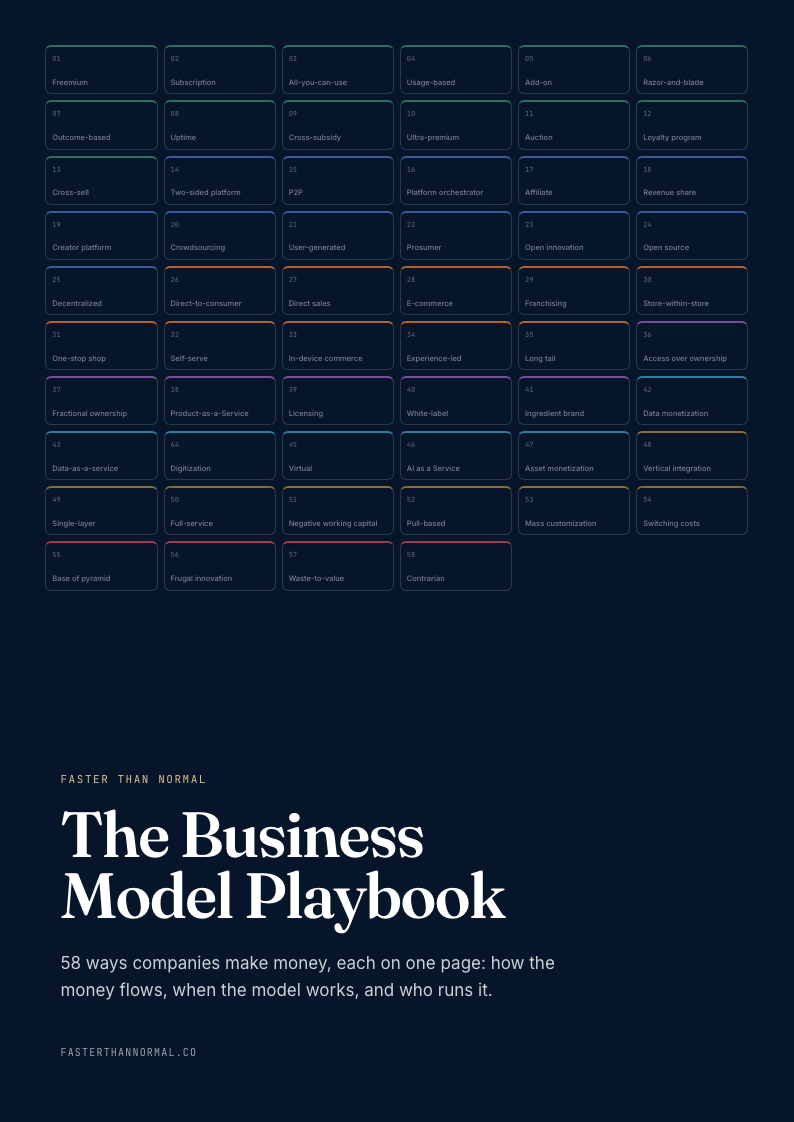
Free playbook
Get The Business Model Playbook
58 business models, one visual page each: how the money flows, the metrics that matter, and who runs it. Free when you join the Faster Than Normal email.
Free. No spam. Unsubscribe anytime.
Part IIIBusiness Breakdown
The Business at a Glance
Vital Signs
Ferrari N.V. — FY2024
€6.68BNet revenues
€1.91BEBIT
28.6%EBIT margin
14,004Cars and spare parts shipped
~€477KRevenue per car shipped
~5,000Employees
RACENYSE / MIL ticker
~$75BMarket capitalization (early 2025)
Ferrari N.V. is the world's highest-margin, highest-value automotive brand, generating luxury-sector economics from an industrial footprint that could fit inside a single warehouse district. Its FY2024 performance exceeded every guidance target the company had set, a year ahead of schedule: revenue grew double-digit, margins expanded, and free cash flow remained robust enough to fund both a significant share buyback program and the capital expenditures required for the e-building and the Elettrica development.
The company's strategic position is unique among publicly traded entities. It is too small to be meaningfully compared to volume automakers, too capital-light to be compared to industrial conglomerates, and too product-focused to be compared to pure brand-licensing businesses. The closest structural analogues are Hermès and Patek Philippe — private or family-controlled luxury houses with decades-long brand heritage, controlled distribution, and demand that permanently exceeds supply. The fact that Ferrari achieves this while operating in one of the world's most capital-intensive industries is the central puzzle of its valuation.
How Ferrari Makes Money
Ferrari's revenue is generated through four primary streams, with the overwhelming majority derived from cars and spare parts.
💶
Revenue Breakdown — FY2024
Estimated based on historical segment reporting
| Revenue Stream | Description | Estimated % of Revenue |
|---|---|---|
| Cars and Spare Parts | Sale of vehicles (including personalization), spare parts, and components | ~84% |
| Engines | Engine supply to Maserati and other customers (declining) | ~4% |
| Sponsorship, Commercial, and Brand | F1 sponsorship revenue, brand licensing, merchandise, Ferrari museums, theme parks | ~9% |
| Other | Financial services, pre-owned program, Corse Clienti, other activities | ~3% |
Cars and Spare Parts is the dominant revenue engine. Within this segment, the key drivers of revenue growth are: (a) mix enrichment — shifting the portfolio toward higher-priced models and limited editions; (b) personalization — the Tailor Made and Atelier programs, where clients specify bespoke configurations at significant premiums; and (c) measured volume growth. The Purosangue, 296 GTB/GTS, and 12Cilindri models form the current volume core, while the SF90 XX Stradale/Spider and 812 Competizione occupy the special series tier.
Sponsorship, Commercial, and Brand revenue is anchored by the F1 team's sponsorship portfolio. HP became title sponsor ("Scuderia Ferrari HP") in 2024. Other sponsors span technology, luxury, and financial services sectors. The Ferrari museums in Maranello and Modena attract hundreds of thousands of visitors annually. Theme parks in Abu Dhabi and Barcelona generate licensing revenue. The brand merchandise and lifestyle collections — eyewear, apparel, accessories — are growing but remain a small fraction of total revenue.
Engine revenue from Maserati has been declining as the relationship between the two brands (now separated following FCA's evolution into Stellantis) winds down. This is a strategically immaterial but directionally negative line item.
Unit economics are exceptionally favorable. The approximate €477,000 in revenue per car shipped, combined with an EBIT margin approaching 29%, implies roughly €136,000 in operating profit per vehicle. By comparison, BMW generates approximately €5,000–€8,000 in operating profit per vehicle. Ferrari's per-unit economics are closer to a luxury watch or handbag than to a car.
Competitive Position and Moat
Ferrari operates in a competitive landscape that is narrower than it appears. Its true peer set is not "luxury automakers" — it is the small universe of brands that occupy the intersection of ultra-high-net-worth consumer goods, motorsport heritage, and engineering art.
⚔️
Competitive Landscape
Ferrari versus key luxury/performance competitors
| Company | Annual Volume (approx.) | Price Range | EBIT Margin | Key Differentiator |
|---|---|---|---|---|
| Ferrari | ~14,000 | $250K–$3M+ | ~29% | F1 heritage, scarcity discipline, sensory identity |
| Lamborghini (VW Group) | ~10,000 | $230K–$4M+ | ~28%* | Extreme design, growing volume |
| Porsche AG | ~310,000 | $65K–$250K+ | ~18% | Scale + performance heritage |
| Aston Martin | ~6,600 | $155K–$3M+ | Negative/low | British luxury, James Bond |
| McLaren Automotive | ~3,500 | $200K–$2M+ | Low/volatile | F1 technology transfer |
Note: Lamborghini margin estimate based on VW Group segment reporting; not directly comparable.
Moat sources:
- Brand heritage depth. Ferrari's 78-year unbroken presence in Formula One, its founding mythology, and its cultural ubiquity create a brand that would take decades and billions to replicate — and even then, probably could not be.
- Controlled scarcity. The production cap and allocation system create structural demand excess, supporting pricing power and residual values.
- Client ecosystem. The hierarchical ownership experience — from entry-level purchases through special series allocation — creates switching costs that are social and emotional rather than contractual.
- Sensory irreplicability. The V-12 engine sound, the design language, the tactile experience — these are not features that can be benchmarked and matched.
- Single-source manufacturing. Everything is made in Maranello, preserving artisanal quality and reinforcing the brand's geographic identity.
Where the moat is weakest:
The EV transition threatens all five moat sources simultaneously. The V-12 sound disappears. The technology differentiator shifts from internal combustion mastery to battery chemistry and software — domains where Ferrari has no historical advantage. The scarcity model is challenged by competitors like Rimac (whose Nevera outperforms any Ferrari on paper specifications) and by well-funded new entrants from the technology sector. The brand heritage is inseparable from internal combustion; whether it can be transferred to electric drivetrains is untested.
The Flywheel
Ferrari's competitive advantage operates as a reinforcing cycle — a flywheel whose individual components are well-understood but whose systemic effect is extraordinarily difficult to replicate.
🔄
The Ferrari Flywheel
How scarcity, heritage, and performance compound
1. Racing excellence → Ferrari competes at the highest level of motorsport, generating global visibility, technological credibility, and emotional engagement.
2. Brand mythology deepens → Racing results, combined with design excellence and cultural ubiquity, reinforce the perception of Ferrari as the ultimate automotive brand.
3. Demand exceeds supply → Brand strength generates more purchase interest than the company is willing to satisfy. Waiting lists lengthen. Allocation becomes a privilege.
4. Pricing power increases → Scarcity and brand strength enable premium pricing and rich personalization revenue. Average selling prices rise without additional volume.
5. Margins fund innovation → High margins generate free cash flow that funds the F1 program, new model development, and technology investments (electrification, hybridization).
6. Technology transfers to road cars → Racing innovations and R&D investments produce next-generation road cars that reinforce the brand's performance credibility.
→ Cycle repeats, compounding brand equity over decades.
The flywheel's critical vulnerability is the racing link. If Scuderia Ferrari endures a prolonged period of non-competitiveness — as it did from roughly 2008 to the early 2020s — the technology transfer pipeline weakens and the brand narrative erodes, even if the road car business continues to perform. The flywheel does not stop in such periods, but it decelerates.
Growth Drivers and Strategic Outlook
Ferrari's growth through 2030 is expected to be driven by five primary vectors:
-
Mix enrichment and personalization. The shift toward higher-priced models (F80, special series, Icona) and increasing personalization uptake (Tailor Made, Atelier) drives revenue per unit higher without requiring additional volume. The company has indicated that personalization revenue per car has been growing at double-digit rates.
-
Measured volume growth. Shipments are expected to grow modestly — likely toward 15,000–16,000 units by 2030 — driven by the full ramp of the Purosangue, the Elettrica, and planned new model introductions. The cap remains disciplined: management has committed to maintaining demand above supply.
-
Electrification and hybrid models. The Elettrica (2026 launch) and expanded hybrid lineup address regulatory requirements and open a new client segment. The revised 2030 target is ~20% fully electric, with the remainder split between hybrid and ICE models. The EV segment, if successfully executed, represents a significant addressable market expansion.
-
Lifestyle and brand extension. The "third pillar" of Ferrari's strategy — after racing and cars — is lifestyle: branded merchandise, restaurants (Ristorante Cavallino in Maranello, with Massimo Bottura), museums, theme parks, and experiences. This segment is small but growing, and it carries margins that approach the personalization business.
-
Geographic expansion. Greater China and the Middle East remain underpenetrated relative to EMEA and the Americas. The company has been expanding its dealer network and brand presence in these regions, though geopolitical risk (particularly U.S.-China trade tensions) introduces uncertainty.
Key Risks and Debates
1. The Elettrica's brand reception. If Ferrari's first EV fails to deliver an emotional experience commensurate with the brand — if it feels like "just" a fast electric car — the damage to the mythology could be severe. Competitors like Rimac and potential entrants from the tech sector (Apple's abandoned car project notwithstanding) are working on the same problem. Ferrari's 2.5-second 0-62 time and 122 kWh battery are impressive on paper; whether they translate to a distinctively Ferrari experience is the question that matters.
2. Volume creep and brand dilution. At 14,004 units in FY2024 — nearly double the ~7,000 ceiling of a decade earlier — Ferrari is already testing the upper bounds of scarcity. The Purosangue has broadened the client base but also introduced a more "accessible" (in relative terms) entry point. If cumulative expansion — Purosangue, Elettrica, future models — pushes shipments significantly above 15,000, the point at which exclusivity perceptibly erodes is unknowable but real.
3. Regulatory and tariff exposure. Ferrari's global sales are exposed to emissions regulations (particularly in the EU, where tightening CO2 standards pressure ICE production), import tariffs (U.S. tariff policy has been volatile; any sustained tariff on European luxury goods would compress margins or raise prices in Ferrari's largest market), and evolving tax treatment of ultra-luxury vehicles.
4. Key-person and succession risk. Vigna's tenure has been strong, but the company's strategic direction depends heavily on the Elkann/Ferrari family governance architecture. Piero Ferrari is eighty. The transfer of his 10% stake — its economic and symbolic significance — is an unresolved question. Elkann's dual role as chairman of both Ferrari and Exor creates governance complexity that could become problematic under stress.
5. F1 competitive risk. Scuderia Ferrari has not won a Constructors' Championship since 2008. The signing of Lewis Hamilton raised expectations enormously. A sustained failure to compete for titles — particularly given the massive investment in the team — would erode the racing mythology that underpins the entire brand narrative. The 2025 season, in which the SF-25 proved difficult to develop and Ferrari dropped to fourth in the constructors' standings, is an early warning.
Why Ferrari Matters
Ferrari is the proof case for a counterintuitive proposition: that in a world obsessed with scale, the most durable competitive advantages may belong to companies that refuse to grow. The production cap, the allocation hierarchy, the sensory obsession, the racing program — these are not strategies in the conventional sense. They are disciplines. They require the constant subordination of short-term revenue maximization to long-term brand preservation, and they demand a governance structure that protects that subordination from the relentless pressure of public markets.
For operators, the lesson is not that every company should manufacture scarcity. Most businesses exist in markets where scale is the prerequisite for survival, and a production cap would be suicide. The lesson is more specific: that pricing power — the ability to charge more for each unit of output, year after year, without losing demand — is the single most valuable characteristic a business can possess, and that it is built not by selling more but by being worth more. Ferrari's entire strategic architecture is designed to answer one question: How do we become more valuable to fewer people?
The Elettrica will test that architecture more severely than anything since Enzo's death. An electric Ferrari that succeeds — that carries the emotional weight of the Prancing Horse without the V-12's scream — would prove that the brand transcends its engineering. A failure would suggest that the mythology was always inseparable from the machinery.
Either way, on the factory floor in Maranello, 5,000 people will show up tomorrow to build approximately fifty-five cars. No more. By design.


